
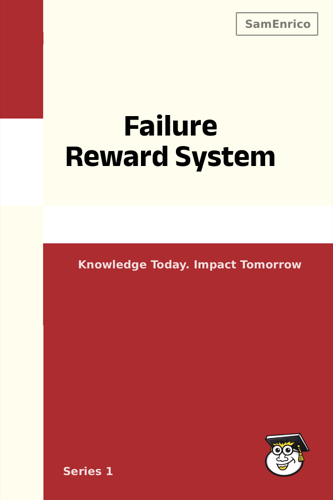
Failure Reward System eBook
Celebrate attempts regardless of outcome to reinfo
by Ragland Chi
Celebrate attempts regardless of outcome to reinforce courage over results.
Formats
Free sample
Chapter 1: The Home Run Trap--–- In the summer of 1941, Ted Williams did something no baseball player has done since. He stepped up to the plate 456 times and got a hit 185 times. That is a .406 batting average—forty percent. By any measure, Williams was the greatest pure hitter who ever lived. He is in the Hall of Fame.
Children have been named after him. Statues commemorate his swing.–- Here is what no one puts on the statue: Ted Williams failed sixty percent of the time.–- He walked back to the dugout empty-handed more often than he reached base. He struck out. He popped out. He grounded into double plays.
He made errors in the field. And yet, we do not call Ted Williams a failure. We call him a legend.–- Now consider a child in third grade. She brings home a math test with sixty percent correct. Forty percent wrong.
Her parents sigh. Her teacher circles the mistakes in red ink. She is told to "try harder" and "pay attention." She is tutored, drilled, and quizzed again. She learns that sixty percent is not good enough.–- Consider an employee at a tech startup. He launches a new feature that succeeds forty percent of the time.
Sixty percent of users encounter bugs. He is put on a performance improvement plan. His manager asks, "What went wrong?" His colleagues avoid using his feature. He learns that sixty percent is not safe.–- Consider a spouse who tries a new way to express affection. Forty percent of the time, it lands well.
Sixty percent of the time, it is awkward, misunderstood, or ignored. That spouse learns to stop trying new things. Stick to what works. Play it safe.–- The paradox sits in plain sight, and yet we have built entire institutions around ignoring it. In baseball, failing sixty percent of the time makes you an immortal.
In school, work, and home, failing sixty percent of the time makes you a problem to be fixed.–- This is the Home Run Trap.The Scoreboard That Lies–- The Home Run Trap is not about baseball. Baseball is merely the clearest mirror we have for a much deeper cultural dysfunction. The trap works like this: we claim to value courage, risk-taking, and perseverance. Our biographies lionize inventors who failed a thousand times before succeeding. Our commencement speeches quote Winston Churchill and Nelson Mandela.
Our corporate mission statements include words like "innovation" and "breakthrough."–- But our systems tell a different story.–- Every day, in ways both obvious and invisible, we reward outcomes and punish attempts. We do not mean to do this. No school board votes to crush creativity. No CEO announces a policy of punishing risk. The trap is accidental, emergent, and all the more dangerous because we cannot see it.–- Let me name it clearly: we live in an Outcome Economy.–- An Outcome Economy is any system—family, classroom, office, or culture—that evaluates behavior almost exclusively by its results.
Did you win? Did you hit the number? Did you pass the test? Did you close the deal? If yes, you are rewarded.
If no, you are punished. The process, the effort, the courage, the learning, the attempt itself—these are invisible variables. They do not show up on the quarterly report. They do not raise the stock price. They do not get you into a good college.–- The Outcome Economy is a machine that consumes courage and produces compliance.–- Consider the evidence.
A study of 11,000 corporate employees found that ninety-four percent would rather avoid taking a risk than fail publicly. Not because they are lazy. Not because they lack ideas. Because their organizations have shown them, repeatedly, that failure is expensive. One failed project can derail a career.
One missed quarterly target can trigger layoffs. One public mistake can become a permanent stain on a reputation.–- Schools are even worse. A survey of 2,500 teachers found that seventy-eight percent believe their students are less willing to take academic risks now than a decade ago. Why? Because standardized testing has made every assignment feel like a final judgment.
A wrong answer is not a step toward learning. A wrong answer is a mark against your permanent record.–- At home, the same logic applies. Developmental psychologists have documented a phenomenon called "praise inflation." Parents, wanting to build confidence, praise outcomes instead of efforts. "You're so smart!" when a child brings home an A. "What a great goal!" when a child scores in soccer.
The child learns: my worth is tied to my results. The child stops trying things that might produce a B, a missed goal, or a red mark.–- The Home Run Trap, then, is not a single mistake. It is a design flaw in the architecture of modern life.The Arena Versus the Scoreboard–- To understand why the trap is so difficult to escape, we need a better vocabulary for what we are actually trying to measure.–- Brené Brown, in her book Daring Greatly, draws on a famous speech by Theodore Roosevelt. Roosevelt spoke of the man in the arena—the one "whose face is marred by dust and sweat and blood; who strives valiantly; who errs, who comes short again and again." Roosevelt contrasted this figure with the critic—the cold observer who sits in the stands, never risking anything, never failing, never learning.–- Brown uses this image to talk about vulnerability. But we can extend it to understand the Home Run Trap.–- The arena is the space of trying.
It is where you raise your hand with a half-formed idea. It is where you launch a product before it is perfect. It is where you ask someone for a date, apply for a job you are not entirely qualified for, or attempt a new parenting technique that might backfire. The arena is messy, loud, humid with sweat, and often painful. But the arena is also the only place where anything new has ever been built.–- The scoreboard is the space of evaluation.
It is where we count results. It is clean, binary, and silent. It does not care about your intentions, your effort, or your courage. It only cares about whether the ball crossed the line. The scoreboard is useful.
Without it, we could not keep track of who won the game, who passed the test, or who met the quota. But the scoreboard is not the game. The scoreboard is a map, not the territory.–- The Home Run Trap occurs when we confuse the scoreboard with the arena.–- We begin to believe that the number on the scoreboard is the value of the attempt. We forget that the scoreboard exists only because someone first built the arena. We reward the observer in the stands and punish the athlete on the field.
We create systems that produce people who are very good at reading scoreboards and very bad at entering arenas.–- Let me give you a concrete example. I worked with a software engineer named Priya. She was brilliant, creative, and terrified. Every time she had an idea for a new…
This is the end of the free sample. Get the eBook to keep going. Buy now
About this book
Details
- Author
- Ragland Chi
- Publisher
- SamEnrico
- Language
- English
- Genre
- Non-Fiction, Self-Help
- Released
- 2026-06-10
- Pages (approx.)
- 138
- Available as
- eBook, Audiobook

Read better in the ZLOADR app
Your eBooks on your phone or tablet. Sign in with your SamEnrico account and start reading.
More by Ragland Chi
 Anger Coping Card CreatorRagland Chi$11.99
 The Father's Red Diaper BabyRagland Chi$11.99
 The Financial Stress WorkbookRagland Chi$11.99
 Financial Fear Exposure TherapyRagland Chi$11.99
 Cross Cultural Difficult ConversationsRagland Chi$11.99
 Tabata Protocol ExplainedRagland Chi$11.99
 Metabolic Adaptation Self TestRagland Chi$11.99
 The Silk Road Warriors: The Lost Art of Medieval Chinese FootballRagland Chi$11.99
 The Siege of Sydney: The 1978 Lufthansa Hijacking and the Man Who Wouldn't SurrenderRagland Chi$11.99
 The Essential Guide to Standup ComedyRagland Chi$11.99
 How to Become a PediatricianRagland Chi$11.99
 Angel Investor Fundraising EthicsRagland Chi$12.99
You may also like
 Hong Kong Handover 1997Dunn Johnnie$11.99
 Zumba For Postnatal Recovery CourseNeal Christian$11.99
 Zumba for BeginnersLadner Nikia$11.99
 YouTube Comment Mining GuideHumes Pandora$12.99
 Worry Box MeditationCarlin Rudy$11.99
 Workplace Stress MeditationNguyen Lynn$11.99
 Workplace Stress and Sleep RepairHawley Ivory$11.99
 Workplace Perfectionism CureDelaney Jeffry$11.99
 Workplace Injustice Anger GuideWallen Isabelle$11.99
 Work Addiction and Burnout LinkGreenwood Ester$11.99
 Women in Yoga and WellnessBeattie Galina$11.99
 Women in Stand Up ComedyChun Evangeline$11.99