
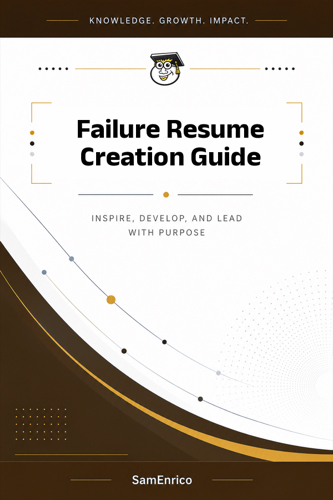
Non-FictionSelf-HelpFailure Resume
Failure Resume Creation Guide eBook
List your failures and what they taught you to des
List your failures and what they taught you to destigmatize flops.
Formats
Free sample
Chapter 1: The Resume Lie--–- Let me tell you something your mother probably never said: "Sweetheart, one day you’re going to fail so hard that it becomes the most valuable line on your resume."No one says that. Instead, we build shrines to success. We polish our wins until they gleam. We arrange our promotions, our completed projects, our spotless performance reviews into a perfectly linear narrative of competence. And then we present this fiction to the world as if it were the truth of who we are.It is a lie.
A beautiful, well-intentioned, utterly exhausting lie.I know because I told it for years. My traditional resume was a masterpiece of omission. Every gap smoothed over. Every failed initiative quietly deleted from the timeline. Every "learning experience" (which is what we call failures when we want to sound professional) scrubbed from existence.
I looked like a person who had never stumbled, never miscalculated, never bet on the wrong horse. I looked, in other words, like someone who had never tried anything truly hard.And here is the irony that cracked my own facade wide open: the more successful I became by traditional measures, the more terrified I was of being exposed. Every new job came with a higher ceiling and a harder floor. The imposter syndrome that whispered in my ear didn't come from my failures. It came from hiding them.This book exists because I finally stopped hiding.
And what I discovered was so counterintuitive, so opposite to everything I had been taught, that it fundamentally rewired my relationship with my own career. Here it is: your failures, when properly documented and framed, are more valuable to your professional reputation than your successes. Not despite their failure-ness. Because of it.The Resume Industrial Complex Let me paint a picture of the problem.You have a traditional resume. It might be one page or two.
It lists your jobs in reverse chronological order. For each role, you have four to six bullet points starting with action verbs: "Led," "Managed," "Increased," "Reduced," "Launched." Everything went well. Every project succeeded. Every metric moved in the right direction.Now ask yourself an honest question: do you believe this person exists?Of course not. You know that every project had moments of chaos, every "increased revenue by 30%" came with near-misses and course corrections and arguments and doubts.
But you've been trained to erase all of that. The resume has become a genre of fiction so widely accepted that no one calls it what it is.This is what I call the Resume Industrial Complex. It includes:The template industry selling you "perfect resume formats"The AI tools promising to "optimize your keywords"The recruiters who spend six seconds scanning for red flags The career coaches who teach you to "spin" every challenge into a triumph The cultural pressure to present as competent, complete, and never struggling All of these forces conspire to produce the same output: a document that hides the most interesting, most human, most instructive parts of your professional life.The cost of this lie is not small. Research from psychologists like Brené Brown has shown that perfectionism is not the same as striving for excellence. Perfectionism is a shield.
It says: "If I look perfect, no one can hurt me." But the shield becomes a cage. When you hide your failures, you also hide your growth. You freeze yourself in amber as the person who got it right the first time—a person who, frankly, does not exist.Worse, the lie breeds isolation. When everyone around you also presents a flawless facade, you assume you are the only one struggling. You assume your mess is unique.
You assume that everyone else has figured out something you haven't. This is the secret engine of imposter syndrome: not failure itself, but the loneliness of hidden failure.I have sat in rooms with CEOs, venture capitalists, award-winning scientists, and bestselling authors. In private, every single one of them can tell you a litany of disasters. Missed predictions. Botched launches.
Money lost. Trust broken. Relationships strained. And then they walk onto a stage or into a boardroom and present a resume of pure success. The gap between the private truth and the public fiction is where shame lives.The Victimhood Trap vs.
The Failure Resume Before we go further, I need to draw a line. A sharp one. Because there is a version of "embracing failure" that is not helpful. It is the victimhood narrative.The victimhood narrative sounds like this:"I didn't get the promotion because my boss plays favorites.""My startup failed because the investors were stupid.""The project went under because marketing dropped the ball.""I was passed over because of office politics."Notice what these statements have in common. They locate the cause of failure entirely outside the self.
They are stories of injustice, not learning. They may even be true. But they are useless.A victimhood narrative is a failure resume's evil twin. It looks backward but extracts nothing. It assigns blame but claims no agency.
It feels satisfying in the moment—who doesn't love a good story about how you were wronged?—but it leaves you exactly where you started. No smarter. No stronger. No different.The failure resume is the opposite. Its structure forces you to look inward first.
Not to blame yourself, but to locate your own actions within the system that produced the failure. The failure resume asks: "What did I do? What did I assume? What did I miss? And now that I know, what will I do differently?"Here is the distinction I want you to tattoo somewhere visible:Victimhood Narrative Failure Resume"They did this to me""I contributed to this outcome"Blame-focused Learning-focused Stops at the event Extracts a lesson Repeats the same failure Pivots to new behavior Feels righteous Feels uncomfortable (at first)The victimhood narrative is a dead end.
The failure resume is a door.I learned this distinction the hard way. Early in my career, I was passed over for a role I desperately wanted. The person who got it had less experience, fewer qualifications, and—in my humble opinion—half the talent. I spent three months telling anyone who would listen about the injustice. It felt good.
It felt true. And it changed absolutely nothing.Years later, when I finally wrote that event into my failure resume, I had to reframe it. I couldn't change what my boss did. But I could ask: what did I do, or fail to do, that contributed to this outcome? The uncomfortable answer: I had never articulated my interest in the role.
I had assumed my work would speak for itself. I had not built relationships with the decision-makers. I had played a passive game and called it professionalism.That reframe didn't excuse the injustice. It didn't have to. What it did was give me a lesson: visibility is not the same as performance.
And from that lesson came a pivot action: in every job since, I have explicitly stated my career goals to my manager in writing, every six months.That is the difference between staying stuck and moving…
This is the end of the free sample. Get the eBook to keep going. Buy now
About this book
Details
- Author
- Bankston Maybell
- Publisher
- SamEnrico
- Language
- English
- Genre
- Non-Fiction, Self-Help, Failure Resume
- Released
- 2026-06-07
- Pages (approx.)
- 152
- Available as
- eBook, Audiobook

Read better in the ZLOADR app
Your eBooks on your phone or tablet. Sign in with your SamEnrico account and start reading.
More by Bankston Maybell
 Angel Investor Term Sheet NegotiationBankston Maybell$12.99
 Lagos Peak Hours GuideBankston Maybell$11.99
 Resilience for Military FamiliesBankston Maybell$11.99
 Workplace Perfection ReleaseBankston Maybell$11.99
 De escalation for HospitalityBankston Maybell$11.99
 Beginner's Mind for FearBankston Maybell$11.99
 Six Thinking Hats TogetherBankston Maybell$11.99
 SAD In Nordic CountriesBankston Maybell$11.99
 Tupua's Shadow: The Navigator's GambitBankston Maybell$11.99
 The Last Counselor of Camp BlackwaterBankston Maybell$11.99
 How to Produce Lawn SweepersBankston Maybell$11.99
 A Collector's Handbook to the Mazda 929Bankston Maybell$11.99
You may also like
 Hong Kong Handover 1997Dunn Johnnie$11.99
 Zumba For Postnatal Recovery CourseNeal Christian$11.99
 Zumba for BeginnersLadner Nikia$11.99
 YouTube Comment Mining GuideHumes Pandora$12.99
 Worry Box MeditationCarlin Rudy$11.99
 Workplace Stress MeditationNguyen Lynn$11.99
 Workplace Stress and Sleep RepairHawley Ivory$11.99
 Workplace Perfectionism CureDelaney Jeffry$11.99
 Workplace Injustice Anger GuideWallen Isabelle$11.99
 Work Addiction and Burnout LinkGreenwood Ester$11.99
 Women in Yoga and WellnessBeattie Galina$11.99
 Women in Stand Up ComedyChun Evangeline$11.99