
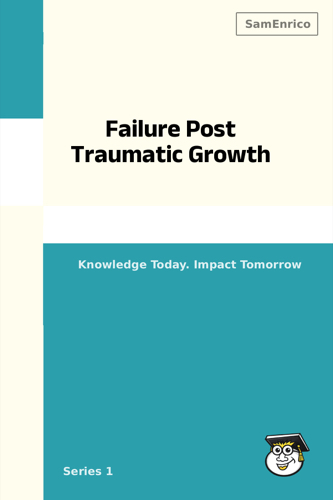
Failure Post Traumatic Growth eBook
Transform major flops into strength using five dom
by Gillen Libby
Transform major flops into strength using five domains of post-traumatic growth.
Formats
Free sample
Chapter 1: The Assumptive Collapse...--–- The call came on a Tuesday. Not a Tuesday you would remember for any other reason—no rain, no holiday, no anniversary. Just a Tuesday. And in the five seconds it took to hear the words “we’re pulling the funding” or “the board has decided” or “I’m leaving” or “you’re being let go,” your entire future split into two timelines: the one you had been walking on five seconds ago, and the one you are standing in now.That is how failure announces itself. Not with a drumroll or a warning label.
With the mundane brutality of an ordinary day that becomes, in retrospect, the day everything changed.You have probably spent the weeks—or months—since that Tuesday trying to convince yourself that what you feel is disproportionate. You tell yourself it was just a business. Just a job. Just a relationship. Just a mistake.
People lose houses. People lose children. People lose their health. What right do you have to feel this shattered?That voice in your head is wrong. And it is doing real damage.This chapter has one job: to convince you that the devastation you feel after a significant failure is not weakness, not self-indulgence, and not a character flaw.
It is a predictable, measurable, and neurologically real response to a specific kind of psychological wound—one that the scientific literature calls trauma, and one that this book will show you how to transform.But transformation cannot begin until you stop pretending the wound isn’t there.The Myth of the Learning Opportunity We live in a culture that has become deeply dishonest about failure. Scroll through Linked In for ten minutes and you will encounter a relentless parade of failure porn: the entrepreneur who lost everything and then built a unicorn; the athlete who missed the shot and then won the championship; the artist who was rejected a thousand times and then became a legend. The message is always the same: failure is just a stepping stone. Failure is feedback. Failure is a learning opportunity.This is not entirely false.
Failure can be those things. But the way this message is deployed—usually by people who are already successful, looking back from a safe distance—has created a toxic silence around what failure actually feels like in the moment.Here is what failure actually feels like: shame that heats the back of your neck when you see a certain name in your inbox. A pit in your stomach when someone asks, “How’s work going?” The compulsive replaying of the moment it went wrong, as if watching the tape again will somehow change the outcome. The urge to hide. The dread of being seen.
The voice that whispers, “You were always a fraud, and now everyone knows.”That is not a learning opportunity. That is a wound.The entrepreneur who lost everything and then built a unicorn did not feel grateful for the lesson while he was sleeping on his friend’s couch. The athlete who missed the shot did not think “what a great learning experience” as she walked off the court. Those narratives are written in retrospect, from the other side of recovery. They are useful as inspiration, but they are useless as a map for the person still in the wreckage.Worse, they create a second layer of suffering: the shame about the shame.
You feel terrible, and then you feel terrible for feeling terrible, because you think you should be “learning” instead of hurting.This chapter is going to ask you to set aside the learning narrative for a while. Not forever. But for long enough to acknowledge something the success stories leave out: before failure becomes a lesson, it is a shattering. And you cannot learn from shattered glass while you are still bleeding.The Assumptive World: The Floor You Didn’t Know You Were Standing On To understand why failure hurts the way it does, we need to talk about something psychologists call the assumptive world.The assumptive world is the invisible floor beneath your feet—the collection of deeply held, mostly unexamined beliefs that allow you to get out of bed in the morning without being paralyzed by terror. These beliefs include:“I am basically competent.”“The world is reasonably predictable.”“Hard work generally leads to good outcomes.”“People I trust will not betray me.”“The future will be okay.”You did not wake up one day and decide to believe these things.
They are not philosophical positions you argued yourself into. They are the background operating system of your psyche, installed through years of lived experience, reinforced by thousands of small confirmations. The promotion you got. The relationship that lasted. The project that succeeded.
The plane that landed.And because these beliefs are background assumptions rather than conscious conclusions, you do not notice them until they break.That is what failure does. Failure does not just take away a job, a deal, a relationship, or a reputation. It punches a hole in the assumptive world. Suddenly, the floor you were standing on is gone, and you are falling through beliefs that used to hold you up.Consider what a single failure can shatter:The belief that you are competent. If you failed despite trying hard, then maybe you are not as smart or capable as you thought.
And if you are not competent, then every future task becomes a threat.The belief that the world is fair. If you worked hard and still lost, then the contract has been broken. Maybe the world does not reward merit. Maybe effort is irrelevant. Maybe the rules you played by were never real.The belief that the future is safe.
If everything collapsed on a random Tuesday, it can collapse again on any other Tuesday. Planning becomes pointless. Hope becomes naive.The belief that you know yourself. If you made a choice that led to disaster, then maybe you do not understand your own judgment. Maybe you cannot trust your own mind.This is not an overreaction.
This is the neurological and psychological reality of a shattered assumptive world. And it explains why failure feels qualitatively different from a simple setback.A setback is when you trip on a step but keep walking. A shattered assumptive world is when you discover there was never a floor beneath that step at all.Small-t Trauma: Why Your Failure Deserves the Word You may be uncomfortable with the word “trauma.” That is understandable. For decades, the word has been reserved for the most extreme experiences: combat, sexual assault, natural disaster, the sudden death of a loved one. To call a business failure or a public humiliation “trauma” can feel like an insult to people who have survived those things.Let me be clear: I am not equating a lost deal with a lost child.
Those experiences are different in magnitude, in duration, and in kind. But they are not different in mechanism. The psychological machinery that activates after a life-threatening event is the same machinery that activates after an ego-threatening event. The same cortisol spike. The same rumination loop.
The same hypervigilance. The same shame response.Psychologists make a useful distinction between Big-T Trauma and small-t trauma.Big-T Trauma involves actual…
This is the end of the free sample. Get the eBook to keep going. Buy now
About this book
Details
- Author
- Gillen Libby
- Publisher
- SamEnrico
- Language
- English
- Genre
- Non-Fiction, Self-Help
- Released
- 2026-06-09
- Pages (approx.)
- 127
- Available as
- eBook, Audiobook

Read better in the ZLOADR app
Your eBooks on your phone or tablet. Sign in with your SamEnrico account and start reading.
More by Gillen Libby
 Promotion Self Advocacy GuideGillen Libby$11.99
 TM Technique Step by StepGillen Libby$11.99
 Flow for Programmers GuideGillen Libby$11.99
 Cold Exposure HGH ActivationGillen Libby$11.99
 Postnup Emotional RecoveryGillen Libby$11.99
 Delegation Decision MatrixGillen Libby$11.99
 Cannabis WithdrawalGillen Libby$11.99
 Enki’s Abzu: The Chaos Beneath the WatersGillen Libby$11.99
 Tangaroa’s Tide: The Architect of the First WaveGillen Libby$11.99
 How to Produce Puffed Rice CakesGillen Libby$11.99
 Five Hour Digital Afternoon GuideGillen Libby$12.99
 A B Testing Mailchimp GuideGillen Libby$12.99
You may also like
 Hong Kong Handover 1997Dunn Johnnie$11.99
 Zumba For Postnatal Recovery CourseNeal Christian$11.99
 Zumba for BeginnersLadner Nikia$11.99
 YouTube Comment Mining GuideHumes Pandora$12.99
 Worry Box MeditationCarlin Rudy$11.99
 Workplace Stress MeditationNguyen Lynn$11.99
 Workplace Stress and Sleep RepairHawley Ivory$11.99
 Workplace Perfectionism CureDelaney Jeffry$11.99
 Workplace Injustice Anger GuideWallen Isabelle$11.99
 Work Addiction and Burnout LinkGreenwood Ester$11.99
 Women in Yoga and WellnessBeattie Galina$11.99
 Women in Stand Up ComedyChun Evangeline$11.99