
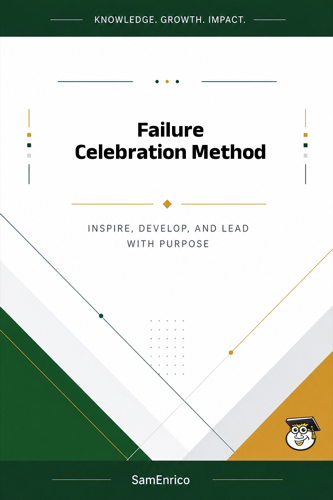
Failure Celebration Method eBook
Learn from unsuccessful experiments to fuel future
Learn from unsuccessful experiments to fuel future innovation.
Formats
Free sample
Chapter 1: The Perfection Trap--–- In 1995, a young supply chain manager at Apple named Ron Johnson walked into Steve Jobs’s office with his stomach in knots. He had just lost the company three million dollars. A new logistics system he had championed—one that was supposed to revolutionize how Apple sourced components—had collapsed spectacularly. Parts arrived late. Assembly lines stopped.
The numbers were undeniable, and the mistake was entirely his.Johnson had rehearsed the conversation a dozen times on the walk over. He practiced his apology, his resignation speech, and the logistical details of his own departure. He was certain he was about to be fired. When he finally stood before Jobs, he blurted out the truth: “I just lost us three million dollars.”Jobs looked up from whatever he was working on. His expression was unreadable.
Then he asked a question that Ron Johnson would remember for the rest of his career: “How much did you learn?”Johnson blinked. “A lot,” he said.“Then it wasn’t a loss,” Jobs replied. “It was tuition.”Ron Johnson kept his job. Years later, he became the creator of the Apple Store—one of the most profitable retail innovations in history, a design so successful that it transformed not just Apple but the entire consumer electronics industry. And he told that story over and over again, not as a warning, but as a lesson: the failure that almost ended his career was the exact experience that made his later success possible.This book is for everyone who has ever hidden a mistake, fudged a number, stayed silent in a meeting, or nodded along to an idea they knew was flawed—all because they were afraid of being wrong.
You are not broken. Your culture is. And there is a way to fix it.But first, we have to understand the trap.THE PARADOX OF OUR AGEWe live in an era of unprecedented innovation. The smartphone in your pocket has more computing power than the spacecraft that landed humans on the moon. Medical breakthroughs that once took decades now arrive in months.
Entire industries have been born, died, and been reborn within a single decade.Yet here is the paradox: we punish failure more harshly than ever before.Consider the evidence. In 2019, a study of corporate performance reviews found that employees who had been involved in a failed project—even one that was well-conceived and intelligently executed—were thirty-one percent less likely to receive a promotion in the following two years, regardless of their individual performance. The stain of association with failure was so powerful that it overwhelmed data about their actual competence.In venture capital, the math is even more brutal. According to a longitudinal study of startup founders, entrepreneurs whose first venture failed were forty percent less likely to receive funding for their second venture—even when the second venture was objectively stronger, better researched, and more likely to succeed. The market had labeled them, and the label was “failure.”And in schools, the data is heartbreaking.
A survey of over ten thousand college students found that sixty-eight percent admitted to having avoided taking a challenging course because they were afraid of getting a low grade. Not because they lacked ability. Not because they lacked interest. Because they were afraid of the judgment that would come with a single “F” on their transcript.We have built a world that worships success and exiles failure. And then we wonder why innovation is slowing.THE APPLE + Z GENERATIONThere is a metaphor that captures this moment perfectly, and it comes from an unexpected place: your keyboard.For anyone who grew up using a computer, the command “Apple + Z” (or “Control + Z” on Windows) means one thing: undo.
Made a typo? Undo. Deleted a file by accident? Undo. Posted something embarrassing on social media?
Undo, undo, undo.The “Apple + Z Generation” is the first workforce in human history to be raised on the undo button. Every mistake can be erased. Every wrong turn can be reversed. Every embarrassing comment can be deleted before anyone sees it.This is a miracle of modern technology. But it has also atrophied something essential: our ability to sit with discomfort, to iterate through ugly drafts, to let mistakes breathe and evolve into something original.Before the digital age, if a potter threw a lopsided bowl, she couldn’t undo it.
She had to look at the lopsided bowl, feel the weight of its wrongness in her hands, and decide what to learn from it. If a writer typed a terrible sentence on a typewriter, she couldn’t backspace it into oblivion. She had to cross it out with a pen, leaving a visible scar on the page that reminded her of where she had been.Today, we delete. We erase. We hide.
And in doing so, we also delete the evidence of our learning. The scar disappears, and so does the lesson.I have watched this play out in corporate innovation labs across the country. Teams will spend weeks building a prototype, only to abandon it the moment it shows signs of weakness. They don’t ask, “What did we learn?” They ask, “How do we make this go away?” They delete the file. They archive the Slack channel.
They pretend it never happened.And then they make the same mistake again six months later.THE THREE ROOT CAUSESThe Perfection Trap is not an accident. It is not simply human nature. It is a cultural and psychological system that has been built, reinforced, and weaponized by three powerful forces in modern life.Root Cause One: Schooling Think back to your own education. Raise your hand if you were ever rewarded for an interesting wrong answer.Most people cannot raise their hands. From kindergarten through graduate school, the educational system penalizes wrong answers and rewards right ones.
This seems obvious and even necessary. How else would we measure learning?But here is the problem: in the real world, the most valuable answers are rarely known in advance. Innovation is not a multiple-choice test. It is an open-ended exploration of an unknown landscape. The person who gets the “wrong” answer first—the one that reveals a hidden assumption or an unexpected constraint—is often more valuable than the person who guesses the “right” answer by following the crowd.Consider the history of the microwave oven.
In 1945, engineer Percy Spencer was working on radar technology when he noticed that a candy bar in his pocket had melted. That was a “wrong” outcome. He wasn’t supposed to be melting candy bars. He was supposed to be perfecting radar. But instead of ignoring the melted candy bar, Spencer asked why it had happened.
That question led to the invention of the microwave oven.No school graded Spencer on his melted candy bar. No teacher gave him extra credit for noticing the anomaly. But that “failure” of the radar system was the seed of a billion-dollar industry.The grading system has trained us to fear wrong answers. It has taught us that being wrong is shameful, not informative. And we carry that training into every meeting, every project, and every decision for the rest…
This is the end of the free sample. Get the eBook to keep going. Buy now
About this book
Details
- Author
- Beckham Crysta
- Publisher
- SamEnrico
- Language
- English
- Genre
- Non-Fiction, Self-Help, Learning
- Released
- 2026-06-07
- Pages (approx.)
- 145
- Available as
- eBook, Audiobook

Read better in the ZLOADR app
Your eBooks on your phone or tablet. Sign in with your SamEnrico account and start reading.
More by Beckham Crysta
 Twitter Addiction Recovery HandbookBeckham Crysta$11.99
 Social Work Client Anger GuideBeckham Crysta$11.99
 Cataract Surgery Recovery HandbookBeckham Crysta$11.99
 Nicotine Addiction Freedom GuideBeckham Crysta$11.99
 The Last Oracle of Delphi: AI vs. Ancient ProphecyBeckham Crysta$11.99
 The Betrayal of the Phoenix: How a Whistleblower Exposed the Dark Side of a Tech GiantBeckham Crysta$11.99
 Understanding Carbonic Anhydrase Ii DeficiencyBeckham Crysta$17.99
 How to Start a Construction of Housing Association and Local Authority Housing Business (Beginners GBeckham Crysta$11.99
 Gulf Region B2B Sales GuideBeckham Crysta$12.99
 Application Fee Waiver GuideBeckham Crysta$12.99
 Mortgage Loan CloserBeckham Crysta$11.99
You may also like
 Hong Kong Handover 1997Dunn Johnnie$11.99
 Zumba For Postnatal Recovery CourseNeal Christian$11.99
 Zumba for BeginnersLadner Nikia$11.99
 YouTube Comment Mining GuideHumes Pandora$12.99
 Worry Box MeditationCarlin Rudy$11.99
 Workplace Stress MeditationNguyen Lynn$11.99
 Workplace Stress and Sleep RepairHawley Ivory$11.99
 Workplace Perfectionism CureDelaney Jeffry$11.99
 Workplace Injustice Anger GuideWallen Isabelle$11.99
 Work Addiction and Burnout LinkGreenwood Ester$11.99
 Women in Yoga and WellnessBeattie Galina$11.99
 Women in Stand Up ComedyChun Evangeline$11.99