
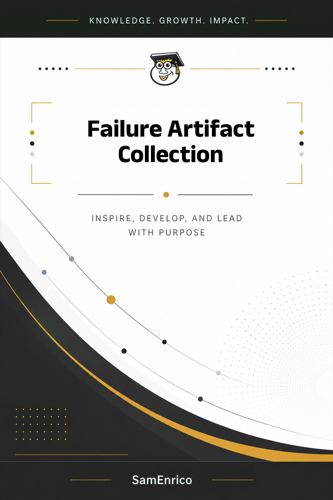
Failure Artifact Collection eBook
Display physical reminders of past flops to celebr
Display physical reminders of past flops to celebrate courage and growth.
Formats
Free sample
Chapter 1: The Black Box Lie--–- The email arrived at 11:47 PM on a Tuesday. I had been waiting for this response for six weeks, refreshing my inbox an average of forty-seven times per day (I know the number because I counted, and then I felt ashamed of counting, and then I felt ashamed of the shame). The subject line read: “Decision Regarding Your Proposal.” I opened it. I read the first sentence. I closed it.
Then I opened it again, because denial is not a river in Egypt, as my grandmother used to say, but a very specific neurological loop that compels us to reread bad news as if the words might rearrange themselves into something kinder.The proposal had been for a community arts space in a neglected neighborhood. I had spent three months on it. I had interviewed fourteen local business owners. I had drawn maps by hand because I believed, sentimentally, that hand-drawn maps communicated care. I had written and rewritten the budget seventeen times.
And then a committee of people I would never meet, in a room I would never see, had decided—in what I imagined as a thirty-second vote between sips of room-temperature coffee—that my project was not worth funding.I did something that night that I have since learned millions of people do every single day. I deleted the email. Then I emptied my trash folder. Then I took the physical folder containing all my notes, my hand-drawn maps, my printed drafts, and my spiral notebook full of margin scribbles, and I walked it to the recycling bin behind my apartment building. It was raining.
I remember thinking that the rain was appropriate, like a movie scene where the weather conspires to reflect the protagonist’s interior state. Then I thought: You are thinking about cinematography while throwing away three months of your life. What is wrong with you?Then I thought: Nothing is wrong with me. This is what normal people do. Normal people delete evidence of failure.
Normal people move on.That was the lie. That is always the lie.The Archaeology of Disappearance Let me tell you about a man named Victor. Victor was an entrepreneur in the early 2000s, before “entrepreneur” became a lifestyle brand. He started a company that made software for dental offices—not glamorous, but necessary, like toilet paper or garbage trucks. The company failed after fourteen months.
Victor had borrowed money from his father-in-law, which meant that the failure was not merely a professional setback but a Thanksgiving dinner liability for the rest of his natural life. In the weeks after the company folded, Victor did something methodical and, as he later described it, “almost surgical.” He collected every piece of paper associated with the business: contracts, emails he had printed for some reason, sticky notes with login passwords, business cards from vendors he would never call again, a half-eaten bag of trail mix from the last team meeting. He put it all in a cardboard box. He drove the box to a commercial shredding service. He paid cash.
He watched through a window as the machine reduced fourteen months of his life to confetti.“I thought I was cleansing,” Victor told me twenty years later, when I interviewed him for this book. We were sitting in his living room, which was decorated with photographs of his second company—the one that succeeded, the one that made him wealthy enough to retire at fifty-three. “I thought I was making space for the future by destroying the past. But here’s what actually happened.” He leaned forward. “I repeated every single mistake in the second company.
Every. Single. One.”Victor had shredded his black box. And because he had shredded it, he could not learn from it. The second company nearly failed for exactly the same reasons as the first—poor cash flow management, a co-founder he should never have trusted, a product launch timed against a major holiday.
The only difference was that the second company got lucky. A last-minute investor appeared. Victor survived. But he still wakes up at 3:00 AM sometimes, thinking about the mistakes he made twice because he destroyed the evidence the first time.Victor’s story is not unusual. It is not even slightly unusual.
It is the default human response to failure, and it is wrong.The Perfectionism Trap: A Working Definition Before we go any further, I need to name something that will appear in almost every chapter of this book. I call it the Perfectionism Trap, and it is the single greatest enemy of the practice you are about to learn.The Perfectionism Trap is the belief that if you hide the broken thing, you yourself are not broken. It is a cognitive distortion that confuses evidence with identity. When a perfectionist fails at something, they do not think, “I failed at a task.” They think, “I am a failure.” And because they believe they are a failure, they feel an urgent need to destroy any physical evidence that could confirm this terrifying identity to anyone else. The rejected proposal must be shredded.
The burnt pan must be thrown away before anyone sees it. The broken tool must be buried at the bottom of the garbage can under coffee grounds and eggshells.Here is the cruel irony of the Perfectionism Trap: destroying the evidence does not make you feel better. It makes you feel worse, but the worsening happens so slowly that you do not notice it. You feel a brief rush of relief when the paper hits the shredder or the pan hits the bottom of the trash can. That relief lasts about six to eight hours.
Then a low-grade dread sets in—a sense that you have erased something important, that you have lost the ability to tell the story of what happened, that you have become, in some small way, a less honest person. But because the evidence is gone, you cannot examine this feeling. You cannot hold it up to the light and ask, “What is this?” You can only feel it, vaguely, like a bruise you cannot see.This is why I call the practice in this book Failure Artifact Collection. It sounds strange, even morbid, because we have been trained to think that keeping evidence of failure is pathological. Hoarders keep broken things.
Losers keep evidence of losing. Successful people throw things away and move on.That narrative is backwards.What This Chapter Is Really About You might have picked up this book expecting a gentle, encouraging introduction to the idea of keeping failure artifacts. You might have expected me to hold your hand and tell you that everything is going to be okay, that failure is just a stepping stone, that you should hang your rejected proposals on the wall like a proud parent hanging a child’s crayon drawing.This is not that chapter.This chapter is about why you have been lying to yourself about failure. Not because you are a bad person, but because you have been trained by a culture that worships success and treats failure as something to be hidden, fast-forwarded through, or reframed as “learning” without ever looking at…
This is the end of the free sample. Get the eBook to keep going. Buy now
About this book
Details
- Author
- Chappell Robert
- Publisher
- SamEnrico
- Language
- English
- Genre
- Non-Fiction, Self-Help
- Released
- 2026-06-08
- Pages (approx.)
- 155
- Available as
- eBook, Audiobook

Read better in the ZLOADR app
Your eBooks on your phone or tablet. Sign in with your SamEnrico account and start reading.
More by Chappell Robert
 High Intensity Exercise HGHChappell Robert$11.99
 Fly On Wall PerspectiveChappell Robert$11.99
 Time Boundary Protection PlanChappell Robert$11.99
 Talking About Foster CareChappell Robert$11.99
 HIIT Recovery GuideChappell Robert$11.99
 Weight Loss App Data FixChappell Robert$11.99
 Financial Hoarding RecoveryChappell Robert$11.99
 The Last Curtain Call: How an Egyptian Composer Defied Censorship to Stage a Broadway RevolutionChappell Robert$11.99
 The Last Stand at Ichi-no-Tani: Minamoto's Blood and GloryChappell Robert$11.99
 The Essential Guide to GarageChappell Robert$11.99
 How to Start a Manicure and Pedicure Sets Business (Beginners Guide)Chappell Robert$11.99
 Coffee Sample Roasting GuideChappell Robert$12.99
You may also like
 Hong Kong Handover 1997Dunn Johnnie$11.99
 Zumba For Postnatal Recovery CourseNeal Christian$11.99
 Zumba for BeginnersLadner Nikia$11.99
 YouTube Comment Mining GuideHumes Pandora$12.99
 Worry Box MeditationCarlin Rudy$11.99
 Workplace Stress MeditationNguyen Lynn$11.99
 Workplace Stress and Sleep RepairHawley Ivory$11.99
 Workplace Perfectionism CureDelaney Jeffry$11.99
 Workplace Injustice Anger GuideWallen Isabelle$11.99
 Work Addiction and Burnout LinkGreenwood Ester$11.99
 Women in Yoga and WellnessBeattie Galina$11.99
 Women in Stand Up ComedyChun Evangeline$11.99