
Non-FictionHealth & WellnessManufacturing
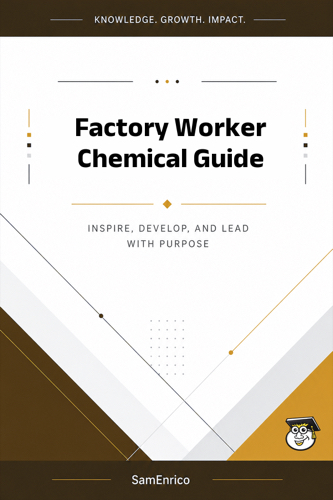
Factory Worker Chemical Guide eBook
Teaches ventilation, glove use, and decontaminatio
Teaches ventilation, glove use, and decontamination protocols for industrial settings.
Formats
Free sample
Chapter 1: The Rusty Fan...–- The first thing Jose noticed that morning was the silence. The ventilation fan above the degreasing station wasn't running. He paused with his coffee cup halfway to his lips, listening. Nothing. No hum.
No vibration through the concrete floor. Just the distant clatter of presses from the next bay.He should have reported it. He knew the procedure. But the shift supervisor was already in a bad mood after the night crew left three pallets of raw stock in the wrong aisle, and Jose had heard the lecture before: "If it was working yesterday, it's probably fine today. Stop finding problems." So he shrugged, finished his coffee, and walked to his station.
The solvent smelled stronger than usual, but he figured that was just because the air wasn't moving. He'd get used to it. Everyone did.Three hours later, Jose was on his knees in the locker room, vomiting into a trash can. His head pounded. His skin felt like it was crawling.
The company nurse checked his blood pressure and sent him home with instructions to "rest and drink water." She didn't mention the word poisoning. Neither did his supervisor. But Jose knew something was wrong. He couldn't sleep that night. Every time he closed his eyes, he saw the degreaser tank and that silent, motionless fan.This book is for Jose.
And for everyone who has ever walked past a broken fan, ignored a strange smell, or worn the wrong glove because "that's what was in the supply closet." This is not a textbook for safety engineers. It is a field guide for the person on the factory floor who mixes chemicals, cleans spills, changes filters, and goes home with sore hands and a headache they can't explain.Most chemical safety training teaches you what to fear. This book teaches you what to do.The Problem with "You'll Get Used to It"The human body is remarkably adaptable, and that is precisely the problem. When you step into a room with a strong chemical odor, your nose screams a warning. But if you stay in that room for twenty minutes, something happens: the screaming stops.
Your olfactory receptors become fatigued. The smell fades, not because the chemical has disappeared, but because your brain has learned to ignore it. This is called olfactory fatigue, and it is one of the most dangerous phenomena in industrial safety.Consider hydrogen sulfide. At low concentrations, it smells like rotten eggs – an unmistakable warning. But at higher concentrations, above 100 parts per million, it does something terrifying: it paralyzes your sense of smell entirely.
The smell disappears. Workers who have been exposed to deadly levels of hydrogen sulfide have been known to pull off their respirators because they thought the danger had passed. They died within seconds.Other chemicals never had a strong smell to begin with. Carbon monoxide is odorless, colorless, and kills by displacing oxygen in your blood. You don't feel it coming.
One moment you are alert; the next, you are unconscious. There is no middle ground.Jose wasn't exposed to hydrogen sulfide or carbon monoxide. He was working with a common industrial solvent called trichloroethylene (TCE). At room temperature, TCE evaporates quickly, producing a sweet, chloroform-like odor. The permissible exposure limit (PEL) for TCE is 100 parts per million over an eight-hour shift.
That is a very small amount – roughly equivalent to a single drop of solvent dispersed throughout an entire two-car garage. Jose's ventilation fan had been silent for three hours. He was breathing concentrations many times higher than that.His body reacted the way bodies always react to solvent poisoning: headache, nausea, dizziness, skin irritation. But here is the insidious part – those symptoms overlap with common illnesses. A worker with the flu also has a headache and nausea.
A worker who didn't sleep well also feels dizzy. It is easy to blame the symptoms on anything except the chemical exposure. That is what Jose's supervisor did. That is what Jose did, at first. He went home, slept it off, and returned to work the next day.The fan was still broken.The Three Doors: How Chemicals Enter Your Body To understand how to protect yourself, you first need to understand the three pathways chemicals use to enter your body.
Think of these as three doors. If you leave any of them open, you are exposed.Door One: Inhalation (The Fastest Route)Your lungs are not simple balloons. They are approximately 70 square meters of moist, thin tissue – roughly the size of a tennis court – folded neatly inside your chest. This massive surface area is designed for one purpose: to absorb oxygen from the air and transfer it directly into your bloodstream. But the lungs cannot distinguish between oxygen and a chemical vapor.
They absorb both with equal efficiency.Once a chemical enters the bloodstream through the lungs, it travels throughout your body within seconds. Solvents like toluene, xylene, and acetone are particularly dangerous because they are lipophilic – they love fat. Your brain is approximately 60 percent fat. So when a solvent enters your bloodstream, it heads straight for your nervous system. That is why solvent exposure causes dizziness, confusion, and memory problems.
You are not imagining it. Your brain is being chemically altered in real time.The key statistic to remember: Inhalation is the fastest route of entry. A chemical that touches your skin might take minutes or hours to reach your bloodstream. A chemical you breathe reaches your brain in less than ten seconds.Door Two: Absorption (The Silent Route)Most factory workers believe that if they can't see a burn or a rash, their skin is fine. This is dangerously wrong.Your skin is not a solid barrier.
It is a layered structure of cells held together by lipids (fats). Many industrial chemicals, particularly organic solvents, dissolve these lipids. They slip between the cells of your outer skin layer and pass into the living tissue beneath. From there, they enter your bloodstream – slower than inhalation, but just as certain.Here is what makes absorption insidious: you usually cannot feel it happening. A solvent that is actively penetrating your skin may cause no immediate sensation.
There is no warning burn, no sting, no visible redness until hours later – and often not even then. Workers who develop chemical-induced contact dermatitis often assume they have a skin condition or an allergy. In reality, their skin barrier has been chemically compromised, and repeated exposure is causing cumulative damage.The materials that penetrate fastest are not always the most dangerous. Water passes through skin slowly. But dimethyl sulfoxide (DMSO), a common industrial solvent, passes through skin so quickly that workers have reported tasting it in their mouths seconds after skin contact.
If you can taste a chemical that touched your hand, it has already entered your bloodstream.The parts of your body that absorb fastest are not your palms (which have thick, protective skin) but your forearms, face, groin, and the backs of your hands. Gloves protect your palms and fingers, but if you wipe your forehead with a contaminated glove cuff, you have just opened a high-speed absorption route directly to your brain.Door Three: Ingestion (The Avoidable Route)You are…
This is the end of the free sample. Get the eBook to keep going. Buy now
About this book
Details
- Author
- Fisher Suzanne
- Publisher
- SamEnrico
- Language
- English
- Genre
- Non-Fiction, Health & Wellness, Manufacturing
- Released
- 2026-06-07
- Pages (approx.)
- 150
- Available as
- eBook, Audiobook

Read better in the ZLOADR app
Your eBooks on your phone or tablet. Sign in with your SamEnrico account and start reading.
More by Fisher Suzanne
 Search And Rescue SwimmerFisher Suzanne$11.99
 Tea Plantation GuideFisher Suzanne$11.99
 Postpartum Healing First Weeks GuideFisher Suzanne$11.99
 Breath for SeniorsFisher Suzanne$11.99
 Arthritis Shoulder ExercisesFisher Suzanne$11.99
 Beginners TM WorkbookFisher Suzanne$11.99
 Sheppard Case Jury SelectionFisher Suzanne$11.99
 Carnegie Success LessonsFisher Suzanne$11.99
 The Clockmaker of Greenwich: John Harrison and the Quest for LongitudeFisher Suzanne$11.99
 The Last Broadcast of the Sky GodsFisher Suzanne$11.99
 Volt Rush: The Untold Story of Elon Musk’s Secret Tesla Roadster Space MissionFisher Suzanne$11.99
 The Dancer's Guide to Cretan SyrtosFisher Suzanne$11.99
You may also like
 Hong Kong Handover 1997Dunn Johnnie$11.99
 Zumba For Postnatal Recovery CourseNeal Christian$11.99
 Zumba for BeginnersLadner Nikia$11.99
 YouTube Comment Mining GuideHumes Pandora$12.99
 Worry Box MeditationCarlin Rudy$11.99
 Workplace Stress MeditationNguyen Lynn$11.99
 Workplace Stress and Sleep RepairHawley Ivory$11.99
 Workplace Perfectionism CureDelaney Jeffry$11.99
 Workplace Injustice Anger GuideWallen Isabelle$11.99
 Work Addiction and Burnout LinkGreenwood Ester$11.99
 Women in Yoga and WellnessBeattie Galina$11.99
 Women in Stand Up ComedyChun Evangeline$11.99