
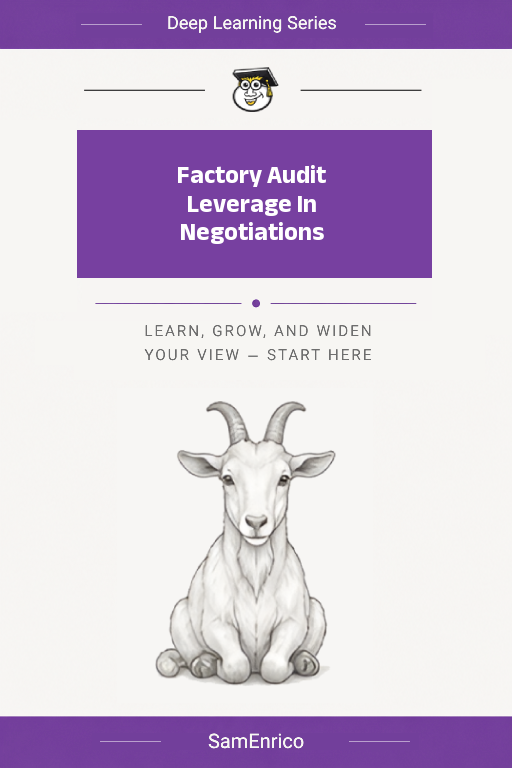
Factory Audit Leverage In Negotiations eBook
Use site visit findings and capability assessments
by Cowles Nicol
Use site visit findings and capability assessments to negotiate better pricing and priority production slots.
Formats
Free sample
Chapter 1: The $10 Million Blind Spot--–- It was 2:47 PM on a Tuesday when David Chen, a senior procurement manager for a mid-sized electronics firm, realized he had just lost $400,000. He was standing in the middle of a factory floor in Shenzhen, surrounded by idle assembly lines, dusty machines, and workers scrolling through their phones. The factory manager, Mr. Wei, had just spent forty-five minutes explaining why prices needed to increase by 7 percent next quarter. "Labor costs are up," Wei had said, gesturing vaguely at a wall of charts.
"Material inflation. You understand."David did understand. He understood that the line behind him had not moved in the two hours since his arrival. He understood that the shiny new machines against the far wall still had plastic wrapping on their control panels. He understood that the "full production schedule" Wei had emailed him last week was, at this very moment, a fiction.What David did not understand was why he felt powerless.
He had a clean audit report. He had ISO certifications. He had a spreadsheet of corrective actions from last year's visit. And yet here he was, nodding along to a price increase request while standing in a factory that was clearly desperate for work.The answer, which would cost David's company nearly half a million dollars over the next eighteen months before he figured it out, was simple: he had been conducting compliance audits when he should have been conducting intelligence missions.This book is about the difference between those two things. It is about the ten million dollars that procurement professionals leave on the table every year because they mistake paperwork for leverage.
And it begins with a single, uncomfortable truth: most factory audits are not just useless for negotiation. They are actively harmful.The Audit That Does Nothing Let us define our terms. A standard compliance audit—whether ISO 9001, BSCI, SMETA, or any of the other alphabet-soup certifications that fill your supplier files—is designed to answer one question: Is this factory safe enough, legal enough, and organized enough to avoid embarrassing us?That is not a trivial question. No one is suggesting you ignore safety violations or child labor or environmental hazards. Those are hard walkaway conditions, and we will address them thoroughly in Chapter 11.
But here is the problem that cost David four hundred thousand dollars: a passing grade on a compliance audit tells you absolutely nothing about whether the factory is desperate, inefficient, or willing to deal.Think about what a compliance audit actually measures. The auditor walks the floor with a checklist. Fire extinguishers present? Check. Emergency exits marked?
Check. Worker IDs displayed? Check. Bathrooms clean? Check.
At the end of the day, the factory receives a score—perhaps 92 percent, perhaps "Gold" status, perhaps a simple "Pass."What does that score tell you about their capacity utilization? Nothing. What does it tell you about their cash flow? Nothing. What does it tell you about their turnover rate, their bottleneck constraints, their willingness to fill a ghost shift at variable cost?
Absolutely nothing.Worse, the passing grade actively harms your negotiating position. The factory now has a credential. They can say, "We are ISO certified. Our prices reflect our quality." They can hide behind the audit report the same way a landlord hides behind a fresh coat of paint in a building with crumbling foundations. You asked for proof of compliance.
They gave it to you. And now you have no basis to ask for a discount.This is the $10 million misunderstanding. Across a typical procurement career, the gap between what compliance audits provide and what negotiation leverage requires adds up to eight figures of unnecessary cost. Not because buyers are stupid. Because buyers are asking the wrong questions and looking at the wrong things.The Prospecting Mindset The solution is to shift from policing to prospecting.
A police officer walks the floor looking for violations. A prospector walks the floor looking for value. The distinction changes everything about how you prepare, what you observe, and how you negotiate.The policing mindset asks: "Are they following the rules?" The prospecting mindset asks: "What do they have that they do not know is valuable to me?" The policing mindset celebrates a clean audit. The prospecting mindset is disappointed by a clean audit because it means less leverage. The policing mindset produces a corrective action plan.
The prospecting mindset produces a list of concessions the factory can afford to give.Here is the analogy that has helped thousands of procurement professionals reframe their approach. Imagine you are shopping for a used car. The seller hands you a mechanic's report showing that the brakes work, the tires have tread, and the engine does not leak oil. That is a compliance audit. It tells you the car is safe enough to drive.
It does not tell you that the seller has three other cars on the lot that have not moved in six months. It does not tell you that the seller's rent is due next week. It does not tell you that the car has been sitting so long the battery is dead and the seller will take almost anything to get it off the lot.A prospector does not stop at the mechanic's report. The prospector walks the lot, notices the dust on the unsold cars, notices the empty spaces where cars used to be, notices the urgency in the seller's voice. The prospector turns that information into a lower price.The same principle applies to factories.
The compliance audit is the mechanic's report. It is table stakes. It gets you to the starting line. But the race is won by the buyer who reads the parking lot, the WIP piles, and the maintenance logs.The Three-Lever Matrix Over the course of this book, we will explore dozens of specific observations you can make during a factory audit. But they all reduce to three fundamental sources of leverage.
I call this the Three-Lever Matrix, and it is the framework that will guide every negotiation you conduct after reading this book.Lever One: Capacity Idle Versus Overloaded Every factory has a theoretical maximum output. Very few factories operate at that maximum. The gap between what they could produce and what they are producing is your first and most powerful source of leverage.Why does idle capacity create leverage? Because factories have fixed costs. Rent, salaries, loan payments, insurance, utilities—these expenses do not go away when machines stop running.
Every hour a machine sits idle, the factory loses the opportunity to spread those fixed costs over more units. The marginal cost of producing one additional unit is just materials and direct labor. The overhead is already paid.When you identify idle capacity, you are not asking the factory to lose money. You are offering them a chance to make money on an asset that is currently generating nothing. A machine that is sitting idle costs the factory money every minute.
Your order, even at a steep discount, turns that negative into a positive.In Chapter 5, we will drill down on exactly how to calculate OEE on the fly, how to spot ghost shifts, and how to structure…
This is the end of the free sample. Get the eBook to keep going. Buy now
About this book
Details
- Author
- Cowles Nicol
- Publisher
- SamEnrico
- Language
- English
- Genre
- Non-Fiction, Business Brief
- Released
- 2026-05-30
- Pages (approx.)
- 157
- Available as
- eBook, Audiobook

Read better in the ZLOADR app
Your eBooks on your phone or tablet. Sign in with your SamEnrico account and start reading.
More by Cowles Nicol
 Faith Based Counseling Integration GuideCowles Nicol$11.99Faith Based Counseling Integration GuideCowles Nicol$11.99
 Medicaid LTC Alternative GuideCowles Nicol$11.99
 Posture Tips for Breath MeditationCowles Nicol$11.99
 John Wayne Gacy's Double LifeCowles Nicol$11.99
 FCPA Self Disclosure LogCowles Nicol$11.99
 Betrayed Partner RecoveryCowles Nicol$11.99
 Two Minute Rule for ParentsCowles Nicol$11.99
 TM For High Blood PressureCowles Nicol$11.99
 Affirmations For Academic PressureCowles Nicol$11.99
 The Unlikely Champion: How a High School Dropout Became the Voice of a GenerationCowles Nicol$11.99
 The Skyward Spires: How Gothic Builders Defied GravityCowles Nicol$11.99
You may also like
 Hong Kong Handover 1997Dunn Johnnie$11.99
 Zumba For Postnatal Recovery CourseNeal Christian$11.99
 Zumba for BeginnersLadner Nikia$11.99
 YouTube Comment Mining GuideHumes Pandora$12.99
 Worry Box MeditationCarlin Rudy$11.99
 Workplace Stress MeditationNguyen Lynn$11.99
 Workplace Stress and Sleep RepairHawley Ivory$11.99
 Workplace Perfectionism CureDelaney Jeffry$11.99
 Workplace Injustice Anger GuideWallen Isabelle$11.99
 Work Addiction and Burnout LinkGreenwood Ester$11.99
 Women in Yoga and WellnessBeattie Galina$11.99
 Women in Stand Up ComedyChun Evangeline$11.99