
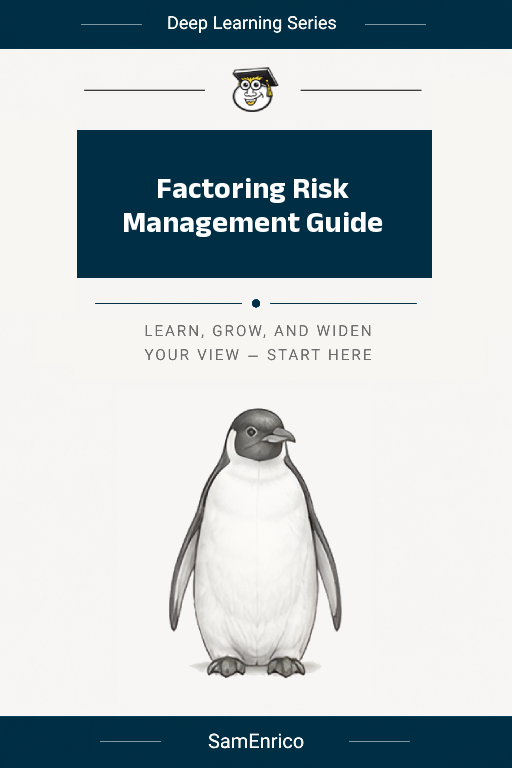
Non-FictionBusiness BriefWorking Capital Guide
Factoring Risk Management Guide
Manage risks when using invoice factoring in emerg
by Finley Aliza
Manage risks when using invoice factoring in emerging markets. Concentration and debtor risk.
Formats
About this book
Free sample
Chapter 1: The $5.7 Trillion Blind Spot–- In 2019, a mid-sized Singaporean factoring firm called Globe Trade Finance did everything by the book. They had a diversified portfolio of thirty-seven clients across six emerging markets. Their concentration reports showed no single debtor exceeding 12% of total outstandings. Their credit insurance policies were current. Their auditors had signed off on every client file.
Six months later, the firm was insolvent.The collapse did not make headlines outside trade finance circles. No fraud was involved. No single debtor defaulted in isolation. What killed Globe Trade was something far more insidious: the perfect alignment of multiple risks they thought they had managed separately. When palm oil prices crashed 22% in six weeks, three of their top five debtors—all Indonesian palm oil buyers—defaulted simultaneously.
When the Indonesian rupiah devalued 15% against the dollar, the currency losses exceeded their political risk insurance limits. When the Malaysian government suddenly required central bank approval for all cross-border receivables assignments, two more debtors simply stopped paying, citing "regulatory uncertainty." By the time Globe Trade's lawyers figured out how to file claims, their 30-day insurance notification window had closed on 40% of their exposure.The post-mortem revealed a painful truth: Globe Trade had not actually managed risk. They had merely measured it. There is a profound difference.This book exists because that difference has destroyed more factoring firms in emerging markets than any other single cause. The global factoring industry now handles over €3 trillion annually, with the fastest growth occurring not in saturated European markets but in Africa, Southeast Asia, Latin America, and the Middle East.
The opportunity is staggering. The Micro, Small, and Medium Enterprise (MSME) finance gap in emerging markets stands at $5.7 trillion—a number larger than the GDP of every country except the United States and China. Factoring, done correctly, is the most elegant solution to that gap. It is self-liquidating. It requires no hard collateral.
It turns accounts receivable—often the largest asset on an SME's balance sheet—into working capital.But the same features that make factoring powerful also make it fragile in emerging markets. The shift from Letters of Credit…
This is the end of the free sample. Get the eBook to keep going. Buy now
Contents
- Chapter 1
- Chapter 2
- Chapter 3
- Chapter 4
- Chapter 5
- Chapter 6
- Chapter 7
- Chapter 8
- Chapter 9
- Chapter 10
- Chapter 11
- Chapter 12
Details
- Author
- Finley Aliza
- Publisher
- SamEnrico
- Language
- English
- Genre
- Non-Fiction, Business Brief, Working Capital Guide
- Released
- 2026-05-30
- Pages (approx.)
- 138
- Available as
- eBook, Audiobook

Read better in the ZLOADR app
Your eBooks on your phone or tablet. Sign in with your SamEnrico account and start reading.
More by Finley Aliza
 Sports Nutrition for TriathlonFinley Aliza$11.99
 Fear Of Failure In MarketingFinley Aliza$11.99
 Dual Diagnosis Eating DisordersFinley Aliza$11.99
 Anger Management for PhotographersFinley Aliza$11.99
 The Small Kitchen Cooking GuideFinley Aliza$11.99
 The Nordic Jazz Revolution: How a Cold Climate Ignited a Hot SoundFinley Aliza$11.99
 Understanding Sadistic Personality DisorderFinley Aliza$17.99
 Packaging EngineerFinley Aliza$11.99
 How to Start a Cans Made of Blackplate Business (Beginners Guide)Finley Aliza$11.99
 Business Name Availability CheckFinley Aliza$12.99
You may also like
 Hong Kong Handover 1997Dunn Johnnie$11.99
 Zumba For Postnatal Recovery CourseNeal Christian$11.99
 Zumba for BeginnersLadner Nikia$11.99
 YouTube Comment Mining GuideHumes Pandora$12.99
 Worry Box MeditationCarlin Rudy$11.99
 Workplace Stress MeditationNguyen Lynn$11.99
 Workplace Stress and Sleep RepairHawley Ivory$11.99
 Workplace Perfectionism CureDelaney Jeffry$11.99
 Workplace Injustice Anger GuideWallen Isabelle$11.99
 Work Addiction and Burnout LinkGreenwood Ester$11.99
 Women in Yoga and WellnessBeattie Galina$11.99
 Women in Stand Up ComedyChun Evangeline$11.99