
Non-FictionProfessional's Cheat SheetFacilitation
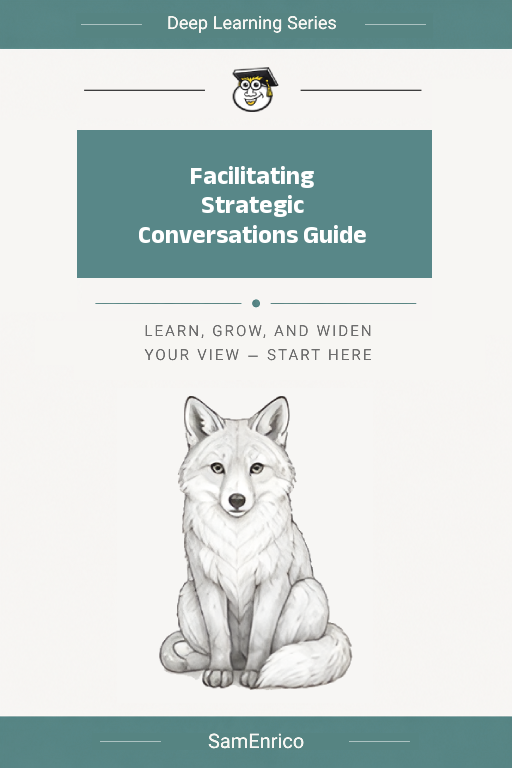
Facilitating Strategic Conversations Guide eBook
Guide strategic discussions when running one hour
Guide strategic discussions when running one hour strategy meetings using powerful facilitation techniques.
Formats
Free sample
Chapter 1: The Silent Killer--Every Monday morning, millions of professionals walk into conference rooms, dial into video calls, and take their seats at tables covered in coffee cups and scattered notebooks. They have one hour. They have a topic. They have good intentions.And they have almost no chance of success.Not because they are incompetent. Not because their teams are disengaged.
Not because the strategy is wrong. They fail because no one has ever taught them how to facilitate a strategic conversation. They are running a meeting the same way their managers ran meetings, who learned from their managers before them, in an unbroken chain of inherited mediocrity stretching back decades.The cost of this inherited mediocrity is staggering. Workplace miscommunication—much of which happens in poorly facilitated strategic meetings—costs US businesses an estimated $1.2 trillion annually in wasted time, errors, and reduced productivity. That is not a typo.
Trillion with a T. To put that number in perspective, it exceeds the GDP of all but eleven countries on earth. Your organization is paying its share of that trillion dollars whether you realize it or not.This chapter is not a gentle invitation to improve. It is a forensic accounting of exactly how strategic meetings fail, what those failures cost, and why the problem has persisted for so long. By the time you finish reading, you will never look at a one-hour strategy meeting the same way again.
You will see the drift, the dominance, and the disengagement. You will calculate the cost of every hour your team spends in unfacilitated conversation. And you will understand, with absolute clarity, why the remaining eleven chapters of this book exist.The $1,000 Hour Let us start with a story. It happens somewhere in corporate America every day, in every industry, at every level. The details change.
The pattern does not.A product team at a mid-sized software company gathers for a "strategic planning meeting." The manager has booked one hour on a Tuesday at 10 AM. Thirteen people attend: the product manager, three developers, two designers, the marketing lead, the sales director, customer support manager, QA lead, data analyst, engineering manager, and the team's project coordinator.The product manager opens the meeting. "Thanks for coming, everyone. Today we need to figure out our priorities for next quarter. Lots of competing requests.
Let's go around and share what each team needs."For the next forty-five minutes, the conversation lurches from topic to topic. The sales director needs a feature for a major prospect. The developers are worried about technical debt. Marketing wants to redesign the onboarding flow. Customer support reports a spike in tickets about a specific bug.
The data analyst shares a report that no one looks at. The project coordinator reminds everyone about an upcoming release deadline that conflicts with everything.The product manager takes notes. No decisions are made. No action items are assigned. At 10:58 AM, the product manager says, "Okay, this was really helpful.
Let's take these ideas back to our teams and keep thinking about them. I'll send out a summary."As people file out, one engineer turns to another and says, "What was the point of that?"That one-hour meeting, with thirteen people at an average loaded cost of 75perhour,costthecompanynearly75 per hour, cost the company nearly 75perhour,costthecompanynearly1,000 in salary time alone. Not including the opportunity cost of what those thirteen people could have been doing instead. Not including the cost of the meeting room, the coffee, the technology. Not including the cost of the errors that will result from the lack of clarity and the rework that will follow.
Just the raw cost of bodies in chairs.Now multiply that by the millions of similar meetings happening every day. The $1.2 trillion figure becomes disturbingly plausible.The Meeting Cost Calculator Before you read another paragraph, you need to know exactly what your organization is spending on meetings. Not what you think you are spending. The real number.Here is the formula:Meeting Cost = (Number of Attendees) × (Average Hourly Loaded Cost) × (Meeting Duration in Hours)Loaded cost includes salary, benefits, overhead, and the opportunity cost of time not spent on productive work. A conservative estimate for loaded cost is 1.3 to 1.5 times base salary.
If your average employee earns 50perhour,theirloadedcostis50 per hour, their loaded cost is 50perhour,theirloadedcostis65 to $75 per hour.Now apply that formula to your calendar.Take out your phone or open your calendar app. Count how many meetings you attended last week. Multiply by the average number of attendees (including yourself). Multiply by the average duration in hours. Multiply by your organization's average loaded cost.That number is what your organization spent on meetings last week.
Now multiply by 50 (weeks per year). That number is what your organization spends on meetings annually.If you are like most professionals, that number will be between 15% and 30% of your organization's total payroll. In other words, your organization spends nearly a third of its salary budget on people sitting in meetings.The question is not whether you can afford to run those meetings well. The question is whether you can afford to run them poorly.Why Strategic Conversations Fail Not all meetings are created equal. A status update meeting that runs long is annoying.
A strategic conversation that fails is catastrophic.Strategic conversations are fundamentally different from tactical check-ins or operational reviews. They involve ambiguity, multiple possible futures, and decisions with long-term consequences. There is no single right answer. There is no playbook to follow. The value of the conversation is not the information shared—it is the insight generated collectively by the group.Tactical facilitation (who does what by when) fails when applied to strategic questions (where should we go and why).
You cannot check-in your way to a strategy. You cannot status-update your way to alignment.Strategic facilitation requires different tools. It requires structured questioning that moves a group from facts to feelings to meaning to action. It requires stakeholder mapping that accounts for different perspectives and levels of influence. It requires generative listening that hears not just what is said but what is not being said.Most managers have none of these tools.
They have been trained to manage projects, not facilitate strategic conversations. They have been promoted because they have answers, not because they ask good questions. They run strategic meetings the only way they know how: the same way their managers ran them.The result is predictable. Strategic conversations fail in three distinct ways.The Three Symptoms: Drift, Dominance, and Disengagement Every poorly facilitated strategic meeting exhibits at least one of three symptoms. Most exhibit all three.Drift: The Conversation That Goes Nowhere Drift occurs when the conversation jumps from topic to topic with no progression and no closure.
The group spends ten minutes on customer acquisition, then five minutes on a budget issue, then fifteen minutes on a staffing problem, then ten minutes on a product roadmap decision. Each topic is touched but none is resolved.Drift happens because there is no clear arc to the conversation. No one has decided what the group should accomplish first, second, and third. The facilitator has not said, "We are not discussing that today." Participants introduce whatever is…
This is the end of the free sample. Get the eBook to keep going. Buy now
About this book
Details
- Author
- Scherer Marquita
- Publisher
- SamEnrico
- Language
- English
- Genre
- Non-Fiction, Professional's Cheat Sheet, Facilitation
- Released
- 2026-05-29
- Pages (approx.)
- 127
- Available as
- eBook, Audiobook

Read better in the ZLOADR app
Your eBooks on your phone or tablet. Sign in with your SamEnrico account and start reading.
More by Scherer Marquita
 Assertiveness For Public QuestionsScherer Marquita$11.99
 The Self Compassion EQ LinkScherer Marquita$11.99
 1031 Exchange Intermediary RoleScherer Marquita$11.99
 Mindfulness Based EQ DevelopmentScherer Marquita$11.99
 Gratitude for Body Function GuideScherer Marquita$11.99
 Trolls in the Twilight: The Hidden Lore of the FjordsScherer Marquita$11.99
 How to Start a Hobby in SurvivalScherer Marquita$11.99
 Early Payment Discount Capture GuideScherer Marquita$12.99
 MAC & Occupancy SpecialistScherer Marquita$11.99
 Understanding Magnesium Defect In Renal Tubular Transport OfScherer Marquita$17.99
You may also like
 Hong Kong Handover 1997Dunn Johnnie$11.99
 Zumba For Postnatal Recovery CourseNeal Christian$11.99
 Zumba for BeginnersLadner Nikia$11.99
 YouTube Comment Mining GuideHumes Pandora$12.99
 Worry Box MeditationCarlin Rudy$11.99
 Workplace Stress MeditationNguyen Lynn$11.99
 Workplace Stress and Sleep RepairHawley Ivory$11.99
 Workplace Perfectionism CureDelaney Jeffry$11.99
 Workplace Injustice Anger GuideWallen Isabelle$11.99
 Work Addiction and Burnout LinkGreenwood Ester$11.99
 Women in Yoga and WellnessBeattie Galina$11.99
 Women in Stand Up ComedyChun Evangeline$11.99