
Non-FictionSelf-HelpConflict Resolution
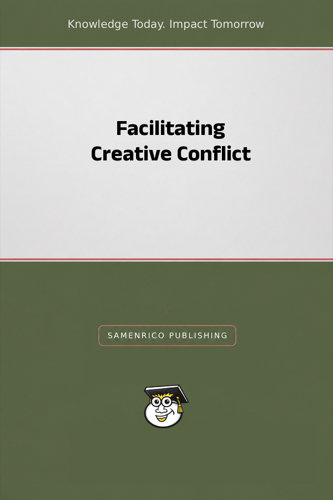
Facilitating Creative Conflict eBook
Turns team disagreements into productive creative
by Dumas Ciera
Turns team disagreements into productive creative tension and better outcomes.
Formats
Free sample
Chapter 1: The Abilene Trap...–- In fifteen years of consulting with over two hundred teams, I have never once walked into a room where someone said, "You know what our problem is? We're too polite." And yet, nearly every team I've ever worked with suffers from exactly that condition. They just don't know it yet.The meeting had gone beautifully. Twenty-three people around a massive conference table, every agenda item checked off, every decision ratified by what appeared to be unanimous consent. The CEO turned to me afterward, beaming.
"You see?" she said. "We're a high-trust team. No drama. We get things done."I asked if I could interview a few team members privately. She agreed.The first person I spoke with—a senior director with seventeen years at the company—waited until the door clicked shut, then slumped into her chair like a marionette with cut strings.
"Can I tell you something?" she whispered. "That whole meeting was a lie."I asked her what she meant."I've known for six months that the new product strategy is going to fail," she said. "The data doesn't support it. Three of us have the same concerns. But every time we bring it up in the group, someone says 'Let's stay positive' or 'We need to be team players.' So we smile and nod.
And then we go back to our offices and pray someone else will be the one to say it."She wasn't the outlier. She was the norm. Of the twenty-three people in that meeting, nineteen privately told me they had serious reservations about the strategy. Zero had voiced those reservations in the room.The strategy failed eight months later. Cost the company forty-two million dollars.In the post-mortem, the CEO gathered the team and asked the obvious question: "Why didn't anyone tell me?"No one had a good answer.
Or rather, everyone had the same bad answer: "I assumed everyone else agreed with it."That is the Abilene Paradox. And it is the single greatest threat to innovation, performance, and truth in organizations today.The Paradox That Destroys Teams Let me tell you the story that gave this phenomenon its name, because it captures something essential about how well-intentioned people make catastrophic decisions together.In the 1970s, management professor Jerry Harvey was spending a hot July afternoon with his family in Coleman, Texas. The temperature was pushing 104 degrees. They were playing dominoes on a porch, drinking lemonade, and generally enjoying the simple pleasure of doing nothing.Then Harvey's father-in-law said, "Let's drive to Abilene and get dinner."Harvey's first thought was: Abilene? That's fifty-three miles away.
In this heat. In a car with no air conditioning. Why would anyone want to do that?But he didn't say that. Instead, he thought: Maybe the others want to go. I don't want to be the killjoy.His wife thought: It's probably not a great idea, but Dad seems excited.
I don't want to disappoint him.Her mother thought: The kids are probably bored. They'd never say so, but maybe they need a change of scenery.Her father thought: I hope they want to go. It was just a suggestion. But if no one wants to, that's fine too. I don't want to force anyone.So they all got in the car.
Four hours round trip. Dusty roads. Stifling heat. A mediocre cafeteria meal. They returned exhausted, irritable, and deeply aware that no one had actually wanted to go.Harvey later wrote, "All of us would have preferred not to go to Abilene.
But none of us admitted it. We went because we thought the others wanted to go."That is the Abilene Paradox in its purest form: a situation where a group collectively agrees to a course of action that no individual member actually wants, simply to avoid conflict or appearing difficult.Notice what didn't happen. No one was coerced. No one was threatened. No one was overruled by a tyrant.
The decision emerged from a cascade of polite assumptions, each person silently calculating what they thought others wanted, and each person choosing silence over honesty.Now ask yourself: How many meetings have you sat in where exactly this dynamic played out?The research on this is sobering. A meta-analysis of sixty-seven studies on group decision-making found that in over eighty percent of meetings where a consensus appeared to be reached, at least one participant privately disagreed with the outcome. The vast majority of those participants never voiced their dissent.They smiled. They nodded. They said "Sounds good." And then they went back to their desks and told a colleague, "That was a disaster."The Myth of the Conflict-Free Team We have been sold a lie about what great teams look like.The lie goes like this: High-performing teams are harmonious.
They trust each other, which means they agree with each other. Disagreement is a sign of dysfunction. If people are arguing, something is wrong. The goal of team development is to reduce friction until everyone aligns.This lie is seductive because it feels true. Who doesn't want to work on a team where people get along?
Who hasn't fantasized about a meeting where everyone nods in agreement and you finish early?But here is the truth that the data forces us to confront: Harmony is not the absence of conflict. Harmony is the absence of truth.Jeff De Graff, one of the most provocative thinkers on innovation and team dynamics, puts it even more bluntly: "Harmony is sublime in music but deadly to innovation."Think about what harmony actually is in a musical context. A chord is harmonious because different notes are played at the same time. The beauty comes from the tension between the frequencies, the way they vibrate against each other to create something greater than any single note could produce alone. If you eliminated the tension—if you forced every instrument to play the exact same note—you wouldn't have harmony.
You would have a single, thin, boring tone.Teams are exactly the same. The "harmony" that produces breakthrough results is not the absence of disagreement. It is the productive tension between different perspectives, different data, different ways of seeing the world. When those differences are suppressed in the name of politeness, you don't get harmony. You get the Abilene Paradox.
You get silent agreement masking silent doubt. You get a team that feels good but performs poorly.The most comprehensive study of team effectiveness ever conducted—Google's Project Aristotle, which analyzed over 180 internal teams for three years—found exactly this. The number one predictor of team performance was not IQ, not educational background, not even the individual talent of team members. It was psychological safety: the shared belief that the team is safe for interpersonal risk-taking.And what does psychological safety actually enable? The willingness to disagree.
The willingness to say "I see it differently." The willingness to voice a minority opinion without fear of punishment or humiliation.In other words, the best teams are not the teams that avoid conflict. They are the teams that know how to have conflict productively.The Two Faces of Conflict Before we go any further, I need to introduce…
This is the end of the free sample. Get the eBook to keep going. Buy now
About this book
Details
- Author
- Dumas Ciera
- Publisher
- SamEnrico
- Language
- English
- Genre
- Non-Fiction, Self-Help, Conflict Resolution
- Released
- 2026-06-09
- Pages (approx.)
- 148
- Available as
- eBook, Audiobook

Read better in the ZLOADR app
Your eBooks on your phone or tablet. Sign in with your SamEnrico account and start reading.
More by Dumas Ciera
 Road Rage Complete Management GuideDumas Ciera$11.99
 Retirement Asset Basis GuideDumas Ciera$11.99
 Nicotine Detox Meal PlanDumas Ciera$11.99
 Diamond District Security UpgradeDumas Ciera$11.99
 Benzo Recovery and TinnitusDumas Ciera$11.99
 Mnemonic Peg Lists HandbookDumas Ciera$11.99
 Chasteberry For PMS ReliefDumas Ciera$11.99
 Pediatric RLS ManagementDumas Ciera$11.99
 The Vanishing of Amelia Earhart: The Lost TransmissionDumas Ciera$11.99
 The Last Voyage of the Nautilus: Jules Verne's Unseen BlueprintDumas Ciera$11.99
 The Hammer of the Scots: Robert the Bruce and the Birth of a NationDumas Ciera$11.99
 The Dancer's Guide to Jove Malaj MomeDumas Ciera$11.99
You may also like
 Hong Kong Handover 1997Dunn Johnnie$11.99
 Zumba For Postnatal Recovery CourseNeal Christian$11.99
 Zumba for BeginnersLadner Nikia$11.99
 YouTube Comment Mining GuideHumes Pandora$12.99
 Worry Box MeditationCarlin Rudy$11.99
 Workplace Stress MeditationNguyen Lynn$11.99
 Workplace Stress and Sleep RepairHawley Ivory$11.99
 Workplace Perfectionism CureDelaney Jeffry$11.99
 Workplace Injustice Anger GuideWallen Isabelle$11.99
 Work Addiction and Burnout LinkGreenwood Ester$11.99
 Women in Yoga and WellnessBeattie Galina$11.99
 Women in Stand Up ComedyChun Evangeline$11.99