
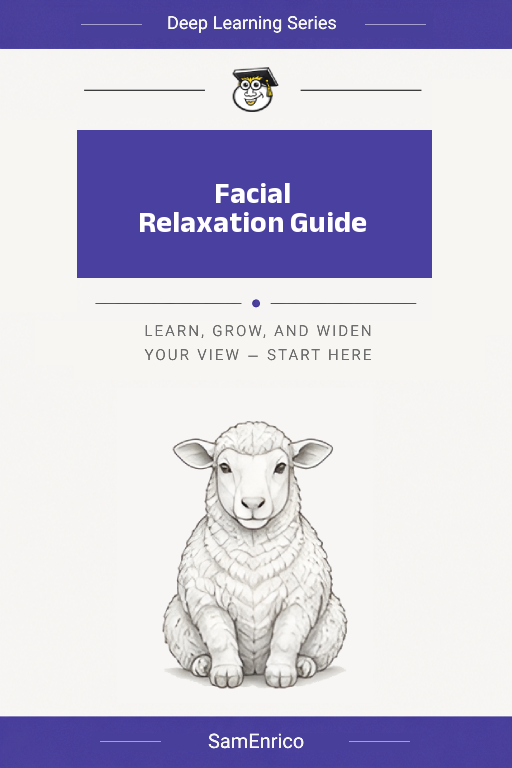
Facial Relaxation Guide eBook
Release jaw, forehead, and eye muscles to reduce s
Release jaw, forehead, and eye muscles to reduce stress held in the face.
Formats
Free sample
Chapter 1: The Face Keeps the Score...--The first time I noticed my jaw was clenched, I was lying in a dentist’s chair, and the hygienist asked me a question I had never considered: “Do you know you’re biting down right now?”I wasn’t angry. I wasn’t in pain. I was simply… thinking. I was mentally reviewing my afternoon schedule while a metal probe hovered near my molars. And in that quiet moment of concentration, my jaw had locked itself into a vice grip so tight that the hygienist had to pause her work.That was the beginning of my education in facial bracing—the unconscious habit of tensing the muscles of the face, jaw, and forehead during moments of effort, stress, or even mild focus.
And once I started noticing it, I couldn’t stop. I saw it in myself during traffic jams, while reading emails, and most embarrassingly, while meditating (the irony was not lost on me). I saw it in my partner when he balanced the checkbook. I saw it in strangers on the subway, their brows furrowed into permanent question marks, their jaws set like concrete.What I was witnessing—and what this entire book will teach you to recognize and reverse—is a silent epidemic. We are walking around with our faces braced for impact, even when no impact is coming.
And that chronic tension is not just causing wrinkles. It is causing headaches, jaw pain, tooth fractures, neck strain, anxiety, and poor sleep. It is aging us from the inside out, and most of us have no idea we are doing it.This chapter is called “The Face Keeps the Score” because your face is not merely a canvas for expression. It is a diary. Every unspoken worry, every suppressed emotion, every moment of concentration without release has been written into the muscles around your eyes, your forehead, and your jaw.
The question is not whether you hold tension in your face. The question is: how much, and for how long?Let us begin by understanding what facial bracing actually is, why your brain thinks it is helping you, and why it has become one of the most overlooked sources of chronic pain in modern life.The Anatomy of an Unconscious Habit Before we talk about solutions, we must first understand the problem. Facial bracing is exactly what it sounds like: the involuntary contraction of one or more facial muscle groups in response to internal or external stimuli. Unlike a voluntary smile or a deliberate frown, bracing happens beneath the threshold of conscious awareness. Your brain sends a signal to your masseter (jaw) or your occipitofrontalis (forehead) or your orbicularis oculi (eyes) to tighten, and you never receive the memo.This is not a design flaw.
It is a feature—one that served your ancestors well. The human face is wired to the autonomic nervous system in ways that other muscle groups are not. When a predator appeared on the savanna, your ancestor did not have time to consciously decide to squint, clench, and prepare for impact. The brain shortcut that process. The trigeminal nerve—the largest cranial nerve, which we will explore in detail later—connects directly to the brainstem’s threat-detection centers.
In milliseconds, the face could brace for a blow, protect the eyes, and prepare the jaw for biting or shouting.The problem is that your brain cannot distinguish between a saber-toothed tiger and a passive-aggressive email from your boss.The same neural pathway that once protected your ancestors now activates when you are stuck in traffic, when you are balancing your budget, when you are trying to remember a password, or when you are simply lying in bed replaying an awkward conversation from 2017. Your brain interprets cognitive load and emotional stress as physical threats, and it responds by bracing your face.This is not a metaphor. Researchers using electromyography (EMG) have repeatedly demonstrated that mental stress produces measurable increases in facial muscle tension, particularly in the corrugator supercilii (the “frown muscle” between the eyebrows) and the masseter (the primary chewing muscle). In one landmark study, participants who were asked to perform difficult arithmetic problems showed a 200% increase in brow tension within seconds. They did not know they were frowning.
They were just doing math.This is the hidden cost of modern life. We spend hours each day in a state of low-grade facial bracing, and because it happens automatically, we never release it. The tension accumulates. The muscles shorten. The fascia—the connective tissue that surrounds every muscle fiber—becomes stiff and adhered.
And eventually, what started as a momentary response to a stressful email becomes a permanent resting state.The Polyvagal Theory: Why Your Face Listens to Your Fear To truly understand facial bracing, we need to take a brief detour into the vagus nerve and the polyvagal theory. Do not let the scientific terms intimidate you. This is simply the story of how your nervous system decides whether you are safe or not—and how your face is the primary messenger of that decision.The vagus nerve is the longest nerve in the body, running from your brainstem down through your neck and into your chest and abdomen. It is the main highway of your parasympathetic nervous system—the “rest and digest” system that calms you down after a threat has passed. But here is what most people do not know: the vagus nerve has two branches, and the more evolved branch (the ventral vagus) is directly connected to the muscles of your face, head, and neck.When your nervous system detects safety—when you are among trusted friends, when you are resting, when you are not under threat—the ventral vagus sends signals that soften your facial muscles, relax your jaw, and even produce spontaneous micro-expressions of warmth and connection.
This is why you look different when you are genuinely relaxed. Your face literally changes shape.But when your nervous system detects a threat—real or imagined—the ventral vagus shuts down, and an older, more primitive branch (the sympathetic nervous system) takes over. Your heart rate increases. Your breathing becomes shallow. And your face braces.
The jaw tightens to prepare for biting. The brow furrows to protect the eyes. The lips press together to prevent sound that might attract predators.This is the polyvagal theory in a nutshell: your face is a readout of your nervous system’s threat assessment. And because modern life is full of low-grade, chronic stressors rather than acute, resolvable threats, many of us are stuck in a state of sympathetic activation for hours or days at a time. Our faces never get the signal to relax.Consider your typical workday.
You wake up to an alarm (stress). You check your phone and see a news alert (stress). You commute in traffic (stress). You sit through a meeting where you are expected to perform (stress). You eat lunch at your desk (stress).
You receive a critical email (stress). You drive home (stress). You scroll through social media (stress). You watch a tense television show (stress). You go to bed and lie awake thinking about tomorrow (stress).At no point during…
This is the end of the free sample. Get the eBook to keep going. Buy now
About this book
Details
- Author
- Guillory Rhett
- Publisher
- SamEnrico
- Language
- English
- Genre
- Non-Fiction, Mental Wealth
- Released
- 2026-06-01
- Pages (approx.)
- 150
- Available as
- eBook, Audiobook

Read better in the ZLOADR app
Your eBooks on your phone or tablet. Sign in with your SamEnrico account and start reading.
More by Guillory Rhett
 Zookeeper Emergency Stress GuideGuillory Rhett$11.99
 Restroom Social AnxietyGuillory Rhett$11.99
 Selling Your Home in RetirementGuillory Rhett$11.99
 The First Car GenerationGuillory Rhett$11.99
 Listening Skills for LibrariansGuillory Rhett$11.99
 Bus Stop Conversation GuideGuillory Rhett$11.99
 Remote Work Focus Music GuideGuillory Rhett$11.99
 Personal Branding for Real EstateGuillory Rhett$11.99
 The Phantom of the Met: The Great Imposter Who Stole a LifeGuillory Rhett$11.99
 Quetzalcoatl's Celestial Spire: The Feathered Serpent's SkybridgeGuillory Rhett$11.99
 How to Produce Lighter FluidGuillory Rhett$11.99
 How to Produce Waste Container WheelsGuillory Rhett$11.99
You may also like
 Hong Kong Handover 1997Dunn Johnnie$11.99
 Zumba For Postnatal Recovery CourseNeal Christian$11.99
 Zumba for BeginnersLadner Nikia$11.99
 YouTube Comment Mining GuideHumes Pandora$12.99
 Worry Box MeditationCarlin Rudy$11.99
 Workplace Stress MeditationNguyen Lynn$11.99
 Workplace Stress and Sleep RepairHawley Ivory$11.99
 Workplace Perfectionism CureDelaney Jeffry$11.99
 Workplace Injustice Anger GuideWallen Isabelle$11.99
 Work Addiction and Burnout LinkGreenwood Ester$11.99
 Women in Yoga and WellnessBeattie Galina$11.99
 Women in Stand Up ComedyChun Evangeline$11.99