

Facebook Pixel Installation Guide eBook
Install Facebook Pixel on your website for trackin
Install Facebook Pixel on your website for tracking. Measure conversions and build audiences from first campaign.
Formats
Free sample
Chapter 1: The $47 Billion Blind Spot--–- Most business owners wake up to three numbers every morning: their bank balance, their ad spend, and their revenue. But there is a fourth number they never see, and it is quietly stealing their future. That number is the percentage of their Facebook advertising budget that vanishes into what industry insiders call "the attribution gap"—sales that happened because of an ad but were never credited to that ad.Here is the hard truth that no Facebook representative will tell you and that most marketing guides actively hide: over 80 percent of Facebook pixels are installed incorrectly or, once installed, never used for optimization. Not "slightly suboptimal." Not "could use a tune-up." Completely broken in ways that directly drain profit from your business.This book exists because that statistic is both terrifying and entirely fixable.I have audited hundreds of ecommerce stores, Saa S companies, and local businesses over the past six years. The pattern is always the same.
A business owner comes to me frustrated, convinced that "Facebook ads don't work for my industry." They show me their Ads Manager dashboard. The numbers are ugly: high cost per result, low ROAS, inconsistent performance. They have tried different creatives, different audiences, different offers. Nothing moves the needle.Then I open their Events Manager, and within sixty seconds, I find the real problem. Their pixel is installed on only half their pages.
Their Purchase event hasn't fired in three months because the thank-you page URL changed. They are optimizing for link clicks instead of conversions because they never changed the default setting. They are losing thirty to forty percent of their sales to i OS 14 tracking restrictions and don't even know what the Conversions API is.Every single time, after we fix the tracking, the same thing happens. Their cost per acquisition drops. Their ROAS climbs.
Campaigns that were "dying" suddenly become profitable. Not because the ads changed, but because Facebook finally knew what to optimize for.This is the $47 billion blind spot. That is the estimated annual ad spend wasted on broken or nonexistent tracking across Meta's platforms. And you are almost certainly contributing to that number right now.If you have ever run a Facebook ad and felt like the results were inconsistent, like some days were great and most days were not, like you could never quite trust the numbers in your dashboard—you are not imagining things. Your tracking is likely broken in ways that are invisible to the casual observer but devastating to your bottom line.The Three Lies You Have Been Told Before we fix anything, we must first unlearn what most "Facebook ad experts" have taught you.
The industry is built on three foundational lies that keep you confused and spending.Lie Number One: "Just paste the pixel code and you're good to go."This is the most damaging lie in the entire Facebook advertising ecosystem. It is perpetuated by platform-specific tutorials (the ones that say "click here, paste there, done"), by agencies that want you to think tracking is simple so they can charge you for "management" instead of "fixing," and by Facebook itself, which has a vested interest in making advertising seem easy.The truth is that pasting the base pixel code is approximately five percent of the work required to have accurate tracking. It is the equivalent of saying "just buy a car and you're ready to race in Formula One." The base pixel fires a Page View event every time someone loads a page. That tells Facebook that someone visited your website. It does not tell Facebook that someone added a product to their cart, initiated checkout, or completed a purchase.
It does not tell Facebook how much money they spent or which product they bought. It does not tell Facebook that someone scrolled through your blog post or watched your video or clicked your "download case study" button.Without that data, Facebook's optimization algorithm is flying blind. It is trying to find you buyers while knowing absolutely nothing about buying behavior. That is like asking a fisherman to catch salmon in the dark using only the sound of the water. Possible, perhaps, but extraordinarily inefficient.Lie Number Two: "The pixel is a tracker."This lie is more subtle but equally damaging.
Most business owners think of the pixel as a passive observer—a piece of code that sits on their website and reports back to Facebook about what happened. This framing leads people to install the pixel and then forget about it. They check once a month to see if the little green dot is still there, and if it is, they assume everything is working.The truth is that the pixel is not a tracker. It is a retargeting engine. Every single page view, every scroll, every button click, every millisecond someone spends on your site—all of it creates raw material for future audiences.
When you understand the pixel as an audience-building machine rather than a reporting tool, everything changes. You stop asking "did the pixel fire?" and start asking "what audiences can I build from the data the pixel collected?"Consider two business owners. Both have the exact same website traffic. Business Owner A installs the base pixel and forgets about it. Business Owner B installs the base pixel, adds Purchase, Add To Cart, and Initiate Checkout events, adds scroll depth tracking for their blog content, and builds custom audiences from each behavioral segment.
Who do you think will have a lower cost per acquisition in thirty days? Business Owner B, by a factor of three to five times, every single time.Lie Number Three: "More data is always better."This lie is seductive because it feels true. Surely, if Facebook knows more about what happens on my website, it can optimize better. Therefore, I should track everything. Every button click, every page view, every hover, every exit intent.
Flood the pixel with data.This is wrong, and it is wrong in a way that actively hurts your performance. Facebook limits each domain to eight priority conversion events that it will use for reporting and optimization. If you send fifty different events, Facebook will ignore most of them. Worse, if you send events that are too high-funnel (like Page View) or too noisy (like every single button click), you dilute the signal that Facebook uses to find buyers.The key insight—and this will be a recurring theme throughout this book—is that data quality crushes data quantity every single time. Five well-implemented events with accurate parameters will outperform fifty sloppy events by an enormous margin.
This book will teach you exactly which events matter, which parameters to attach to them, and which events you can safely ignore forever.The Three Pillars of Pixel Success Now that we have cleared away the lies, let me introduce you to the framework that will guide every decision in this book. I call it the Three Pillars of Pixel Success. Every chapter, every technique, every checklist in the following pages connects back to one of these three pillars.Pillar One: Tracking (Data In)This is what most people think the pixel does. Tracking means ensuring that every…
This is the end of the free sample. Get the eBook to keep going. Buy now
About this book
Details
- Author
- Crist Mohammad
- Publisher
- SamEnrico
- Language
- English
- Genre
- Non-Fiction, First 30 Days, Tracking
- Released
- 2026-05-30
- Pages (approx.)
- 155
- Available as
- eBook, Audiobook

Read better in the ZLOADR app
Your eBooks on your phone or tablet. Sign in with your SamEnrico account and start reading.
More by Crist Mohammad
 Career Transition for HousekeepersCrist Mohammad$11.99
 Citizenship Test Study GuideCrist Mohammad$11.99
 Depression in Medical IllnessCrist Mohammad$11.99
 Foster Care Childhood SurvivalCrist Mohammad$11.99
 Death Rattle RecoveryCrist Mohammad$11.99
 Cognitive Behavioral Relapse PreventionCrist Mohammad$11.99
 Resentment Toward NeighborsCrist Mohammad$11.99
 Midair Collision SurvivorCrist Mohammad$11.99
 Centimetric Radar and the U-Boat WarCrist Mohammad$11.99
 Operation Chromite: The Deception That Won the Korean WarCrist Mohammad$11.99
 The Alchemist's Last Formula: The Secret Ledger of ParacelsusCrist Mohammad$11.99
 The Last Broadcast of Signal IslandCrist Mohammad$11.99
You may also like
 VAT Application Status UKChun Yulanda$12.99
 Mailchimp Link Tracking and UTMDelarosa Lavina$12.99
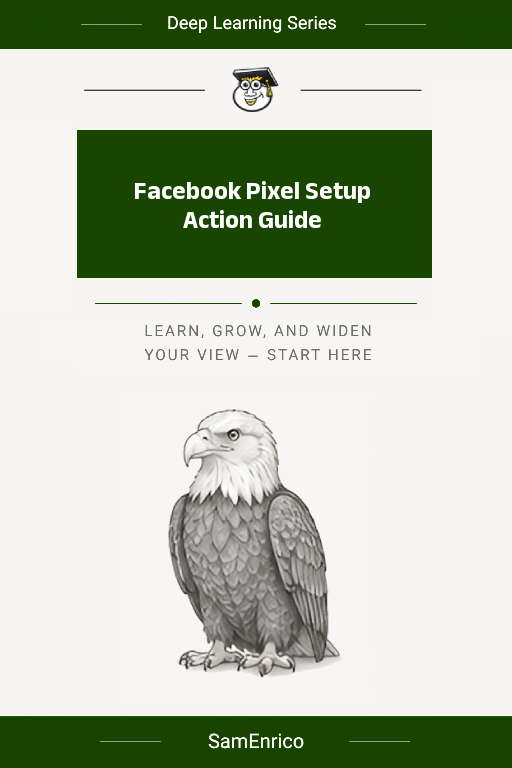 Facebook Pixel Setup Action GuideHouston Bradford$12.99
 Mentor Tracking SpreadsheetBillingsley Fe$12.99
 Mentor Tracking Spreadsheet GuideCalabrese Terisa$12.99
 GST Registration Status TrackGrigsby Simona$12.99
 Mailchimp Link Tracking GuideChambers Sharon$12.99