
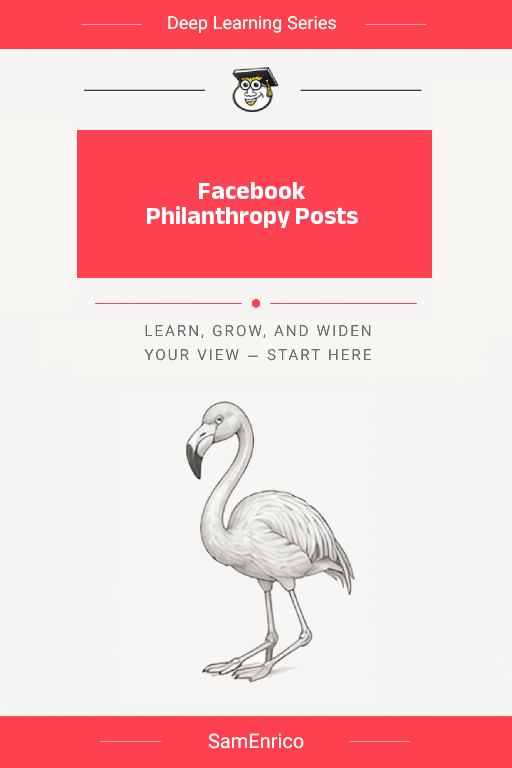
Non-FictionMental WealthPhilanthropy
Facebook Philanthropy Posts eBook
Manage envy from friends' charity posts and giving
Manage envy from friends' charity posts and giving photos. Give meaningfully without performance and measure impact not online recognition.
Formats
Free sample
Chapter 1: The Scroll That Stole Your Soul--You have felt it. That specific, shameful twitch in your chest when a friend’s charity gala photo appears in your feed. The sequined dress. The auction paddle raised high. The caption that reads, “So blessed to give back tonight.” And there you sit, in sweatpants, eating cereal from the box, having donated nothing to anyone in weeks—or so your brain tells you.
In that single second, before reason can intervene, envy floods in. Then guilt. Then a strange, hollow anger. Then you scroll faster, hoping to bury the feeling under a meme or a baby photo.This book exists because that moment happens to nearly everyone, and almost no one talks about it honestly.We have built a world where charitable giving—one of the most intimate, generous, and humane acts a person can perform—has become a competitive spectator sport. The Facebook feed is no longer a place to share news of your life.
It has become a curated museum of moral superiority, where every donation post is a trophy and every viewer is a judge. The result is a quiet epidemic of donor envy, performative generosity, and wasted resources that could have changed lives if only they had been given silently, strategically, and without the need for a single “like.”This chapter will show you why your brain reacts to charity posts as if they were attacks, why “raising awareness” is almost always a lie we tell ourselves, and how to take the first real step toward breaking free. By the end of this chapter, you will have a new framework for understanding every giving post you see—and a clear sense of where you currently stand on the path from performance to purpose.The Psychology of the Scroll Let us begin with a hard truth that no self-help book wants to admit: you are not a bad person for feeling envy when a friend posts about charity. You are a normal person with a normally wired brain that has not yet caught up to the bizarre reality of social media.Social Comparison Theory, developed by psychologist Leon Festinger in 1954, argues that humans determine their own social and personal worth by comparing themselves to others. We do this constantly, automatically, and mostly unconsciously.
In the ancestral environment, this was useful. If your neighbor had more firewood, you needed to know why—and quickly. Comparison drove adaptation.But social media has weaponized this instinct. On Facebook, you are not comparing your actual life to your friend’s actual life. You are comparing your private, messy, ordinary reality—the unpaid bills, the forgotten birthday, the charity check you meant to mail last month—to your friend’s polished, curated, heavily edited highlight reel.
This is not a fair fight. And when the highlight reel includes a photo of your friend holding a giant check in front of a new school building, the comparison becomes devastating.Your brain does not process that photo as altruism. It processes it as a status threat. Evolutionarily, you are wired to notice who is gaining social capital. And a charity post, whether the poster intends it or not, announces to your entire network: “I am a good person.
I have resources to give. I am morally superior to those who are not posting.” This is not an interpretation. This is the hidden subtext of every giving post, and pretending otherwise only deepens the wound.The Awareness Lie Now we arrive at the most common justification for posting about charity: “I’m just raising awareness.” You have said it. I have said it. We have all said it.
And it is almost always a lie—not a malicious lie, but a comforting fiction we tell ourselves to avoid admitting the truth.Let us examine the awareness claim with cold, hard logic. You post a link to a charity on your Facebook wall. Your friends scroll past it. Some percentage—generously, ten percent—pause to read the caption. Of those, a smaller percentage—perhaps one percent—click the link.
Of those, a fraction of one percent actually donate. Meanwhile, your post has accomplished one thing with perfect reliability: it has announced your virtue to your network.The mismatch between intended impact and actual impact is staggering. You believe you are helping a cause. In reality, you are performing virtue for your audience. The cause receives negligible benefit.
Your ego receives a small boost. And your friends, the ones who did not post anything recently, receive a small wound of comparison. Everyone loses except your own reputation.This is not to say that awareness campaigns never work. They can, when executed professionally with targeting, follow-up, and measurable goals. But a casual Facebook post from an individual donor is not an awareness campaign.
It is a status update dressed in altruistic clothing.The Authenticity Spectrum Because this book will return to the same core framework repeatedly, we introduce it now: the Authenticity Spectrum. Every act of giving—every donation, every volunteer hour, every shared link—falls somewhere between two poles.At the left pole lies Performative Giving. This is giving done primarily for social approval, status enhancement, guilt relief, or identity reinforcement. Performative giving asks the question: “What will this make people think of me?” It is measured in likes, comments, shares, and the warm glow of being seen as generous. It is not evil.
It is not useless. But it is shallow, and it is prone to envy, competition, and waste.At the right pole lies Quiet Generosity. This is giving done primarily for impact, for the benefit of the recipient, with no expectation of recognition or return. Quiet generosity asks the question: “What will this actually change for the person I am trying to help?” It is measured in outcomes, QALYs (Quality Adjusted Life Years, which we will explore in Chapter 7), and the quiet satisfaction of a job well done. It is harder.
It offers no immediate dopamine hit. But it endures.Most of us live somewhere in the middle, sliding left or right depending on the day, the cause, and our mood. The goal of this book is not to shame you for being left of center. The goal is to give you the tools to move steadily rightward, toward quiet generosity, without requiring you to become a saint or delete all your social media accounts overnight.One critical rule, however, will govern every chapter that follows. You will see it referenced repeatedly, so remember it now:Public posting about your own giving is always harmful to your psychological health and to charitable efficacy.
Private messaging using Facebook’s infrastructure—sending a specific offer to a specific person or organization—is a neutral tool that can be used for good or ill.This rule resolves the apparent contradiction that plagues many discussions of social media and giving. The problem is not the platform. The problem is the broadcast. When you post publicly, you invite comparison, envy, and performance pressure. When you message privately, you simply communicate.
One is a stage. The other is a mailbox. Learn the difference, and you will save yourself years of psychological distress.The Four…
This is the end of the free sample. Get the eBook to keep going. Buy now
About this book
Details
- Author
- Mcduffie Luetta
- Publisher
- SamEnrico
- Language
- English
- Genre
- Non-Fiction, Mental Wealth, Philanthropy
- Released
- 2026-06-01
- Pages (approx.)
- 142
- Available as
- eBook, Audiobook

Read better in the ZLOADR app
Your eBooks on your phone or tablet. Sign in with your SamEnrico account and start reading.
More by Mcduffie Luetta
 The Air Quality Prevention GuideMcduffie Luetta$11.99
 Burnout Recovery for Social WorkersMcduffie Luetta$11.99
 Black Dahlia Case TimelineMcduffie Luetta$11.99
 Legal Nonverbal GuideMcduffie Luetta$11.99
 The Silent Siege: Helen’s Forgotten WarMcduffie Luetta$11.99
 Operations Team MemberMcduffie Luetta$11.99
 How to Produce BenchesMcduffie Luetta$11.99
 How to Start a Diamond Impregnated Disc and Wheel Business (Beginners Guide)Mcduffie Luetta$11.99
You may also like
 Hong Kong Handover 1997Dunn Johnnie$11.99
 Zumba For Postnatal Recovery CourseNeal Christian$11.99
 Zumba for BeginnersLadner Nikia$11.99
 YouTube Comment Mining GuideHumes Pandora$12.99
 Worry Box MeditationCarlin Rudy$11.99
 Workplace Stress MeditationNguyen Lynn$11.99
 Workplace Stress and Sleep RepairHawley Ivory$11.99
 Workplace Perfectionism CureDelaney Jeffry$11.99
 Workplace Injustice Anger GuideWallen Isabelle$11.99
 Work Addiction and Burnout LinkGreenwood Ester$11.99
 Women in Yoga and WellnessBeattie Galina$11.99
 Women in Stand Up ComedyChun Evangeline$11.99