
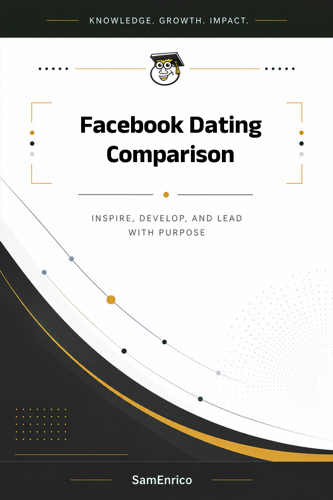
Non-FictionSelf-HelpDatingRelationships
Facebook Dating Comparison eBook
Stop comparing your relationship status to others'
Stop comparing your relationship status to others' posts on Facebook Dating.
Formats
Free sample
Chapter 1: The Curated Lie--–- On a Tuesday evening in November, a thirty-two-year-old marketing director named Sarah did something she would never post on Facebook Dating. She ordered a large pepperoni pizza, ate three slices in bed while crying at a reality TV show, and then spent forty-five minutes scrolling through profiles of people who all seemed to be hiking Machu Picchu, adopting rescue puppies, or laughing at rooftop bars with friends who looked like they stepped out of a J.Crew catalog. Sarah had matched with seven people that week. She had gone on one date that ended after twenty minutes when the man excused himself to the bathroom and never came back. She had sent twelve messages that received either one-word replies or silence.
And yet, every profile she saw told a story of effortless romance, endless adventure, and people who had somehow figured out the secret to love while she was still eating pizza in her pajamas.Sarah is not broken. Sarah is not unloved. Sarah is not failing at dating. Sarah is failing at one thing only: she is comparing her behind-the-scenes reality to everyone else’s curated highlight reel. And that is a losing game for every single person who plays it.This book is not about deleting your dating apps, moving to a cabin in the woods, and swearing off romance forever.
If that were the solution, Sarah would have done it already, and so would you. This book is about something far more practical and far more urgent: learning to see dating profiles for what they actually are, rather than what they pretend to be. Because once you understand the mechanics of the curated lie, you cannot unsee it. And once you cannot unsee it, the comparison trap loses its power over you.The Fundamental Deception of Selective Self-Presentation Every human being who has ever used a dating app has engaged in selective self-presentation. This is not a moral failing.
It is not dishonesty in the traditional sense. It is a psychological universal: we show the world the version of ourselves we want to be, not the version we actually are at 11 PM on a Tuesday with pizza grease on our chin.Selective self-presentation is the process of curating which parts of ourselves we reveal to others. On dating apps, this takes an extreme form because the medium rewards compression. You have six photos and a hundred and sixty characters to convince a stranger that you are worth their time. No one uses that space to say, “I sometimes cry in my car after work” or “I haven’t done laundry in three weeks” or “My last relationship ended because I was too scared to say I love you.” They use that space to say, “I love hiking and tacos and my niece,” because those are safe, likable, and impossible to verify.The problem is not that people curate.
The problem is that you forget they are curating. When you see a profile of a woman laughing at a winery with three friends, your brain does not automatically add the footnote: “This photo was taken after a fight with her sister, during a hangover, and it took twenty-seven attempts to get one where everyone’s eyes were open.” You see the laugh. You see the wine. You see the friends. And you conclude: her life is better than mine.This is the curated lie.
It is not a lie in the sense of fabrication. It is a lie in the sense of omission. And omission is far more dangerous than fabrication because you cannot fact-check what is missing.The Rooftop Bar Illusion: A Case Study in Invisible Context Let us examine a real profile that appeared on Facebook Dating in Austin, Texas, in 2023. A man named David posted four photos. The first showed him holding a fish he had caught.
The second showed him at a concert, arms around two friends. The third showed him on a mountain summit, smiling at sunrise. The fourth showed him with a woman at a wedding, both holding cocktails and laughing.If you compared yourself to David, you might feel inadequate. He seems outdoorsy, social, athletic, and romantically successful. But here is what David’s photos did not show.
The fish photo was taken five years ago. He has not been fishing since. The concert was a work event where he knew no one and spent most of the night checking his phone. The mountain summit was a guided tourist hike where he vomited from altitude sickness immediately after the photo. And the woman at the wedding was his cousin, and the laughter was because he had just spilled red wine on his rental tuxedo.David is not a liar.
David is a normal person who posted his best moments. But if you compared your ordinary Tuesday to David’s greatest hits, you would lose every time. That is not because you are losing at life. That is because you are comparing a feature-length film to a trailer. The trailer always looks more exciting.
That is what trailers are designed to do.The 1% Rule: Mentally Appending the Missing Context The single most practical tool you will learn in this chapter is deceptively simple. Every time you see a profile that triggers envy, you will mentally append five words: “This is just the one percent.”You see a couple celebrating their one-year anniversary. You add: “This is just the one percent.” The other ninety-nine percent of their relationship—the arguments about dishes, the silent car rides, the times they went to bed angry—is invisible to you.You see a profile of someone who just got engaged. You add: “This is just the one percent.” The years of loneliness before that person met their partner, the bad dates, the rejected messages, the nights they cried wondering if they would ever find anyone—all invisible.You see a photo of a perfect beach vacation. You add: “This is just the one percent.” The flight delay, the sunburn, the diarrhea from bad seafood, the argument about directions—invisible.This is not cynicism.
This is statistical literacy. No one posts the mundane, the painful, or the embarrassing. The internet is not a repository of truth. It is a museum of highlights. And you are comparing your unedited reality to a museum.Why Your Brain Falls for This Trap Every Time Evolution did not prepare you for Facebook Dating.
Your brain evolved in small tribes where every piece of social information was relevant and verifiable. If someone in your tribe caught a large fish, you saw them catch it. If someone was sad, you saw their tears. There was no curation. There was no highlight reel.
There was only reality.Dating apps exploit what psychologists call the availability heuristic. This is the mental shortcut where you judge the likelihood of something based on how easily examples come to mind. When you see twenty profiles in a row of happy couples and exciting adventures, your brain concludes that happiness and adventure are everywhere—except in your life. You are not mentally subtracting the millions of people who are not posting because they are lonely, bored…
This is the end of the free sample. Get the eBook to keep going. Buy now
About this book
Details
- Author
- Borden Suzann
- Publisher
- SamEnrico
- Language
- English
- Genre
- Non-Fiction, Self-Help, Dating, Relationships
- Released
- 2026-06-09
- Pages (approx.)
- 134
- Available as
- eBook, Audiobook

Read better in the ZLOADR app
Your eBooks on your phone or tablet. Sign in with your SamEnrico account and start reading.
More by Borden Suzann
 Parenting Partner Self EsteemBorden Suzann$11.99
 Neural Frames Animation GuideBorden Suzann$11.99
 OKRs for Parenthood TransitionBorden Suzann$11.99
 Women Alcohol and the Pressure to DrinkBorden Suzann$11.99
 The Frozen Frontier: Nansen’s Arctic OdysseyBorden Suzann$11.99
 StatisticianBorden Suzann$11.99
 How to Start a Briquette Solid Fuel Production Business (Beginners Guide)Borden Suzann$11.99
 Indoor Air Quality Standard PrimerBorden Suzann$12.99
 Digital Twin Fields GuideBorden Suzann$12.99
 Understanding Ilyina–amoashy–grygory SyndromeBorden Suzann$17.99
You may also like
 Hong Kong Handover 1997Dunn Johnnie$11.99
 Zumba For Postnatal Recovery CourseNeal Christian$11.99
 Zumba for BeginnersLadner Nikia$11.99
 YouTube Comment Mining GuideHumes Pandora$12.99
 Worry Box MeditationCarlin Rudy$11.99
 Workplace Stress MeditationNguyen Lynn$11.99
 Workplace Stress and Sleep RepairHawley Ivory$11.99
 Workplace Perfectionism CureDelaney Jeffry$11.99
 Workplace Injustice Anger GuideWallen Isabelle$11.99
 Work Addiction and Burnout LinkGreenwood Ester$11.99
 Women in Yoga and WellnessBeattie Galina$11.99
 Women in Stand Up ComedyChun Evangeline$11.99