
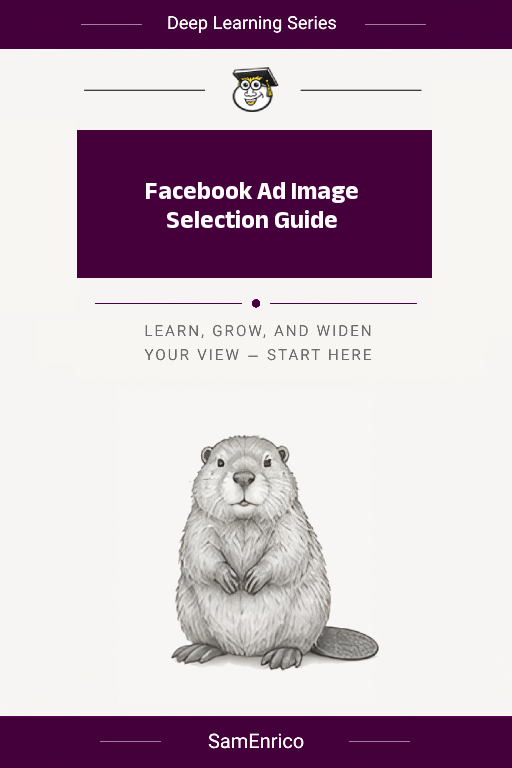
Facebook Ad Image Selection Guide eBook
Choose stock photos or take product shots that per
Choose stock photos or take product shots that perform well.
Formats
Free sample
Chapter 1: The Blink Test--–- You have three seconds. Actually, less. Much less.The average Facebook user, according to internal Meta data from 2024, spends just 1.7 seconds looking at a mobile ad before their thumb decides to scroll or stop. That is not enough time to read a headline. It is barely enough time to register a logo.
It is, however, enough time for the most ancient part of the human brain to make a powerful, irreversible judgment: friend or foe, relevant or irrelevant, worth my attention or worth ignoring forever.This chapter is not about aesthetics. It is not about what looks "pretty" or "professional." This chapter is about survival in the most competitive advertising environment in human history. Every day, Facebook serves approximately 2.6 billion active users more than 15 billion ads. Your image is competing against vacation photos, breakup announcements, newborn baby pictures, breaking news alerts, and viral videos of dogs riding skateboards. Your advertisement is not fighting other ads alone.
It is fighting life itself.And the only weapon that matters in the first 1.7 seconds is your image.I learned this lesson the expensive way. Seven years ago, I spent 47,000ona Facebookcampaignforadirect−to−consumersupplementbrand.Thecopywaswrittenbyaconversioncopywriterwhohadworkedwith Agora.Theofferwasa47,000 on a Facebook campaign for a direct-to-consumer supplement brand. The copy was written by a conversion copywriter who had worked with Agora. The offer was a 47,000ona Facebookcampaignforadirect−to−consumersupplementbrand.Thecopywaswrittenbyaconversioncopywriterwhohadworkedwith Agora.Theofferwasa27 trial with a 60-day money-back guarantee. The targeting was dialed in to a 95% audience match using Lookalike modeling.
Everything was perfect on paper. Everything failed in reality.The images were beautiful. I had hired a professional food and beverage photographer who charged 2,500perday.Sheuseda2,500 per day. She used a 2,500perday.Sheuseda15,000 camera, a full lighting kit, and a studio with seamless white walls. The product shots looked like they belonged in a magazine.
The problem was that magazine aesthetics kill Facebook performance. My elegant, shadowless, perfectly lit supplement bottles achieved a 0.4% click-through rate and a cost per acquisition of $89 — more than triple the product price.I fired the photographer. I fired my assumptions. And I started studying what actually works.What I discovered changed everything I knew about advertising. The highest-converting images on Facebook are rarely the most expensive.
They are rarely the most polished. And they almost never come from a studio. The winning images look like they were taken by a friend on an i Phone. They have shadows, texture, imperfections, and emotional messiness. They pass what I now call the Blink Test.This chapter will teach you the neuroscience of the scroll-stop.
You will learn exactly what happens inside a user's brain during those 1.7 seconds. You will understand why the F-pattern of mobile browsing changes everything about image composition. And you will walk away with a three-second audit checklist that allows you to predict an image's click-through rate before you spend a single dollar on testing.Let us begin with a story about a coffee cup.The Coffee Cup That Changed Everything In 2018, a small coffee subscription company tested two images. Both images promoted the exact same offer: three bags of single-origin beans for $24, shipped free. Both used identical copy: "Wake up better.
Try our sampler box." Both targeted the same audience: people who had visited the website but not purchased.Image A was a professional product shot. A ceramic white mug sat on a polished wooden table. Steam rose gracefully from the coffee. A burlap sack of beans rested beside the mug, artfully wrinkled. The lighting was warm and even.
The composition followed the rule of thirds. A professional food stylist had arranged every element. The image cost $1,200 to produce.Image B was a customer photo. A woman named Sarah had posted it on Instagram with the caption "Monday morning survival mode." The photo showed a chipped blue mug on a cluttered desk. The coffee had spilled slightly onto a stack of sticky notes.
A half-eaten granola bar wrapper sat in the background. The lighting was harsh overhead office fluorescent. The photo was taken on an i Phone 8. It cost zero dollars.Which image won?The ugly one. By a landslide.Image B achieved a 4.7% click-through rate.
Image A achieved 1.2%. Image B's cost per acquisition was 6.30.Image A′swas6.30. Image A's was 6.30.Image A′swas19.40. The ugly, imperfect, real customer photo outperformed the professional studio shot by nearly four times.Why?Because Image B triggered a neurological response that Image A could never trigger: recognition without skepticism.When users saw the professional image, their brains subconsciously said, "This is an advertisement. Someone was paid to make this look perfect.
They are trying to sell me something. Proceed with caution."When users saw the customer photo, their brains said, "This is a real person. This is how coffee actually looks on a Tuesday morning. She is not trying to sell me. She is just living her life.
I trust this."That is the Blink Test in action. The professional image failed the test because it looked too much like an ad. The ugly image passed because it looked like reality.The Neuroscience of 1.7 Seconds To understand why images matter more than copy, you need to understand how the human brain processes visual information versus textual information.The visual cortex processes images at approximately 60,000 times the speed of text processing. This is not an exaggeration. When light hits your retina, signals travel to the thalamus and then directly to the amygdala — the brain's emotional center — in under 100 milliseconds.
By the time your prefrontal cortex (responsible for rational analysis) even wakes up, the amygdala has already decided whether you feel curious, afraid, happy, or indifferent.This means that emotion precedes logic. You feel something about an image before you know what you are feeling. The rational part of your brain then creates a story to explain the emotion. This is why you can look at an image and say "I don't know why, but I like it" without being able to articulate why.For Facebook advertisers, this has a devastating implication: your copy does not matter if your image fails to trigger an emotion in the first 300 to 400 milliseconds.Copy is processed by the prefrontal cortex. That takes time — at least 3 to 5 seconds just to read a short headline.
But by the time the user's rational brain engages, the thumb has already scrolled. The decision to stop or scroll is made before a single word is read.Consider this data from eye-tracking studies conducted by the Nielsen Norman Group. On a mobile Facebook feed, users spend:80% of their time looking at images15% of their time looking at the primary text (the ad copy)5% of their time looking at the link description, the call-to-action button, and the brand name Your image gets 80 cents of every attention dollar you spend. The rest fights over leftovers.This is why the most successful Facebook advertisers think like cinematographers, not copywriters. They storyboard emotions before they write headlines.
They test thumbnail images before they test body text. They know that a mediocre image with brilliant copy will lose every single time to a brilliant image with mediocre copy.The Mobile F-Pattern and the Z-Pattern Desktop browsing and mobile browsing are fundamentally different. On a…
This is the end of the free sample. Get the eBook to keep going. Buy now
About this book
Details
- Author
- Bedford Alejandra
- Publisher
- SamEnrico
- Language
- English
- Genre
- Non-Fiction, First 30 Days
- Released
- 2026-05-26
- Pages (approx.)
- 157
- Available as
- eBook, Audiobook

Read better in the ZLOADR app
Your eBooks on your phone or tablet. Sign in with your SamEnrico account and start reading.
More by Bedford Alejandra
 Data Processing Agreement AI ReviewBedford Alejandra$11.99
 The Koresh FBI Negotiation LogsBedford Alejandra$11.99
 Myths About EmotionsBedford Alejandra$11.99
 Self Esteem for Military TransitionBedford Alejandra$11.99
 Deep Sea Bends PreventionBedford Alejandra$11.99
 The Still Breath MethodBedford Alejandra$11.99
 Social Connection Against BurnoutBedford Alejandra$11.99
 Egyptian HieroglyphsBedford Alejandra$11.99
 Architecture Student PalaceBedford Alejandra$11.99
 The Last Play: How a Legend Fell from GraceBedford Alejandra$11.99
 The Last Light of Icarus: The Rise and Fall of the Space Shuttle ProgramBedford Alejandra$11.99
 Frozen Rivalry: Amundsen vs. Scott – The Ultimate Polar DuelBedford Alejandra$11.99
You may also like
 Hong Kong Handover 1997Dunn Johnnie$11.99
 Zumba For Postnatal Recovery CourseNeal Christian$11.99
 Zumba for BeginnersLadner Nikia$11.99
 YouTube Comment Mining GuideHumes Pandora$12.99
 Worry Box MeditationCarlin Rudy$11.99
 Workplace Stress MeditationNguyen Lynn$11.99
 Workplace Stress and Sleep RepairHawley Ivory$11.99
 Workplace Perfectionism CureDelaney Jeffry$11.99
 Workplace Injustice Anger GuideWallen Isabelle$11.99
 Work Addiction and Burnout LinkGreenwood Ester$11.99
 Women in Yoga and WellnessBeattie Galina$11.99
 Women in Stand Up ComedyChun Evangeline$11.99