
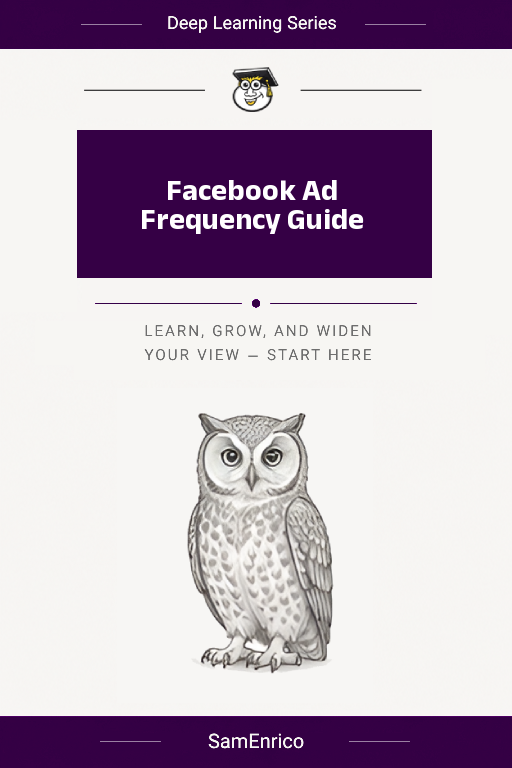
Facebook Ad Frequency Guide eBook
Manages ad frequency in first campaign to prevent
Manages ad frequency in first campaign to prevent ad fatigue and maintain performance over time.
Formats
Free sample
Chapter 1: The Profit Killer--–- Let me tell you about Sarah. She runs a small e-commerce brand selling ergonomic office accessories. In January, she launched a video ad that performed beautifully. For nine days, her return on ad spend sat comfortably at 4.2. Her cost per acquisition was the lowest she had ever seen.
She told her team they had finally cracked the code.On day ten, everything changed.Her cost per acquisition doubled overnight. By day eleven, it had tripled. Her click-through rate, which had been a healthy 2.8 percent, dropped to 1.1 percent. She paused the campaign on day twelve, confused and frustrated. She had changed nothing.
The ad was the same. The audience was the same. The offer was the same. But the results were unrecognizable.Sarah made a classic mistake. She treated her Facebook ad like a set-it-and-forget-it asset.
She assumed that because it worked yesterday, it would work today. She did not know about frequency. She did not know that her best-performing asset was actually a ticking clock.This book exists because of Sarah. And because of the thousands of advertisers just like her who watch their winning campaigns die for what seems like no reason. There is a reason.
The reason is frequency. And once you understand it, you will never lose another campaign to invisible fatigue again.The Hidden Math That Most Advertisers Never See Frequency is a simple equation. Impressions divided by reach equals frequency. If one thousand people see your ad a total of two thousand times, your frequency is two. That seems straightforward.
But here is where the math becomes dangerous.Meta reports an average frequency number. That average can hide catastrophic problems. Imagine you have ten thousand people in your audience. Three thousand of them see your ad five times. Seven thousand of them see your ad once.
Your average frequency is calculated as follows. Total impressions are twenty-two thousand. Three thousand people times five impressions equals fifteen thousand. Seven thousand people times one impression equals seven thousand. Total impressions are twenty-two thousand.
Divide by ten thousand people reached. Your average frequency is 2.2.That looks healthy. That looks like a campaign with room to grow. But three thousand people in your audience have already seen your ad five times. They are fatigued.
They are annoyed. They are starting to ignore you. And because the average looks fine, you never investigate.This is the averaging trap. It is the single most common reason advertisers miss frequency problems until it is too late. By the time the average frequency climbs to four or five, some segments of your audience have seen your ad ten, twelve, or fifteen times.
Those segments are not just fatigued. They have developed negative associations with your brand.The Psychological Breaking Point Meta has conducted extensive research on how many ad impressions actually drive results. Their findings are counterintuitive and essential to understand.Ad recall plateaus at approximately one impression per week. After a person has seen your ad once in a seven-day period, their ability to remember your brand does not significantly increase with additional exposures. That first impression does the heavy lifting for memory.
Every impression after that is diminishing returns for recall.Purchase intent behaves differently, but only up to a point. For products under one hundred dollars—the vast majority of e-commerce purchases—purchase intent continues climbing past one impression. It peaks at approximately one point five impressions per week. Beyond that, additional exposures add very little to a person's likelihood of buying.Let me restate that because it is so important. After someone has seen your ad once or twice in a week, showing it to them a third, fourth, or fifth time produces almost no additional purchase intent.
You are spending money for no return. Worse, you are actively annoying people who might have bought from you if you had left them alone.This research comes from Meta's own internal studies. They are not hiding this information. But most advertisers never look for it. They assume that more impressions mean more sales.
They assume that if an ad is working, they should pour more budget into it. They assume that frequency will take care of itself.These assumptions are expensive.The Data That Will Change How You Spend Ad Espresso conducted a comprehensive analysis of thousands of Facebook ad campaigns. They looked at what happens to key metrics as frequency increases. The results should be printed on the wall of every media buyer's office.When frequency exceeds four impressions per week, click-through rate drops by approximately twenty-three percent. That is nearly one in four clicks disappearing.
At the same time, cost per click rises by sixty-eight percent. You are paying more than two-thirds higher for each click, and those clicks are coming from people who are increasingly annoyed with your brand.When frequency reaches nine impressions per week, the situation becomes catastrophic. Click-through rate has fallen by nearly fifty percent. Cost per click has more than doubled, rising by one hundred sixty-one percent. Your ad is now twice as expensive and half as effective as it was at frequency one.Let me put these numbers in practical terms.
Imagine you have a campaign that generates one hundred clicks per day at one dollar per click. Your daily cost is one hundred dollars. At frequency four, your click-through rate drops by twenty-three percent. You now get seventy-seven clicks per day. But your cost per click has risen to one dollar and sixty-eight cents.
Your daily cost for those seventy-seven clicks is now approximately one hundred twenty-nine dollars. You are paying twenty-nine percent more for twenty-three percent fewer clicks.At frequency nine, you are paying two dollars and sixty-one cents per click. Your click volume has dropped to approximately fifty-one clicks per day. Your daily cost is approximately one hundred thirty-three dollars. You are paying thirty-three percent more for half the clicks you used to get.This is not a hypothetical.
This happens to advertisers every single day. It happens to Sarah with her ergonomic office accessories. It happens to six-figure brands and six-figure agencies. It happens because no one taught them about frequency.Why Most Books Get This Wrong I have read dozens of Facebook advertising books. The best of them are genuinely useful.
They teach targeting strategies. They teach creative frameworks. They teach budget management. But almost all of them treat frequency as an afterthought.A typical book will mention frequency in a single paragraph. It will say something like "monitor your frequency and pause ads when it gets too high." That is technically correct but practically useless.
It tells you what to do after damage has already started. It does not tell you how to build campaigns that never hit frequency problems in the first place.This book inverts that approach entirely. Frequency management belongs in campaign setup. It belongs in audience selection. It belongs in creative strategy.
It belongs in budget allocation. It is not something you check after performance tanks. It is something you design for from day one.The difference between reactive frequency management and proactive frequency management is the difference between fighting fires and building with fire-resistant materials. One is…
This is the end of the free sample. Get the eBook to keep going. Buy now
About this book
Details
- Author
- Mccall Kindra
- Publisher
- SamEnrico
- Language
- English
- Genre
- Non-Fiction, First 30 Days, Frequency
- Released
- 2026-05-30
- Pages (approx.)
- 132
- Available as
- eBook, Audiobook

Read better in the ZLOADR app
Your eBooks on your phone or tablet. Sign in with your SamEnrico account and start reading.
More by Mccall Kindra
 Influencer Reality CheckMccall Kindra$11.99
 Stress Appetite ChangesMccall Kindra$11.99
 Fish Consumption Longevity GuideMccall Kindra$11.99
 The Performance Review EngagementMccall Kindra$11.99
 Kegel Exercise Technique GuideMccall Kindra$11.99
 Glitch Protocol: The Last Broadcast of Radio Free 1999Mccall Kindra$11.99
 The Breeder's Guide to Beltsville Small White TurkeysMccall Kindra$11.99
 Impact Pitch Practice GuideMccall Kindra$12.99
 How to Start a Beakers Made of Paper Business (Beginners Guide)Mccall Kindra$11.99
 Chaplain ResidentMccall Kindra$11.99