
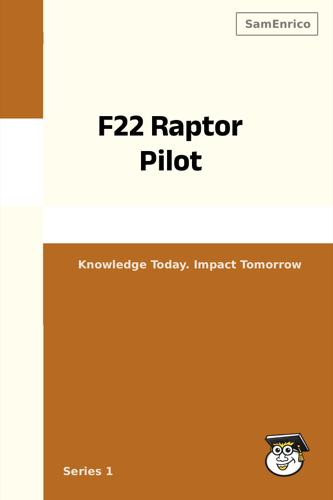
Free sample
Chapter 1: The Ghost Program...--The rain was falling sideways over the Potomac, driven by a November gale that had grounded every other aircraft within two hundred miles. But inside a windowless conference room on the fourth floor of the Pentagon's C-Ring, the weather was irrelevant. The men gathered around the scarred mahogany table—five generals, three civilian defense analysts, and one quietly anxious colonel from Air Force Intelligence—were not there to discuss the forecast. They were there to confront a number that had kept them awake for six months.The number was classified Top Secret/Sensitive Compartmented Information. It had no name, only a designation: T-382.
And it suggested that the United States Air Force, the most dominant aerial fighting force in human history, was about to lose its crown.The intelligence colonel, a thin man named David Ashby who had spent the last fourteen years of his life studying Soviet aviation, placed a grainy photograph on the table. It showed a delta-winged fighter parked on a tarmac in Ramenskoye, a testing facility southeast of Moscow. The aircraft was obscured by a canvas tarp, but the shape was unmistakable. The nose was sharp, the intakes rectangular, the horizontal stabilizers canted outward at an aggressive angle."We call it the Su-27," Ashby said, his voice flat. "Flanker, according to their internal designation.
First flight was May 20th of this year—1977. We missed it because our agents were focused on their bomber fleet." He paused. "We won't miss it again."One of the generals, a heavy-set man with a chest full of ribbons from Vietnam, pushed the photograph back across the table. "It's another Mi G-25. Big, fast, and stupid.
We've seen these before."Ashby shook his head. "General, the Mi G-25 was a stainless steel interceptor built to catch the XB-70 Valkyrie and the SR-71. It has no look-down/shoot-down radar. It cannot track a low-flying F-15. This is different.
The Flanker has a pulse-Doppler radar, infrared search and track, and a maneuverability profile that our analysts are calling 'unprecedented.'" He slid another photograph across the table. "And this is the Mi G-29. Fulcrum. Lightweight fighter. Same radar technology.
Helmet-mounted sight. It can fire an Archer missile at a ninety-degree angle off its nose."The room went silent. The helmet-mounted sight was not a new concept—the Americans had experimented with it in the 1960s—but the idea that the Soviets had operationalized it, that a Mi G pilot could simply turn his head, lock a target, and kill without ever maneuvering into a traditional firing position, was a nightmare dressed in titanium.The general who had spoken earlier, whose name was Morrison and whose command included the Tactical Air Command's entire F-15 fleet, picked up the photograph of the Su-27 and held it to the fluorescent light. "You're telling me that the jet we designed to kill every fighter in the sky is obsolete before it even reaches squadron service?"Ashby did not blink. "I'm telling you that the gap is closing, sir.
Faster than we predicted. And if we don't start designing the next generation now, we will lose air superiority over the Central Front by 1985."That meeting, which would be declassified only thirty-two years later, marked the official birth of the program that would eventually become the F-22 Raptor. But in 1977, it had no name. It had no budget. It had no congressional champions or prime contractors or patriotic news articles.
It was a whispered conversation in a locked room, a single line in a classified annex to the Defense Planning Guidance, and a question that no one wanted to ask aloud: What happens when the world catches up?The Fighter Mafia and the Eagle's Arrogance To understand the F-22, you must first understand the F-15—not as a machine, but as a philosophy. The Mc Donnell Douglas F-15 Eagle emerged from the ashes of the Vietnam War, a conflict that had humiliated American air power in ways that the Air Force still struggles to acknowledge. Between 1965 and 1968, the kill ratio of the F-4 Phantom II against North Vietnamese Mi G-17s and Mi G-21s hovered around 2.5 to 1. Against the Mi G-21 alone, it fell to 1.4 to 1. For every American fighter shot down, the Air Force could claim barely more than one Mi G in return.
This was not dominance. This was a bar fight.The post-Vietnam analysis produced a document that became scripture: the "Fighter Mafia's" manifesto, informally known as the Boyd Doctrine. Colonel John Boyd, a fighter pilot turned tactical theorist, had spent the late 1960s developing the Energy-Maneuverability (E-M) theory, which argued that aerial combat was not about top speed or climb rate but about specific excess power—the ability to accelerate, turn, and regain energy faster than the opponent. Boyd's acolytes, a loose collection of maverick officers and civilian analysts, pushed for a fighter designed around maneuverability above all else. The result was the F-16 Fighting Falcon, a lightweight, agile dogfighter that felt more like a sports car than a weapons platform.But the F-15 took a different path.
The Eagle was designed not for turning fights but for energy retention and radar dominance. It was big, powerful, and expensive. Its AN/APG-63 radar could detect a fighter-sized target at over a hundred miles. Its two Pratt & Whitney F100 engines produced nearly fifty thousand pounds of thrust combined. It could accelerate in a vertical climb, something no fighter had ever done.
And it carried eight air-to-air missiles, four more than the F-4.When the F-15 entered service in 1976, the Air Force believed it had built the perfect fighter. The mantra, repeated in countless briefings and press releases, became gospel: "Not a pound for air-to-ground." The F-15 would never carry bombs. It would never strafe tanks. It would only kill other fighters, and it would do so from beyond visual range, using its radar and missiles to destroy enemies before they ever saw the Eagle.The arrogance was not unfounded. In the 1977 test program, an F-15 achieved a 1.9 to 1 thrust-to-weight ratio at combat weight—meaning it could accelerate straight up.
No Soviet fighter in existence could match that. The Su-27, still in development, was heavier and less powerful. The Mi G-29, for all its agility, carried limited fuel and primitive avionics. The United States had not just a lead; it had a chasm.But chasms can be closed. And in the Soviet Union, in the closed city of Zhukovsky and the testing grounds of Akhtubinsk, engineers were working furiously to bridge that distance.
They knew about Boyd's theories. They had studied the F-15's specifications from leaked intelligence reports. And they had concluded that the American approach—relying on radar and missiles for beyond-visual-range kills—had a fatal flaw. Radar could be jammed. Missiles could be outmaneuvered.
But a helmet-mounted sight and a high-off-boresight missile could kill at any angle, turning the merge from a transition point into a firing solution.The Americans, by contrast, had abandoned helmet-mounted sight technology in the 1970s, citing technical difficulties and cost overruns. They believed that beyond-visual-range engagement was the future. The Soviets believed that the merge was inevitable and that whoever won the close-in fight would…
This is the end of the free sample. Get the eBook to keep going. Buy now
About this book
Details
- Author
- Tomlin Chadwick
- Publisher
- SamEnrico
- Language
- English
- Genre
- Non-Fiction, Biography / Fighter
- Released
- 2026-06-08
- Pages (approx.)
- 155
- Available as
- eBook, Audiobook

Read better in the ZLOADR app
Your eBooks on your phone or tablet. Sign in with your SamEnrico account and start reading.
More by Tomlin Chadwick
 Assertive Request Making GuideTomlin Chadwick$11.99
 Major Depressive Disorder HandbookTomlin Chadwick$11.99
 Stage Parent Psychological TollTomlin Chadwick$11.99
 DoorDash Fast Pay Setup GuideTomlin Chadwick$11.99
 Citation Rules for Theses and DissertationsTomlin Chadwick$11.99
 UK VAT Registration for Farmers and Agricultural Businesses CourseTomlin Chadwick$11.99
 Mentorship For BalanceTomlin Chadwick$11.99Mentorship For BalanceTomlin Chadwick$11.99
 Resentment In FriendshipTomlin Chadwick$11.99
 The Scorpion King's Gambit: Tuthmosis III and the Battle of MegiddoTomlin Chadwick$11.99
 The Crown and the Crisis: How Queen Elizabeth II Navigated BrexitTomlin Chadwick$11.99
 The Synth Underworld: How a Secret Lab in Shanghai Changed the WorldTomlin Chadwick$11.99
You may also like
 Hong Kong Handover 1997Dunn Johnnie$11.99
 Zumba For Postnatal Recovery CourseNeal Christian$11.99
 Zumba for BeginnersLadner Nikia$11.99
 YouTube Comment Mining GuideHumes Pandora$12.99
 Worry Box MeditationCarlin Rudy$11.99
 Workplace Stress MeditationNguyen Lynn$11.99
 Workplace Stress and Sleep RepairHawley Ivory$11.99
 Workplace Perfectionism CureDelaney Jeffry$11.99
 Workplace Injustice Anger GuideWallen Isabelle$11.99
 Work Addiction and Burnout LinkGreenwood Ester$11.99
 Women in Yoga and WellnessBeattie Galina$11.99
 Women in Stand Up ComedyChun Evangeline$11.99