
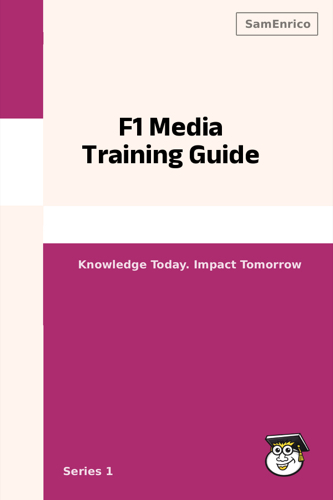
F1 Media Training Guide eBook
Handle post race interviews with diplomacy.
Handle post race interviews with diplomacy.
Formats
Free sample
Chapter 1: The Unspoken Reality...–- The checkered flag waves. You’ve just spent ninety minutes wrestling a machine that wants to kill you, endured 5G forces in every direction, and lost three kilograms of water weight. Your heart is hammering at 180 beats per minute. Your ears are still ringing from the engine note. And before you can take a breath, a journalist shoves a microphone into your face while a cameraman frames your sweat-streaked, helmet-haired, red-eyed expression for a live global broadcast of 70 million people.
Welcome to the post-race pen. This is where careers are made, contracts are broken, and championships are lost—not on the track, but between your own teeth.The 60-Second Career Audit Every post-race interview is, in reality, a compressed performance review. You have approximately sixty seconds to accomplish three impossible things simultaneously: process what just happened, translate that experience into coherent language, and manage the perceptions of three distinctly hostile audiences. The team principal watching from the garage wants to know if you’re a reliable asset or a loose cannon. The millions of fans watching at home are deciding whether to buy your cap, follow your social media, or dismiss you as another entitled driver.
And the FIA stewards, listening from race control, are waiting to hear if you’ll incriminate yourself or someone else before they issue penalties.Consider what you’re up against physiologically. At rest, your heart rate sits around 60 to 80 beats per minute. During a Formula 1 race, it averages 160 to 170, spiking to 190 under overtaking or defending. At those levels, your prefrontal cortex—the part of your brain responsible for impulse control, strategic thinking, and language filtering—is partially offline. Your body is flooding with cortisol and adrenaline, hormones designed for fight or flight, not for diplomatic nuance.
Your core temperature has risen to 39 or 40 degrees Celsius, inducing cognitive fog similar to mild hypothermia. You haven’t drunk anything substantial in two hours. Your hands are trembling from the steering wheel vibration. And someone is asking you, live on air, “How do you feel right now?”The honest answer—exhausted, disoriented, euphoric, devastated, or furious—is almost always the wrong one to give.This chapter is not about teaching you to lie. It is about teaching you to recognize that the post-race interview is not a conversation.
It is a transaction. And like any transaction, it has rules, leverage points, and consequences. The drivers who fail to understand this wash out of Formula 1 not because they’re slow, but because they’re radioactive. The drivers who master it extend their careers by years, secure better contracts, and walk into broadcasting or ambassadorial roles the moment they retire.The Three Audiences Theory Let me introduce you to the most important framework you will ever learn about media diplomacy. I call it the Three Audiences Theory, and it has saved more driving careers than any driving coach ever has.Audience One: The Team Principal The first audience is the person who decides whether you keep your seat.
They are watching your interview not for entertainment but for intelligence. They are asking themselves four specific questions:Does this driver protect the team or blame the team?Does this driver understand their role within the organization?Is this driver emotionally volatile enough to become a liability?Would I put this driver in front of a title sponsor?Every word you say is being evaluated against these four questions. When you say “the car was undriveable,” the team principal hears “this driver will publicly humiliate the engineering department.” When you say “the team made the wrong call on strategy,” the team principal hears “this driver will air internal disagreements to the press.” When you say “I’m just disappointed,” the team principal hears “this driver is coachable.” The difference between a career-ending statement and a career-extending one is often a single adjective.Consider the case of two drivers from the same generation. Driver A routinely blamed his engineers for car performance, criticized pit wall decisions in post-race interviews, and used phrases like “they need to give me a better car.” He was undeniably fast. He won races.
He also went through three teams in five years, each one citing “cultural fit” or “professionalism” in the parting statement. Driver B drove the same cars, suffered the same reliability failures, and faced the same strategic blunders. But when the microphone arrived, Driver B said “we struggled with balance today” and “we’ll analyze the strategy call internally.” He wasn’t lying. He was just distributing accountability across the collective pronoun. He stayed with his team for eight years and retired as a beloved figure.The team principal is not looking for a driver who never makes mistakes.
They are looking for a driver who makes mistakes and then says “we” instead of “they.” That is the entire secret.Audience Two: The Global Fanbase The second audience is the one that buys merchandise, clicks links, and generates the revenue that pays your salary. But do not mistake their affection for unconditional support. Formula 1 fans are among the most technically sophisticated sports audiences in the world. They watch practice sessions. They analyze telemetry.
They read technical regulations for fun. They know when you’re lying, and they despise condescension.However, they also value loyalty, humility, and visible effort. A driver who crashes but immediately says “that was my error, I pushed too hard, I’ll learn from it” gains more fan respect than a driver who wins and says “I’m the greatest.” Fans forgive mistakes. They do not forgive arrogance or excuse-making.The modern fan also has a very short memory for details but an extremely long memory for patterns. One bad interview won’t ruin you.
A pattern of bad interviews—always blaming others, never admitting fault, speaking in flat monotones, or exploding with rage—will cement a reputation that no amount of on-track success can erase. Look at the drivers who remain popular years after retirement. They’re not necessarily the ones with the most championships. They’re the ones who spoke with genuine personality, who showed vulnerability, who thanked their mechanics by name, who treated the media pen as an opportunity rather than an interrogation.Here is a counterintuitive truth: the fans do not need you to be happy about a bad result. They need you to be human about it.
If you finish fourth and say “I’m devastated, but we’ll come back stronger,” they will empathize. If you finish fourth and say “it’s fine, it’s only fourth,” they will assume you don’t care. If you finish fourth and say nothing, they will assume you’re sulking. The emotion itself is not the problem. The problem is emotion without direction, or emotion that points outward in blame rather than inward in accountability.Audience Three: The FIA Stewards The third audience is the one most drivers forget exists until the penalty announcement appears.
The stewards are listening to every post-race interview, particularly after incidents. They are not evaluating your emotional state. They are listening for admissions of fault, for descriptions that contradict video evidence, and for language that suggests intent rather than…
This is the end of the free sample. Get the eBook to keep going. Buy now
About this book
Details
- Author
- Stapleton Eufemia
- Publisher
- SamEnrico
- Language
- English
- Genre
- Non-Fiction, Biography, Media
- Released
- 2026-06-11
- Pages (approx.)
- 137
- Available as
- eBook, Audiobook

Read better in the ZLOADR app
Your eBooks on your phone or tablet. Sign in with your SamEnrico account and start reading.
More by Stapleton Eufemia
 The Anxious Partner's GuideStapleton Eufemia$11.99
 Johnny Cash Ring of Fire LifeStapleton Eufemia$11.99
 DBT For Workplace EmotionStapleton Eufemia$11.99
 Slum Based Therapy DeliveryStapleton Eufemia$11.99
 Eleanor Roosevelt BiographyStapleton Eufemia$11.99
 Calming Anger Before SpeakingStapleton Eufemia$11.99
 Alcohol Withdrawal TimelineStapleton Eufemia$11.99
 The Poisoned Pen: The Strange Case of Graham Young and the St. Albans PoisoningsStapleton Eufemia$11.99
 Stonewall Jackson: The Mystic General Who Shaped the ConfederacyStapleton Eufemia$11.99
 Understanding Cerebral GigantismStapleton Eufemia$11.99
 How to Produce Shooting TargetsStapleton Eufemia$11.99
 Business Line of Credit GuideStapleton Eufemia$12.99
You may also like
 Hong Kong Handover 1997Dunn Johnnie$11.99
 Zumba For Postnatal Recovery CourseNeal Christian$11.99
 Zumba for BeginnersLadner Nikia$11.99
 YouTube Comment Mining GuideHumes Pandora$12.99
 Worry Box MeditationCarlin Rudy$11.99
 Workplace Stress MeditationNguyen Lynn$11.99
 Workplace Stress and Sleep RepairHawley Ivory$11.99
 Workplace Perfectionism CureDelaney Jeffry$11.99
 Workplace Injustice Anger GuideWallen Isabelle$11.99
 Work Addiction and Burnout LinkGreenwood Ester$11.99
 Women in Yoga and WellnessBeattie Galina$11.99
 Women in Stand Up ComedyChun Evangeline$11.99