
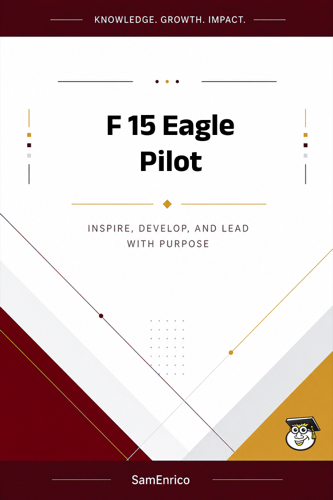
F 15 Eagle Pilot eBook
Fly the air superiority fighter with one hundred f
Fly the air superiority fighter with one hundred four to zero record.
Formats
Free sample
Chapter 1: The Phantom’s Reckoning--The first F-4 Phantom crews who strapped into their fighters over North Vietnam in 1965 believed they were untouchable. They piloted the most advanced combat aircraft ever built—a two-seat, twin-engine supersonic interceptor that could carry more bombs than a World War II B-17, climb faster than any fighter before it, and engage enemy aircraft with radar-guided missiles from distances the Mi Gs couldn’t even dream of matching. The Air Force had sold them a vision of modern aerial warfare: the dogfight was dead, the gun was obsolete, and future battles would be decided by glowing dots on radar scopes and the silent launch of heat-seekers from beyond visual range. This was the age of push-button warfare, where technology would replace skill, and where American engineering would render enemy pilots irrelevant before they ever caught sight of their attackers. The Phantom, with its twin tails and drooping nose, looked like the future.
And for a brief, intoxicating moment, the men who flew it believed that the future had finally arrived.By 1967, that vision lay in ruins over the jungles of North Vietnam.The same F-4 that was supposed to dominate Soviet-built Mi Gs instead found itself outmaneuvered, out-climbed, and often outgunned. American pilots, trained to trust their missiles, discovered that the AIM-7 Sparrow and AIM-9 Sidewinder failed at an alarming rate in the humid, high-G environment of close combat. Missiles launched from a Phantom had less than a ten percent chance of hitting a maneuvering target. When the missiles missed—and they missed constantly—the F-4 pilot was left with no gun, no backup, and an angry Mi G-17 or Mi G-21 closing fast. The enemy pilot, often flying a fighter designed in the 1940s and built in a factory without air conditioning, would slide into a low-speed turning fight where the Phantom’s size and weight became fatal liabilities.
He would pull lead, squeeze the trigger on his 23-millimeter cannon, and watch American technology explode against an American sky.The kill ratio told the story no one in the Pentagon wanted to hear. During the Korean War, American F-86 Sabres had dominated Soviet Mi G-15s at a ratio of nearly ten to one. Over Vietnam, the F-4 Phantom—for all its speed, power, and technological sophistication—managed barely a two-to-one kill ratio against Mi G-17s, Mi G-19s, and Mi G-21s. In some months of 1968, the ratio dipped below one-to-one. American pilots were losing to an enemy flying aircraft that had been obsolete before most of them had graduated high school.
The unthinkable had become routine. The most powerful air force in the world was being humiliated by a third-rate power flying castoffs from Soviet warehouses. Something had gone terribly wrong, and the men who would design the F-15 Eagle were already taking notes.The False Prophet: How the Missile Era Failed To understand the birth of the F-15 Eagle, you must first understand why the fighter aircraft that preceded it—the F-4 Phantom—failed in its primary mission. And to understand that failure, you must go back to the strange, hubristic years of the early 1960s, when American defense planners convinced themselves that the traditional dogfight was a relic of a slower, more primitive age. They had studied the aerial battles of World War II and Korea, but they had drawn the wrong conclusions.
Instead of learning that guns, maneuverability, and pilot skill were eternal truths of air combat, they convinced themselves that technology had finally surpassed the need for such brutish tactics. The future, they believed, belonged to missiles and computers. The past belonged to aces and gunfighters.The doctrine was called "beyond visual range" engagement, or BVR. The theory was elegant: future air combat would occur at such high speeds and altitudes that pilots would never see their opponents. Instead, ground-controlled intercept radars or airborne warning aircraft would vector fighters into position.
The fighter’s own radar would lock onto the enemy from twenty or thirty miles away. A squeeze of the trigger would send a radar-guided Sparrow missile streaking toward a blip on a screen. The enemy would explode before his pilot even knew an American was in the area. No guns. No turning fights.
No risk. It was warfare reduced to a video game, and the Air Force invested billions in making it real.The F-4 Phantom was the embodiment of this vision. It was designed without an internal cannon—a decision that would later be called the most catastrophic oversight in modern fighter design. The theory was that missiles would make guns unnecessary. Why carry a primitive projectile weapon when you had computerized death from afar?
The Phantom carried up to eight missiles, four Sparrow radar-guided missiles and four Sidewinder heat-seekers. Its radar could track multiple targets at once. Its engines could push it past Mach 2. On paper, it was invincible. On paper, the dogfight was dead.Vietnam exposed the lie in brutal, bloody detail.The Sparrow missile required the launching aircraft to maintain a continuous radar lock on the target after launch—a nearly impossible task when both aircraft were pulling six or seven Gs in opposite directions.
The Phantom’s radar, for all its power, was easily confused by ground clutter, by chaff, by the simple act of the target turning hard. When the radar lost lock, the Sparrow lost guidance. It would fly straight, or tumble, or simply disappear into the haze while the Mi G pilot laughed and pulled his fighter into a tighter turn. The Sidewinder heat-seeker was more reliable but could be fooled by the sun, by flares, or simply by losing track of a hot engine against a hot jungle backdrop. The North Vietnamese learned to fly low, where the heat of the earth masked their engines.
They learned to turn toward the sun, blinding the Sidewinder’s seeker head. They learned that American missiles, for all their advertised sophistication, had the attention span of frightened children.When the missiles missed—and they missed constantly—the Phantom pilot had no fallback. He could not close to gun range because he had no gun. He could only run, or turn, and pray. But turning was dangerous: the Phantom bled energy at an alarming rate in sustained turns, dropping airspeed and altitude while the lighter Mi G tightened its circle.
Running was worse: the Mi G-21 could accelerate faster at low altitudes, and the Phantom could not outrun a missile it couldn’t see. So the Phantom pilot did the only thing left to him. He called for help on the radio and hoped his wingman had better luck.The North Vietnamese Mi G pilots learned the Phantom’s weaknesses quickly. They discovered that if they could survive the first missile pass—and they usually could—they could close to within a few thousand feet of the F-4, where American missiles refused to track, and then unleash their own 23-millimeter cannons. The cannon was a simple weapon, older than most of the pilots firing it.
It had no microchips, no guidance logic, no electronic countermeasures. It was a metal tube with an explosive shell and a firing pin. But it worked…
This is the end of the free sample. Get the eBook to keep going. Buy now
About this book
Details
- Author
- Chamberlain Sharron
- Publisher
- SamEnrico
- Language
- English
- Genre
- Non-Fiction, Biography, Air Superiority
- Released
- 2026-06-09
- Pages (approx.)
- 150
- Available as
- eBook, Audiobook

Read better in the ZLOADR app
Your eBooks on your phone or tablet. Sign in with your SamEnrico account and start reading.
More by Chamberlain Sharron
 Film Noir Improv StyleChamberlain Sharron$11.99
 Light Tunnel Relaxation GuideChamberlain Sharron$11.99
 Stroke Emotional BluntingChamberlain Sharron$11.99
 Music Memorization for PerformersChamberlain Sharron$11.99
 Menopause And Urinary HealthChamberlain Sharron$11.99
 Fear of Failure JournalChamberlain Sharron$11.99
 Difficult Conversation MistakesChamberlain Sharron$11.99
 The Siege of the USS Boxer: The Forgotten Carrier Hostage Crisis of 1898Chamberlain Sharron$11.99
 The Blacksmith’s Curse: How the Katana Forged a Nation’s Soul (1336 AD)Chamberlain Sharron$11.99
 Service Providers Guide to CartoonistsChamberlain Sharron$11.99
 A Collector's Handbook to the Lincoln Kv12Chamberlain Sharron$11.99
 How to Produce Vehicle License PlatesChamberlain Sharron$11.99