
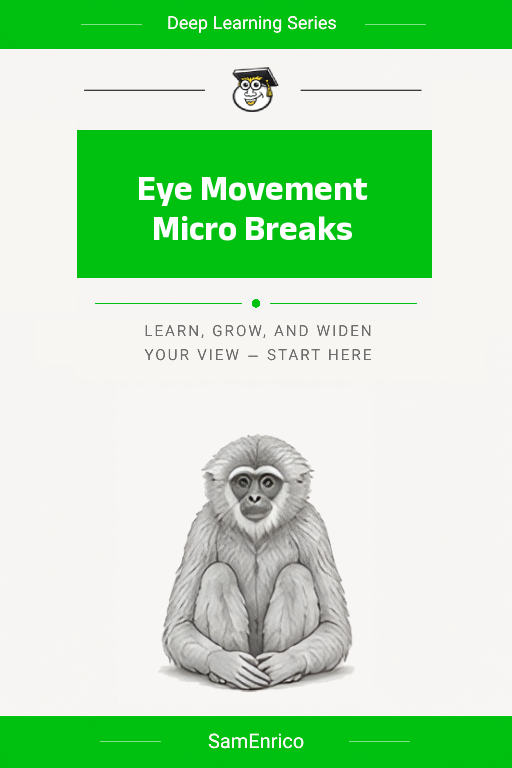
Eye Movement Micro Breaks eBook
Uses horizontal, vertical, and saccadic eye moveme
Uses horizontal, vertical, and saccadic eye movements as micro-breaks to reduce amygdala activation and calm the nervous system.
Formats
Free sample
Chapter 1: The Frozen Gaze--You are reading this sentence right now, and in doing so, your eyes have stopped moving.That single fact—the stillness of your gaze at this very moment—is the most important piece of information about your nervous system that no one has ever told you. Your eyes have been fixed on this page for several seconds. Your extraocular muscles—six tiny but powerful muscles attached to each eyeball—are contracted in a sustained hold. Your brain has interpreted this lack of movement as a signal: We are locked onto a target. Assess for threat.
Do not relax.This is not a design flaw. It is an evolutionary relic that is actively destroying your calm.The Invention You Were Never Supposed to Have Let us go back approximately 300,000 years. Your ancestor stands on the African savanna. Their eyes move constantly—scanning the horizon for predators, tracking the flight of a bird, following the movement of prey, glancing down at the berries in their hand. The eyes never stop moving because the environment never stops moving.
Every shift of gaze tells the brain: We are safe. We are gathering information. We are in control.Now come forward to the present moment. You sit in front of a rectangle of light for nine hours a day. Your eyes fixate on a single plane.
The words move, but your gaze does not. Your extraocular muscles begin to fatigue. They stop making the tiny, unconscious micro-movements—called micro-saccades—that occur approximately three times per second in a healthy visual system. Instead, they lock.This is Visual Fixation Lock. It is a term you have never heard because I invented it to name an epidemic that has no other name.
But the experience is unmistakable: the feeling of being unable to look away from a screen even when you want to. The tension behind your eyes after a long day of virtual meetings. The strange sensation that your field of vision has narrowed, as if you are looking at the world through a tube.Visual Fixation Lock is not eye strain. It is not dry eyes. It is a neurological state in which your oculomotor system has stopped doing its primary job: moving.And your amygdala has noticed.The Amygdala's Secret Surveillance System To understand why frozen eyes create a frozen nervous system, you need to meet a small, almond-shaped cluster of nuclei deep in your temporal lobe.
The amygdala has one job: threat detection. It does not think. It does not reason. It does not care about your deadlines, your relationships, or your desire to be productive. It scans the environment 24 hours a day for one signal only: Is there danger?The amygdala receives information through multiple channels.
Sound. Smell. Touch. But the fastest channel—the one with the shortest neural wiring and the highest priority—is vision. Visual information reaches the amygdala in approximately 50 milliseconds, which is 10 times faster than it takes for the same information to reach your conscious awareness in the prefrontal cortex.This means your amygdala knows whether you are safe or threatened before you know.And the primary data point your amygdala uses to make this assessment is eye movement.Here is the evolutionary logic that will change everything you thought you knew about anxiety.
A predator locks its gaze on prey. The eyes of a hunter are fixed, focused, unmoving. A prey animal, by contrast, has wide, rapidly shifting eyes that scan the environment from every angle. Your ancient nervous system learned a simple rule: Still eyes mean threat. Moving eyes mean safety.When you stare at a screen for hours, your eyes become still.
Not because you are hunting, but because you are reading. Your amygdala does not know the difference. It receives the signal—eyes locked, no movement—and activates the sympathetic nervous system. Your heart rate increases. Your breathing becomes shallow.
Cortisol begins to seep into your bloodstream.You are not anxious about anything specific. You are anxious because your eyes have stopped moving.The Microstress Paradox This would be bad enough on its own. But modern work has added another layer: the relentless accumulation of tiny, individually insignificant stressors that neuroscientists now call microstress.Let me define this term precisely because it is central to everything that follows. A microstress is an event that raises your arousal level for less than 60 seconds and does not, by itself, trigger a full fight-or-flight response. Examples include: a notification sound while you are focused, an email that requires a decision you do not want to make, a colleague who interrupts your flow, a Slack message phrased in a way that could be interpreted as criticism, a deadline that moved up by one day, a typo you did not catch before sending.Each of these events is trivial.
Your nervous system processes it and returns to baseline—or so you believe.Here is the paradox. Microstresses do not require recovery time individually. But when they arrive every few minutes, as they do in a typical knowledge work day, your nervous system never fully returns to baseline between events. The peaks of arousal stack on top of each other. The valleys become shallower.
Your resting heart rate creeps up by five beats per minute. Your baseline cortisol rises by 15 percent. You are not having a panic attack. You are not even particularly anxious. But you are no longer calm.You are in a state of low-grade, chronic sympathetic activation.
And you have no idea it is happening because it has become your normal.Now combine microstress accumulation with Visual Fixation Lock. Your eyes are frozen, telling your amygdala that threat is present. Your microstresses are arriving every few minutes, keeping your sympathetic nervous system engaged. Together, they create a perfect storm: a busy brain that cannot rest, cannot focus, and cannot remember what calm feels like.This is not burnout. This is not anxiety disorder.
This is the default state of the modern knowledge worker.And it is entirely reversible.The Birth of an Epidemic Let us look at the numbers, because they tell a story that no wellness app wants you to hear.In 1990, the average office worker spent approximately two hours per day looking at a computer screen. The rest of the day involved paper documents, face-to-face meetings, phone calls, and walking to colleagues' offices. The eyes moved constantly between different focal distances, different lighting conditions, different spatial orientations.In 2024, the average knowledge worker spends 8.5 hours per day looking at a screen. Add another 2.5 hours on smartphones, and the average waking screen time exceeds 11 hours. The eyes never leave the same focal plane.
They never track a moving object in three-dimensional space. They never shift between near and far distances more than a few times per hour.The human visual system was not designed for this. The extraocular muscles are skeletal muscles, just like the muscles in your legs and back. When you hold any skeletal muscle in a fixed position for hours, it becomes fatigued. It spasms.
It loses range of motion. This is why your neck hurts after a long flight and why your back aches after standing in one place. But…
This is the end of the free sample. Get the eBook to keep going. Buy now
About this book
Details
- Author
- Mcgrath Jules
- Publisher
- SamEnrico
- Language
- English
- Genre
- Non-Fiction, Mental Wealth, EMDR
- Released
- 2026-05-29
- Pages (approx.)
- 149
- Available as
- eBook, Audiobook

Read better in the ZLOADR app
Your eBooks on your phone or tablet. Sign in with your SamEnrico account and start reading.
More by Mcgrath Jules
 Forgiving Your Teenage SelfMcgrath Jules$11.99
 The Lost in Crowd Dream GuideMcgrath Jules$11.99
 Internal Comms Editorial CalendarMcgrath Jules$11.99
 Work Addiction in EntrepreneursMcgrath Jules$11.99
 Anger and Impulse ControlMcgrath Jules$11.99
 The Great Maori Ball Courts: The Ancient Stadiums of AotearoaMcgrath Jules$11.99
 SACCO East Africa GuideMcgrath Jules$12.99
 Understanding SpondylarthritisMcgrath Jules$17.99
 Advanced Video Production and StorytellingMcgrath Jules$11.99Advanced Video Production and StorytellingMcgrath Jules$11.99
 How to Become a DrummerMcgrath Jules$11.99
You may also like
 Hong Kong Handover 1997Dunn Johnnie$11.99
 Zumba For Postnatal Recovery CourseNeal Christian$11.99
 Zumba for BeginnersLadner Nikia$11.99
 YouTube Comment Mining GuideHumes Pandora$12.99
 Worry Box MeditationCarlin Rudy$11.99
 Workplace Stress MeditationNguyen Lynn$11.99
 Workplace Stress and Sleep RepairHawley Ivory$11.99
 Workplace Perfectionism CureDelaney Jeffry$11.99
 Workplace Injustice Anger GuideWallen Isabelle$11.99
 Work Addiction and Burnout LinkGreenwood Ester$11.99
 Women in Yoga and WellnessBeattie Galina$11.99
 Women in Stand Up ComedyChun Evangeline$11.99