
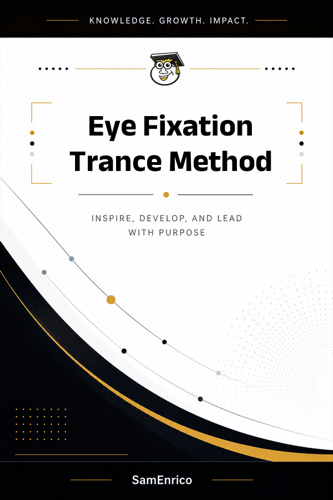
Eye Fixation Trance Method eBook
Use fixed gaze on a point to trigger hypnotic stat
by Ocasio Londa
Use fixed gaze on a point to trigger hypnotic state naturally.
Formats
Free sample
Chapter 1: The Forgotten Key--–- The first thing you must understand about the eye fixation trance method is that you have already experienced it. Not once, but hundreds of times, in moments so ordinary that you never thought to call them hypnosis. That distant stare while waiting for a train, when the world faded to a soft blur and you lost five minutes of time. That fixed gaze into a candle flame during a power outage, when your breathing slowed and your thoughts grew strangely heavy. That moment in a lecture or meeting when your eyes locked onto a single point on the wall, and suddenly the speaker's voice seemed to come from very far away, and you felt a pleasant, floating detachment.
These were not moments of boredom or distraction. They were spontaneous trances, triggered by the oldest and most reliable induction method known to human civilization: the simple, deliberate act of staring.–- The eye fixation trance method is the great grandfather of all modern hypnosis. Before arm catalepsy tests, before progressive muscle relaxation, before Ericksonian metaphors and neuro-linguistic programming, there was the gaze. The fixed, unwavering, exhausting stare at a single point. It is the method that gave hypnosis its name.
It is the method that demystified magnetism and launched hypnotism as a legitimate scientific inquiry. And it is, paradoxically, the method that most contemporary hypnotists have forgotten, neglected, or relegated to a footnote in their training manuals.–- This book is an attempt to restore the gaze to its rightful place. Not as a curiosity or a historical relic, but as a precision tool for trance induction—often faster, deeper, and more elegant than the verbose scripts and complex rituals that clutter modern hypnotherapy. The eye fixation method works because it bypasses the single greatest obstacle to hypnosis: the critical factor of the conscious mind. It does not ask the subject to relax, to imagine, to feel, or to believe.
It simply asks them to look. And in that looking, something ancient and automatic takes over, carrying the subject past the gates of waking awareness and into the receptive terrain of the subconscious.–- This chapter will lay the foundation for everything that follows. We will explore what the eye fixation method actually is, why it fell out of favor, why it is now being rediscovered by researchers and clinicians, and how a single physiological mechanism—the habituation of the orienting response—explains its remarkable effectiveness. By the end of this chapter, you will understand why staring at a point can do what hours of talk therapy cannot, and you will be ready to learn the specific techniques that transform this ordinary act into a reliable gateway to the trance state.The Strange Case of James Braid–- To understand the eye fixation method, you must first understand the man who named hypnosis and then spent the rest of his career trying to rename it. James Braid was a Scottish surgeon working in Manchester, England, in the 1840s.
He was a rationalist, a skeptic, and a man deeply suspicious of the theatrical "animal magnetism" demonstrations that had swept across Europe following the work of Franz Anton Mesmer. Mesmer had claimed that a universal magnetic fluid flowed through all living beings, and that by manipulating this fluid with passes of the hands, a practitioner could induce dramatic trances, convulsions, and apparent cures. By the 1840s, traveling magnetists were packing theaters with audiences eager to see young women fall into magnetic sleeps and exhibit strange insensibility to pain.–- Braid attended one such demonstration in November 1841, performed by a Swiss magnetist named Charles Lafontaine. He went as a skeptic, intending to expose Lafontaine as a fraud. But something unexpected happened.
Braid noticed that the subjects who fell into the deepest trances were those who stared fixedly at Lafontaine's spinning magnets or at his eyes for prolonged periods. They were not being "magnetized" by any fluid. They were being exhausted by their own gaze.–- Braid was too good a scientist to dismiss what he had seen. He went home and began experimenting on himself, his family, and his willing patients. He asked them to stare at a fixed point—a wine bottle, a cork, his own lancet case held just above the bridge of the nose.
He observed, measured, and recorded. What he discovered was that after a period of sustained fixation—typically between two and ten minutes—the subject's eyelids would begin to flutter, grow heavy, and eventually close involuntarily. The subject would then enter a state that Braid initially called "nervous sleep" and later, from the Greek hypnos (sleep), "hypnotism."–- But Braid was careful to distinguish his findings from Mesmer's mysticism. He wrote: "I shall use the term 'hypnotism' to designate the condition produced by this procedure, not because I believe it to be a sleep, but because the subject passes into a state which resembles sleep in many of its ordinary phenomena." Braid's crucial insight was that the trance was not caused by magnetic fluid, not by the hypnotist's personal power, and not by suggestion alone. It was caused by a physiological process: the fatigue of the eye muscles and the neural pathways that control visual attention.–- He called this the "monoideism" of fixation—the concentration of the mind on a single idea or sensation to the exclusion of all others.
When the eyes fixate on a point, the muscles that control convergence (the inward turning of the eyes to focus on a near object) and accommodation (the adjustment of the lens to maintain clear focus) are placed under sustained tension. This tension, maintained beyond the normal duration of a glance, produces fatigue. That fatigue sends signals to the reticular activating system—the brain's arousal center—that the effort of attention is no longer sustainable. The system begins to shut down, starting with the voluntary control of the eyelids.–- Braid published his findings in 1843 in a book titled Neurypnology, or The Rationale of Nervous Sleep. It was the first scientific text on hypnosis, and it established the eye fixation method as the foundational induction technique for the next eighty years.
Every major hypnotist of the late nineteenth and early twentieth centuries—from Ambroise-Auguste Liébeault to Hippolyte Bernheim to Émile Coué to Johannes Schultz—used some variation of the eye fixation method as their primary or secondary induction.The Lost Century–- If the eye fixation method was so effective, why did it disappear from mainstream hypnosis? The answer is a fascinating story of professional rivalries, therapeutic fashions, and the rise of more "verbal" and "permissive" approaches.–- In the 1920s and 1930s, the great psychiatrist and hypnotist Milton Erickson began to develop a radically different approach to trance induction. Erickson rejected the authoritarian, direct style of classical hypnosis—the fixed stare, the command to sleep, the expectation of passive compliance. He argued that trance could be induced more elegantly through indirect suggestion, metaphor, confusion techniques, and the strategic utilization of the subject's own resistances and idiosyncrasies. Erickson's methods were brilliant, effective, and deeply influential.
They gave birth to Ericksonian hypnosis, neuro-linguistic programming (NLP), and much of the conversational hypnosis that dominates contemporary training.–- In…
This is the end of the free sample. Get the eBook to keep going. Buy now
About this book
Details
- Author
- Ocasio Londa
- Publisher
- SamEnrico
- Language
- English
- Genre
- Non-Fiction, Self-Help, Hypnosis
- Released
- 2026-06-06
- Pages (approx.)
- 144
- Available as
- eBook, Audiobook

Read better in the ZLOADR app
Your eBooks on your phone or tablet. Sign in with your SamEnrico account and start reading.
More by Ocasio Londa
 Loneliness Toastmasters GuideOcasio Londa$11.99
 Death and Dying TalksOcasio Londa$11.99
 Tech Startup Founder NetworkingOcasio Londa$11.99
 Antwerp Heist Podcast PhenomenonOcasio Londa$11.99
 Senior Doctor Visit ConfidenceOcasio Londa$11.99
 Stress Multiple Sclerosis GuideOcasio Londa$11.99
 The Prevention ProtocolOcasio Londa$11.99
 Separation Anxiety TranceOcasio Londa$11.99
 The Vanishing of the SS Marine Sulphur Queen: A 50-Year MysteryOcasio Londa$11.99
 The Red Cliff Gambit: Zhuge Liang's Shadow War of DeceptionOcasio Londa$11.99
 Echoes of the Ice: The 1982 Discovery That Changed Climate Science ForeverOcasio Londa$11.99
 The Mineral Guide to TarapacaiteOcasio Londa$11.99
You may also like
 Hong Kong Handover 1997Dunn Johnnie$11.99
 Zumba For Postnatal Recovery CourseNeal Christian$11.99
 Zumba for BeginnersLadner Nikia$11.99
 YouTube Comment Mining GuideHumes Pandora$12.99
 Worry Box MeditationCarlin Rudy$11.99
 Workplace Stress MeditationNguyen Lynn$11.99
 Workplace Stress and Sleep RepairHawley Ivory$11.99
 Workplace Perfectionism CureDelaney Jeffry$11.99
 Workplace Injustice Anger GuideWallen Isabelle$11.99
 Work Addiction and Burnout LinkGreenwood Ester$11.99
 Women in Yoga and WellnessBeattie Galina$11.99
 Women in Stand Up ComedyChun Evangeline$11.99