
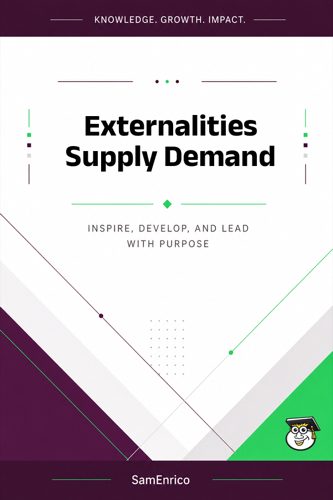
Non-FictionBusiness BriefEnvironmental Economics
Externalities Supply Demand Audiobook
Analyze how pollution and spillover effects distor
Analyze how pollution and spillover effects distort market outcomes.
Formats
Free sample
Chapter 1: The Blind Spot--–- In the summer of 1969, the Cuyahoga River caught fire. This was not a metaphor. The river, which flows through Cleveland, Ohio, had become so saturated with oil, chemicals, and industrial waste that a spark from a passing train ignited the surface. Flames leaped five stories high, damaged two railroad bridges, and sent a column of black smoke over the city. By the time firefighters extinguished the blaze, the river had burned for roughly thirty minutes.What makes this event remarkable is not that it happened—it was the thirteenth time the Cuyahoga had caught fire since 1868—but that anyone bothered to notice.
For most of American history, burning rivers were simply the price of progress. Factories dumped waste into waterways because it was cheap. Steel mills belched smoke into the sky because it was convenient. The air in Pittsburgh was once described as "hell with the lid off." The water in the Hudson River ran the color of rust. These were not scandals.
They were the background conditions of industrial life.The economist sees the Cuyahoga fire and asks a peculiar question: Why was the price of the goods produced along that river too low? The steel, the chemicals, the manufactured products—all of them sold at prices that covered the cost of labor, materials, and capital. None of them sold at a price that covered the cost of a burning river. Someone paid that cost, of course. The city of Cleveland paid for firefighting.
Downstream communities paid for poisoned drinking water. The fishing industry paid with collapsed stocks. Future generations paid with a polluted ecosystem they inherited. But the factories paid nothing. The price on the tag was a lie.That lie has a name.
Economists call it a negative externality—a cost imposed on a third party by a transaction between two others. But the jargon obscures a deeper truth: every time you buy something, you are standing at the end of a chain of decisions, some of which imposed costs on people who never agreed to bear them. The shirt you are wearing was likely dyed in a river that no longer supports fish. The phone in your pocket contains minerals mined from a landscape that will not recover in your lifetime. The electricity powering your home was probably generated by burning something that left behind residues that someone, somewhere, is breathing.This is…
This is the end of the free sample. Get the Audiobook to keep going. Buy now
About this book
Details
- Author
- Madrigal Calista
- Publisher
- SamEnrico
- Language
- English
- Genre
- Non-Fiction, Business Brief, Environmental Economics
- Released
- 2026-06-06
- Pages (approx.)
- 160
- Available as
- eBook, Audiobook

Listen in the VoxFlicks app
Audiobooks and audio dramas wherever you go. Sign in with your SamEnrico account and press play.
More by Madrigal Calista
 Twitch Comparison Culture GuideMadrigal Calista$11.99
 Jump Rope HIIT WorkoutsMadrigal Calista$11.99
 Sugar and Inflammation RecoveryMadrigal Calista$11.99
 The Brush and the Crown: A Love Story in 18th-Century LimaMadrigal Calista$11.99
 How to Start a Binding (woven) Business (Beginners Guide)Madrigal Calista$11.99
 Interview Salary Negotiation GuideMadrigal Calista$12.99
 Learn to Play the BalafonMadrigal Calista$11.99
 Physician RecruiterMadrigal Calista$11.99
You may also like
 Hong Kong Handover 1997Dunn Johnnie$11.99
 Zumba For Postnatal Recovery CourseNeal Christian$11.99
 Zumba for BeginnersLadner Nikia$11.99
 YouTube Comment Mining GuideHumes Pandora$12.99
 Worry Box MeditationCarlin Rudy$11.99
 Workplace Stress MeditationNguyen Lynn$11.99
 Workplace Stress and Sleep RepairHawley Ivory$11.99
 Workplace Perfectionism CureDelaney Jeffry$11.99
 Workplace Injustice Anger GuideWallen Isabelle$11.99
 Work Addiction and Burnout LinkGreenwood Ester$11.99
 Women in Yoga and WellnessBeattie Galina$11.99
 Women in Stand Up ComedyChun Evangeline$11.99