
Non-FictionStudent's ShortcutImmigration Pathway
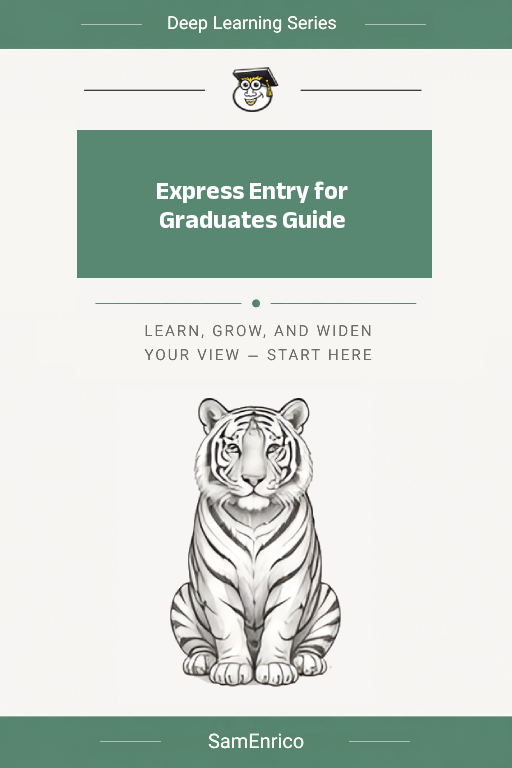
Express Entry for Graduates Guide eBook
Navigate Canadian immigration points system includ
by Townes Wei
Navigate Canadian immigration points system including education, language scores, and work experience for international graduates.
Formats
Free sample
Chapter 1: The 460-Point Trap--The moment your final grades are posted, a silent countdown begins. You have 1,095 days—three years—to transform your Canadian degree into permanent residency. Most graduates don't realize they are already losing.Meet Priya. She came to Canada from India at twenty-two, armed with acceptance to a four-year business program at a respected university. She paid international tuition, lived with roommates, worked part-time at a coffee shop, and graduated with honors.
She did everything her immigration consultant told her: applied for her Post-Graduation Work Permit immediately, found a marketing coordinator job within three months, and started counting down to her one-year work anniversary.On the day she became eligible for the Canadian Experience Class, she sat down with a spreadsheet and calculated her Comprehensive Ranking System score. She had a four-year Canadian degree: 120 points. CLB 8 in English (Listening 8.5, Reading 8.0, Writing 7.5, Speaking 7.5): 82 points for first language. One year of Canadian work experience: 40 points. No spouse.
No French. No foreign work experience. Total CRS score: 460.That same week, Immigration, Refugees and Citizenship Canada held a general draw. The cutoff: 517 points.Priya was fifty-seven points short. Fifty-seven points does not sound like much.
But in the CRS system, fifty-seven points is the difference between a bachelor's degree and a master's degree plus a year of foreign experience. Fifty-seven points is the difference between CLB 8 and CLB 9 plus a sibling in Canada. Fifty-seven points is the difference between checking your email every morning hoping for an Invitation to Apply and watching your PGWP expire while you pack your bags.Priya is not real. But she represents tens of thousands of international graduates who discover, too late, that a Canadian degree is not enough.The Great Disconnect Here is the truth that no university admissions brochure will print: approximately fifty percent of international students intend to become permanent residents of Canada, but the actual transition rate varies wildly based on factors that have nothing to do with academic performance. According to IRCC data and multiple longitudinal studies, graduates from three-year bachelor's programs in general arts have success rates below twenty percent.
Graduates from two-year STEM master's programs with co-op placements have success rates above seventy percent. The difference is not intelligence, effort, or luck. It is strategic planning that begins in year one, not after graduation.The Canadian immigration system does not reward effort. It rewards points. And points are earned by understanding the Comprehensive Ranking System as a gameable algorithm—not a mysterious black box controlled by faceless bureaucrats.This book will teach you to see your CRS score as a character sheet in a video game.
You start at level zero. Every action you take—every course you register for, every job you accept, every language test you schedule, every relationship you document—either levels you up or wastes your precious three hundred and sixty-five days per year of PGWP eligibility. The graduates who succeed treat immigration as a part-time job, dedicating three to five hours per week to actively managing their profile. The graduates who fail treat immigration as something that happens to them after they finish the "real work" of building a career.This book is the difference between those two outcomes.The Five Levers of CRS Optimization Before we dive into specific strategies, you need to understand the architecture of your score. The Comprehensive Ranking System allocutes up to 1,200 points across five categories.
Think of these as levers on a control panel. You cannot change some levers. Others you can pull hard, and the points will flow.Lever One: Age – This is the lever you cannot change. The CRS awards maximum age points (110 for a single applicant, 100 for married applicants) between twenty and twenty-nine years old. Points decline steadily after thirty and drop sharply after thirty-five.
If you are reading this book in your twenties, you have a built-in advantage. Do not waste it by delaying your application. If you are in your thirties, you must compensate by pulling the other levers harder.Lever Two: Education – This lever is more flexible than most graduates realize. A Canadian bachelor's degree is worth 120 points. A master's degree is worth 135 points.
But the most efficient play is not necessarily more years of study. Combining a three-year bachelor's degree with a one-year graduate certificate unlocks the "two or more credentials" category, worth 128 education points plus skill transferability bonuses that can add up to 58 points total. This one-year diploma strategy offers the highest return on investment in the entire CRS system, as you will learn in Chapter 4.Lever Three: Language – This is the highest-ROI lever in the game. Moving from CLB 7 (the minimum for CEC) to CLB 9 adds approximately fifty points. Fifty points for two to three months of focused study.
No other action—not working an extra year, not earning another degree, not even securing an LMIA job offer—delivers that many points for that little time. Most graduates stop at "good enough" language scores. The graduates who get permanent residency keep testing until they reach CLB 9 or higher.Lever Four: Canadian Work Experience – This lever has a steep cliff at twelve months. Zero years of Canadian experience equals zero points for this category. One year equals forty points.
Two years equals fifty-three points. Three or more years equals sixty-four points. The jump from zero to one year is the largest relative gain. After three years, points stop increasing entirely. If you have three years of Canadian experience and still no ITA, you are wasting time.
Every additional month should be redirected toward language improvement or foreign experience.Lever Five: Foreign Work Experience and Spouse – This is the most overlooked lever. Many international graduates arrive in Canada with one or two years of skilled work experience from their home countries. They leave this experience off their Express Entry profiles because they think it "does not count" or "was not in Canada." This is a catastrophic error. Combining one year of Canadian experience with one year of foreign experience triggers skill transferability bonuses worth up to fifty additional points. Similarly, if you have a spouse or common-law partner, their language scores, education, and Canadian work experience can add up to forty points to your file.
In some cases, the lower-skilled spouse should be the principal applicant because their profile is stronger. Chapter 8 provides a spouse swap decision matrix.Myths That Will Destroy Your Application Before we go further, we must clear away dangerous misconceptions. These myths appear repeatedly on immigration forums, in Whats App groups, and even in the advice of well-meaning but uninformed friends.Myth One: "A job offer guarantees permanent residence."False. The CRS awards zero points for a standard job offer without a Labour Market Impact Assessment. An LMIA-supported job offer adds 50 points (for TEER 0, 1, 2, or 3 positions) or 200 points (for TEER 00 executive roles).
But LMIA job offers are rare for recent graduates. Employers must prove they could not find a Canadian citizen or permanent resident to fill the role, which is difficult for entry-level positions. The job offers most graduates receive—post-graduation employment in marketing, administration, retail management, or software development—typically come without LMIA support. These offers help you gain Canadian work experience, but they do not directly add CRS…
This is the end of the free sample. Get the eBook to keep going. Buy now
About this book
Details
- Author
- Townes Wei
- Publisher
- SamEnrico
- Language
- English
- Genre
- Non-Fiction, Student's Shortcut, Immigration Pathway
- Released
- 2026-05-29
- Pages (approx.)
- 144
- Available as
- eBook, Audiobook

Read better in the ZLOADR app
Your eBooks on your phone or tablet. Sign in with your SamEnrico account and start reading.
More by Townes Wei
 TM App and Timer GuideTownes Wei$11.99
 Men's Omega 3 Prescription StrengthTownes Wei$11.99
 French Green Tax Credits ManualTownes Wei$11.99
 Delegation for Data ScientistsTownes Wei$11.99
 Innocence Project Mississippi CasesTownes Wei$11.99
 Vibrant Uprising: The Day Purple Died in the StreetsTownes Wei$11.99
 The Day the Internet Broke: How a Single Tweet Toppled a Billion-Dollar EmpireTownes Wei$11.99
 Understanding Chromosome 15q, Partial DeletionTownes Wei$17.99
 How to Become a Cake TesterTownes Wei$11.99
 Career Vision Statement GuideTownes Wei$12.99
 Variational Inference OperatorTownes Wei$11.99
You may also like
 Hong Kong Handover 1997Dunn Johnnie$11.99
 Zumba For Postnatal Recovery CourseNeal Christian$11.99
 Zumba for BeginnersLadner Nikia$11.99
 YouTube Comment Mining GuideHumes Pandora$12.99
 Worry Box MeditationCarlin Rudy$11.99
 Workplace Stress MeditationNguyen Lynn$11.99
 Workplace Stress and Sleep RepairHawley Ivory$11.99
 Workplace Perfectionism CureDelaney Jeffry$11.99
 Workplace Injustice Anger GuideWallen Isabelle$11.99
 Work Addiction and Burnout LinkGreenwood Ester$11.99
 Women in Yoga and WellnessBeattie Galina$11.99
 Women in Stand Up ComedyChun Evangeline$11.99