
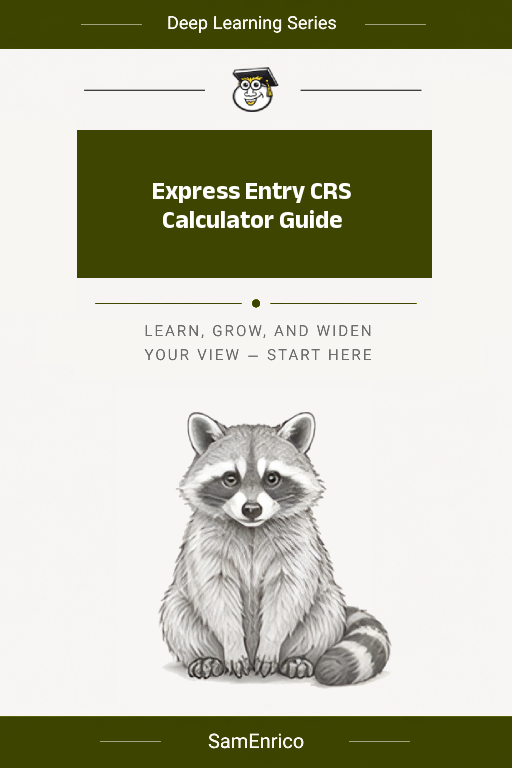
Non-FictionStudent's ShortcutCRS Points
Express Entry CRS Calculator Guide eBook
Calculate your Comprehensive Ranking System score
by Shumate Adam
Calculate your Comprehensive Ranking System score for Canadian PR including education, age, language, and work factors.
Formats
Free sample
Chapter 1: Your Number Destiny--–- The day you calculate your CRS score changes everything. Not because a number on a screen holds magic, but because that single three-digit figure will determine whether you spend the next year building a life in Canada or watching from afar as others receive their Invitations to Apply. Most applicants approach the Comprehensive Ranking System like a lottery ticket—they plug in their age, education, language scores, and work experience, shrug at the result, and hope for the best. This book exists because that approach fails. The CRS is not a lottery.
It is a mathematical optimization problem. And like any optimization problem, it has predictable rules, exploitable levers, and a clear path from where you are now to where you need to be.This chapter will fundamentally change how you see the CRS. By the time you finish reading, you will understand why two people with identical resumes can have CRS scores fifty points apart. You will learn why the March 2025 policy change removing job offer points is the best thing that has happened to honest, hardworking applicants in a decade. And you will discover the single most important truth about Express Entry: your score today is not your destiny.
It is merely your starting point.The Great Misunderstanding: Why the CRS Is Not a Score Let us begin with a radical reframing. Most government immigration systems use a pass-fail model. Meet the minimum points, get a visa. The CRS does not work this way. Canada's Express Entry system is a competitive ranking mechanism.
You are not trying to clear a bar. You are trying to outrank hundreds of thousands of other applicants from around the world.Think of the CRS as a leaderboard. Every two weeks, IRCC decides how many people to invite—typically between 3,000 and 6,000. They start at the top of the leaderboard and work down until they reach that number. The last person invited sets the cut-off score.
If your score equals or exceeds that cut-off, you receive an Invitation to Apply. If you fall one point short, you wait for the next draw.This distinction matters enormously. In a pass-fail system, scoring above the minimum is sufficient. In a ranking system, every single point matters because thousands of other applicants are competing for the same limited spots. A difference of five points can separate an ITA from another six months of waiting.
A difference of twenty points can separate an ITA from never being invited at all.The March 2025 policy change made this reality even more transparent. Before that date, wealthy applicants or those with Canadian connections could effectively purchase 50 or even 200 points through an LMIA-backed job offer. Those points artificially inflated their rankings, pushing honest applicants down the leaderboard. Now those points are gone. The leaderboard has been reset.
Everyone competes on human capital—age, education, language ability, and work experience. Things you can actually control without spending $30,000 on a questionable job offer.A Brief History: How CRS Cut-Offs Have Evolved Understanding where cut-off scores have been helps predict where they are going. Between 2015 and 2019, cut-offs fluctuated between 430 and 470. The system was relatively stable. Then COVID changed everything.In 2020 and 2021, IRCC conducted program-specific draws favoring Canadian Experience Class candidates already inside the country.
Cut-offs plummeted to historic lows—sometimes below 400. Applicants who had been waiting for years suddenly received ITAs. It felt like the rules had changed overnight. In a sense, they had.By 2023, as pandemic restrictions lifted and international travel resumed, IRCC returned to all-program draws. The cut-offs climbed back to familiar territory, settling between 490 and 520 for most of 2024.
This range represents the new normal. The old days of sub-400 cut-offs are gone, likely forever.The March 2025 job offer removal caused a temporary dip as the system recalibrated. Early draws after the change saw cut-offs in the 470–490 range as candidates who had relied on job offer points fell out of the pool. However, by mid-2025, the floor stabilized between 490 and 510 for general draws.Critical insight: Category-based draws tell a different story. French-language draws have seen cut-offs as low as 380–420.
Healthcare draws hover around 440. STEM draws average 480. If your general CRS is 460—hopeless for a general draw—you may still have a path through a category draw. We will explore this strategy in depth in Chapter 11.The Anatomy of the CRS: Where Points Actually Come From The CRS awards points across four main categories. Understanding the weighting of each category is essential for strategic planning.Core Human Capital Points (Maximum 500 for Singles, 460 for Couples)This is the foundation of your score.
Age, education, language ability, and work experience comprise the bulk of your points. For a single applicant without a spouse, the maximum here is 500 points. For a married applicant with an accompanying spouse, the maximum drops to 460 because some points shift to the spouse's credentials.Age accounts for up to 110 points. The maximum occurs between ages 20 and 29. At age 30, you begin losing points.
By age 40, you lose over 50 points. Age is the only factor you cannot improve with effort. If you are over 30, your strategy must account for this ticking clock.Education contributes up to 150 points. A Bachelor's degree earns 112–120 points. "Two or more certificates" earns 119–128 points.
A Master's or professional degree earns 126–135 points. A Ph D earns up to 150 points. Every additional credential matters.First official language (English or French) provides up to 136 points for your primary language. Second official language provides up to 24 additional points. Language is the most cost-effective lever in the entire system.
A few months of focused study can add fifty points or more to your score.Canadian work experience adds up to 80 points. Foreign work experience adds up to 50 points. The combination of both unlocks significant Skill Transferability bonuses, which we will cover in Chapter 7.Spouse Factors (Maximum 40 Points)If you apply with an accompanying spouse, their education, language ability, and Canadian work experience can add up to 40 points. This seems small, but in a competitive ranking environment, 40 points is enormous. The difference between a spouse who contributes nothing and a spouse who contributes maximum points can be the difference between an ITA and rejection.Skill Transferability (Maximum 100 Points)This is the most misunderstood section of the CRS.
Applicants routinely leave thirty to fifty points on the table here because they do not understand how the combinations work. The core principle is simple: certain combinations of education, language, and work experience produce bonus points beyond the sum of their individual parts.For example, a Bachelor's degree alone earns 112–120 points. CLB 9 language alone earns about 100 points. But a Bachelor's degree combined with CLB 9 earns an additional 50 bonus points under Skill Transferability. A Master's degree alone earns more than a Bachelor's, but if paired with only CLB 7, the bonus may be only 25 points.
This is why a Bachelor's degree with exceptional language can outscore a Master's degree with mediocre language.Chapter 7 is dedicated entirely to unlocking these points. For now, understand that Skill Transferability is where most applicants leave the easiest points on the table.Additional Points (Maximum 600)This category includes provincial nominations (600 points), qualifying job offers (0 points after March 2025), and sibling connections (15 points). A provincial nomination guarantees an ITA regardless…
This is the end of the free sample. Get the eBook to keep going. Buy now
About this book
Details
- Author
- Shumate Adam
- Publisher
- SamEnrico
- Language
- English
- Genre
- Non-Fiction, Student's Shortcut, CRS Points
- Released
- 2026-05-29
- Pages (approx.)
- 143
- Available as
- eBook, Audiobook

Read better in the ZLOADR app
Your eBooks on your phone or tablet. Sign in with your SamEnrico account and start reading.
More by Shumate Adam
 Palliative Care Anticipatory GuideShumate Adam$11.99
 Dental Anatomy ForensicsShumate Adam$11.99
 Buffer Time Between BlocksShumate Adam$11.99
 Shopping Addiction Flea MarketsShumate Adam$11.99
 The Postpartum and ThyroidShumate Adam$11.99
 Self Hypnosis for Morning SnoozeShumate Adam$11.99
 Cold Case ReconstructionShumate Adam$11.99
 Body Language for Retail StaffShumate Adam$11.99
 The Healers of Color: Latin America's Impressionist Revolution (1950-1980)Shumate Adam$11.99
 The Kepler Conspiracy: Unlocking the Secrets of the CosmosShumate Adam$11.99
 How to Produce Curling IronsShumate Adam$11.99
 How to Produce Pest Control TrapsShumate Adam$11.99
You may also like
 Hong Kong Handover 1997Dunn Johnnie$11.99
 Zumba For Postnatal Recovery CourseNeal Christian$11.99
 Zumba for BeginnersLadner Nikia$11.99
 YouTube Comment Mining GuideHumes Pandora$12.99
 Worry Box MeditationCarlin Rudy$11.99
 Workplace Stress MeditationNguyen Lynn$11.99
 Workplace Stress and Sleep RepairHawley Ivory$11.99
 Workplace Perfectionism CureDelaney Jeffry$11.99
 Workplace Injustice Anger GuideWallen Isabelle$11.99
 Work Addiction and Burnout LinkGreenwood Ester$11.99
 Women in Yoga and WellnessBeattie Galina$11.99
 Women in Stand Up ComedyChun Evangeline$11.99