
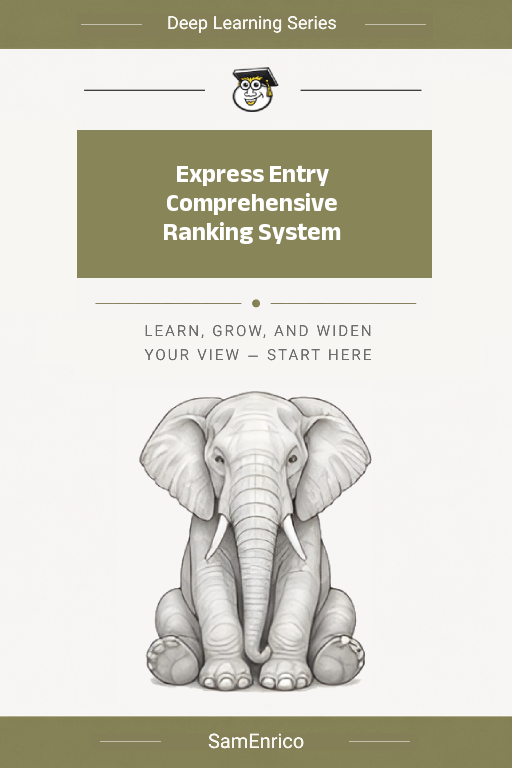
Express Entry Comprehensive Ranking System eBook
Maximize your CRS score as a Canadian graduate, ca
by Vang Breann
Maximize your CRS score as a Canadian graduate, calculating points for age, education, work experience, and language proficiency before entering the pool.
Formats
Free sample
Chapter 1: The Homefield Advantage--–- Every year, tens of thousands of foreign-trained professionals submit their Express Entry profiles with flawless credentials—Master's degrees from prestigious universities, a decade of work experience, near-perfect English scores—only to watch their Comprehensive Ranking System (CRS) scores stagnate in the 430 to 460 range. They refresh their inboxes daily, waiting for an Invitation to Apply (ITA) that never comes. Meanwhile, a Canadian graduate with a three-year Bachelor's degree, two years of retail management experience, and a CLB 8 in English quietly receives an ITA with a score of 492. The foreign applicant cannot understand what happened. The answer lies not in what the foreign applicant lacks, but in what the Canadian graduate possesses: a structural advantage baked directly into the CRS formula.This book is not for the offshore applicant desperately searching for an LMIA-backed job offer.
That path largely died in March 2025 when IRCC eliminated the 50-to-200-point job offer bonus. This book is for the Canadian graduate—the former international student who holds a Post-Graduation Work Permit (PGWP), has already invested years in the country, and sits on a hidden multiplier that most CRS guides completely ignore. You have already paid your tuition, navigated the Canadian classroom, and survived the winter. Now you need to convert that investment into permanent residence.The central thesis of this book is simple but powerful: the sequence of your actions matters more than the raw weight of your qualifications. When you take your language test, when you accept a job, when you enter the pool, and when you add a second credential—these timing decisions can swing your CRS score by 50 points or more, entirely independent of your underlying education or work history.
This chapter lays the foundation for that strategy by decoding the CRS specifically from the perspective of a Canadian graduate, contrasting your position against foreign applicants, and introducing the four pillars that will structure every decision you make.The Post-March 2025 Landscape: Why Canadian Graduates No Longer Fight for LMIAs Before March 2025, the Express Entry playing field was tilted heavily toward candidates who could secure a valid job offer backed by a Labour Market Impact Assessment (LMIA). Those 50 to 200 points created an almost insurmountable gap between candidates with employer support and those without. Canadian graduates, who typically did not have LMIAs (and often could not obtain them due to the cost and administrative burden on employers), found themselves competing against offshore candidates who had never set foot in Canada but had secured job offer points.That era ended in March 2025. IRCC eliminated job offer points entirely, citing fraud concerns and a policy shift toward human capital factors—age, education, language, and work experience—rather than employer sponsorship. For the Canadian graduate, this change is revolutionary.
You no longer need to convince a Canadian employer to spend $1,000 and several weeks on an LMIA application just to level the playing field. Your Canadian degree, your PGWP-eligible work experience, and your age now stand on equal footing with any foreign credential, minus the LMIA arms race.What this means for you: The competition has shifted from "who has the most employer connections" to "who best understands the CRS math." And Canadian graduates have an inherent advantage in that math, as you will see throughout this chapter and the rest of this book.The Four Pillars of the CRS: A Canadian Graduate's Framework The CRS awards a maximum of 1,200 points across four distinct categories. Most guides present these categories as a flat list. This book organizes them as a hierarchy of leverage, because not all points are created equal and not all points are equally accessible to Canadian graduates.Pillar One: Core Human Capital (Maximum 500 Points)This is the foundation of your score. It includes:Age (maximum 100 points)Level of education (maximum 150 points for a Ph D, 135 for a Master's, 120 for a Bachelor's, 128 for two or more credentials)Official language proficiency (maximum 136 points for first language at CLB 9—for a complete explanation of CLB levels and what they mean for your IELTS or CELPIP scores, see Chapter 4)Canadian work experience (maximum 64 points for three or more years—see Chapter 6 for the complete point scale)For a single applicant without a spouse, these 500 points represent your baseline competitiveness.
For a Canadian graduate, Pillar One is where your home field advantage first appears. Your Canadian education is already recognized without an Educational Credential Assessment (ECA). Your PGWP allows you to accumulate Canadian work experience that foreign applicants cannot access. And your age—typically 23 to 25 at graduation—positions you at the maximum 100 points for the next five to seven years.Pillar Two: Spouse or Common-Law Partner Factors (Maximum 40 Points)If you have an accompanying spouse or common-law partner, their education, language, and Canadian work experience can add up to 40 points. However—and this is critical—the maximum score for a single applicant is 500, while the maximum for an accompanied applicant is 460 from Pillar One plus up to 40 from Pillar Two, for a total of 500.
Yes, you read that correctly. The theoretical maximum for a couple is also 500, but achieving it requires your spouse to have near-perfect credentials. Most couples are better off strategically designating the lower-scoring spouse as non-accompanying. We will explore this counterintuitive strategy in depth in Chapter 3.Pillar Three: Skill Transferability (Maximum 100 Points)This is where the CRS rewards combinations of qualifications. You cannot max out Pillar Three with a single strong credential.
You need pairs:Education + language proficiency (maximum 50 points)Foreign work experience + language proficiency (maximum 50 points)Canadian work experience + language proficiency (maximum 50 points)Note that these are not additive in the way most candidates assume. The CRS awards the higher of the education-plus-language or work-plus-language combination, not both. However, for Canadian graduates, the Canadian work experience plus language combination is often easier to achieve than the foreign work experience combination, because your PGWP gives you direct access to Canadian employment.Pillar Four: Additional Points (Maximum 600 Points)This category includes Provincial Nomination (600 points), qualifying Canadian siblings (15 points), French language skills (up to 50 points—see Chapter 4 for the distinction between the French Boost and French-only category draws), and a Canadian post-secondary degree (15 to 30 points—see Chapter 7 for complete eligibility rules). For most Canadian graduates, the Canadian degree points are automatic. The French bonus is achievable with six months of intensive study for English-first candidates (see Chapter 10 for the French-only draw path).
And Provincial Nomination—specifically through streams that do not require a job offer—represents your nuclear option if your base CRS falls below competitive thresholds (see Chapter 9).The Canadian Graduate's Home Field Advantage: Three Compounding Benefits Now let us make explicit what most CRS guides only hint at: the three specific ways that being a Canadian graduate creates compounding advantages unavailable to offshore applicants.Benefit One: The ECA Exemption and Credential Recognition Foreign applicants must pay 200to200 to 200to500 for an Educational Credential Assessment from designated organizations like WES (World Education Services) or IQAS (International Qualifications Assessment Service). They wait four to twelve weeks for a report that may or may not confirm their degree as equivalent to a Canadian standard. If their institution is not recognized, or if their program was not full-time, their ECA may return a lower equivalency—a Master's becoming a Bachelor's…
This is the end of the free sample. Get the eBook to keep going. Buy now
About this book
Details
- Author
- Vang Breann
- Publisher
- SamEnrico
- Language
- English
- Genre
- Non-Fiction, Student's Shortcut
- Released
- 2026-06-01
- Pages (approx.)
- 148
- Available as
- eBook, Audiobook

Read better in the ZLOADR app
Your eBooks on your phone or tablet. Sign in with your SamEnrico account and start reading.
More by Vang Breann
 Parks Arrest RecordVang Breann$11.99
 The Retirement Housing Utility AuditVang Breann$11.99
 The Open Book Exam GuideVang Breann$11.99
 Sam Sheppard 1999 DNA TestVang Breann$11.99
 Goal Setting For BurnoutVang Breann$11.99
 Pet Loss and BirthdayVang Breann$11.99
 Nap Guided Audio GuideVang Breann$11.99
 Morning Routine for Night OwlsVang Breann$11.99
 The Jade Phoenix and the Celestial Weaver: A Love Forbidden by the HeavensVang Breann$11.99
 The Golden Quill of Leopold Sédar Senghor: Africa's Poet-PresidentVang Breann$11.99
 How to Start a Anti-pollution Vessel Service Business (Beginners Guide)Vang Breann$11.99
 How to Produce Vehicle BASE Rack SystemsVang Breann$11.99
You may also like
 Hong Kong Handover 1997Dunn Johnnie$11.99
 Zumba For Postnatal Recovery CourseNeal Christian$11.99
 Zumba for BeginnersLadner Nikia$11.99
 YouTube Comment Mining GuideHumes Pandora$12.99
 Worry Box MeditationCarlin Rudy$11.99
 Workplace Stress MeditationNguyen Lynn$11.99
 Workplace Stress and Sleep RepairHawley Ivory$11.99
 Workplace Perfectionism CureDelaney Jeffry$11.99
 Workplace Injustice Anger GuideWallen Isabelle$11.99
 Work Addiction and Burnout LinkGreenwood Ester$11.99
 Women in Yoga and WellnessBeattie Galina$11.99
 Women in Stand Up ComedyChun Evangeline$11.99