
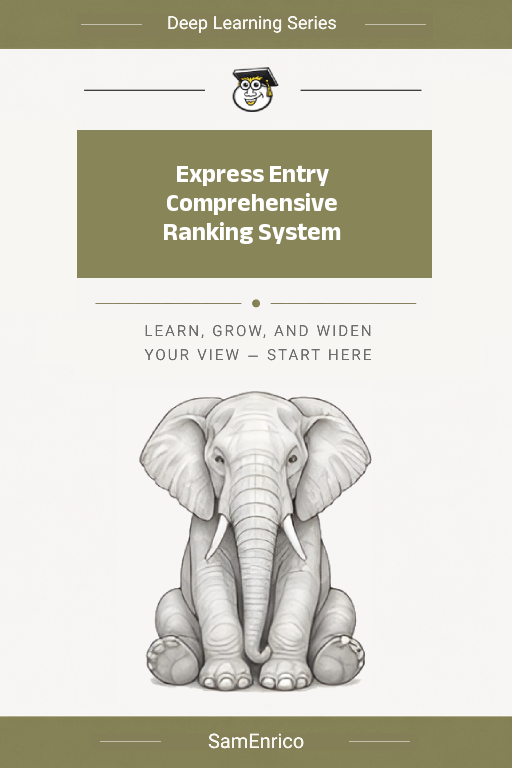
Express Entry Comprehensive Ranking System eBook
Maximize your CRS score as a Canadian graduate, ca
by Vang Breann
Maximize your CRS score as a Canadian graduate, calculating points for age, education, work experience, and language proficiency before entering the pool.
Formats
Free sample
Chapter 1: The Home Field Advantage--–- Most international students who graduate from a Canadian university believe they are playing the same game as everyone else in the Express Entry pool. They are wrong. The difference between a Canadian graduate and a foreign applicant with identical credentials is not small—it is the difference between a candidate who scrapes together 450 points and one who confidently sits at 500 or more. This chapter reveals why your Canadian education, your Post-Graduation Work Permit, and even your age work together as a compounding system rather than isolated factors. Understanding this home field advantage is the first and most critical step before you invest a single dollar in language tests, educational credentials, or immigration consultants.The Comprehensive Ranking System, or CRS, is often described as a 1,200-point grid.
But that description, while technically accurate, hides the more important truth: the CRS is not a simple addition game. It is a multiplier engine. Certain combinations of attributes—Canadian education plus Canadian work experience, or high language scores plus a second credential—generate far more points together than they would individually. For Canadian graduates, this multiplier effect is unusually accessible. You already hold one of the keys: a Canadian degree or diploma.
This chapter shows you how to turn that key into a full suite of compounding advantages that offshore candidates simply cannot replicate.The Great Equalizer of March 2025Before diving into the mechanics, we need to acknowledge a seismic shift in the Express Entry landscape. In March 2025, Immigration, Refugees and Citizenship Canada eliminated the 50-to-200-point bonus for qualifying job offers backed by a Labour Market Impact Assessment. For years, this job offer points system distorted the playing field. A foreign applicant with a moderate CRS of 370 could suddenly leap to 570 if they found an employer willing to endure the costly and uncertain LMIA process. Canadian graduates, despite their local experience and education, were often pushed aside by these inflated scores.That era is over.
The elimination of LMIA-based job offer points means that Canadian graduates no longer need to compete against artificially boosted foreign applicants. Your Canadian work experience, earned on a PGWP, now stands on its own merit. The job offer you receive from a Canadian employer still helps you qualify for certain programs and provides proof of funds exemptions, but it no longer gives you a direct CRS points advantage. This levels the field in two ways. First, it removes the incentive for employers to navigate the LMIA process purely for immigration purposes.
Second, it forces all candidates—domestic and foreign—to compete on the same core factors: language, education, work experience, age, and skill transferability.For Canadian graduates, this is excellent news. You have already invested years in the Canadian education system. You have already built local networks. You are already physically present in the country. The one artificial advantage that offshore candidates could buy with an employer sponsor is gone.
What remains are the genuine, hard-earned advantages of having studied and worked in Canada. The rest of this chapter explains exactly how those advantages compound.The Four Pillars Reimagined for Canadian Graduates The CRS divides its 1,200 points into four main categories. But rather than recite the official IRCC table, let us reframe these pillars through the lens of a Canadian graduate.The first pillar is Core Human Capital, worth up to 500 points for a single applicant. This includes your age, your language proficiency in English and French, your education level, and your Canadian work experience. Notice that foreign work experience is not in this pillar.
That is a deliberate design choice by IRCC. Canadian work experience is weighted more heavily than foreign work experience, and it sits in the most valuable column of the score grid.The second pillar is Spouse or Common-Law Partner factors, worth up to 40 points. If you are applying with an accompanying partner, their language scores, education, and Canadian work experience can add points. However, as we will explore in detail in Chapter 3, including a partner often reduces your own core maximum from 500 to 460, so the decision requires careful analysis.The third pillar is Skill Transferability, worth up to 100 points. This is where the multiplier effect lives.
You earn these points by combining two different strengths: education plus language, or foreign work experience plus language, or Canadian work experience plus a credential. The combinations are what make Canadian graduates unusually powerful. For example, a Bachelor's degree alone gives you 120 core points. But a Bachelor's degree plus CLB 9 in English gives you an additional 50 transferability points. Add a one-year post-graduate certificate to that same Bachelor's degree, and your transferability points jump even higher.
The whole becomes significantly greater than the sum of its parts.The fourth pillar is Additional Points, worth up to 600. This is dominated by Provincial Nomination, which adds a staggering 600 points and guarantees an Invitation to Apply. But there are also smaller bonuses: the 15-to-30-point Canadian studies bonus, a 50-point bonus for CLB 7 in French while maintaining CLB 5 or higher in English, and a 25-point bonus for a sibling in Canada. For Canadian graduates, the provincial nomination path is often more accessible than for foreign applicants because many provincial streams explicitly favor graduates of local universities and colleges.Why Canadian Work Experience Is Not Just "Better" but Different Let us examine a specific comparison that illustrates the home field advantage. Suppose two applicants have identical profiles in every way except one: where they earned their work experience.Candidate A is a Canadian graduate with a three-year Bachelor's degree, CLB 9 in English, and exactly one year of Canadian work experience in a TEER 1 job.
Candidate B holds the same three-year foreign Bachelor's degree (assessed as equivalent by an Educational Credential Assessment), the same CLB 9 English scores, and exactly one year of foreign work experience in the same TEER 1 occupation.Candidate A receives 40 core points for that one year of Canadian experience. Candidate B receives 0 core points for that one year of foreign experience because foreign work experience does not count in the Core Human Capital pillar. Candidate B can only claim that foreign experience later in the Skill Transferability pillar, but only if they also have sufficient language scores and other factors.But the difference grows larger over time. At two years of Canadian experience, Candidate A earns 53 core points. At three years, they max out at 64 core points.
Candidate B, meanwhile, only begins to see points for foreign experience after three years, and those points appear in Skill Transferability, not in Core Human Capital. This means that Candidate A builds a higher floor of points that never disappears, while Candidate B's foreign experience points are conditional on maintaining strong language scores and other credentials.Now add another layer. Candidate A's Canadian work experience also helps them qualify for the Canadian Experience Class, which has no proof-of-funds requirement. Candidate B, using foreign work experience, will likely fall into the Federal Skilled Worker program, which requires a minimum of approximately $13,000 for a single person and higher amounts for families. That difference alone can be a dealbreaker for young graduates who have not yet accumulated significant savings.This is the home field advantage in action.
Your Canadian work experience is not just valued at a higher rate per year. It is valued in a different…
This is the end of the free sample. Get the eBook to keep going. Buy now
About this book
Details
- Author
- Vang Breann
- Publisher
- SamEnrico
- Language
- English
- Genre
- Non-Fiction, Student's Shortcut
- Released
- 2026-05-29
- Pages (approx.)
- 143
- Available as
- eBook, Audiobook

Read better in the ZLOADR app
Your eBooks on your phone or tablet. Sign in with your SamEnrico account and start reading.
More by Vang Breann
 Parks Arrest RecordVang Breann$11.99
 The Retirement Housing Utility AuditVang Breann$11.99
 The Open Book Exam GuideVang Breann$11.99
 Sam Sheppard 1999 DNA TestVang Breann$11.99
 Goal Setting For BurnoutVang Breann$11.99
 Pet Loss and BirthdayVang Breann$11.99
 Nap Guided Audio GuideVang Breann$11.99
 Morning Routine for Night OwlsVang Breann$11.99
 The Jade Phoenix and the Celestial Weaver: A Love Forbidden by the HeavensVang Breann$11.99
 The Golden Quill of Leopold Sédar Senghor: Africa's Poet-PresidentVang Breann$11.99
 How to Start a Anti-pollution Vessel Service Business (Beginners Guide)Vang Breann$11.99
 How to Produce Vehicle BASE Rack SystemsVang Breann$11.99
You may also like
 Hong Kong Handover 1997Dunn Johnnie$11.99
 Zumba For Postnatal Recovery CourseNeal Christian$11.99
 Zumba for BeginnersLadner Nikia$11.99
 YouTube Comment Mining GuideHumes Pandora$12.99
 Worry Box MeditationCarlin Rudy$11.99
 Workplace Stress MeditationNguyen Lynn$11.99
 Workplace Stress and Sleep RepairHawley Ivory$11.99
 Workplace Perfectionism CureDelaney Jeffry$11.99
 Workplace Injustice Anger GuideWallen Isabelle$11.99
 Work Addiction and Burnout LinkGreenwood Ester$11.99
 Women in Yoga and WellnessBeattie Galina$11.99
 Women in Stand Up ComedyChun Evangeline$11.99