
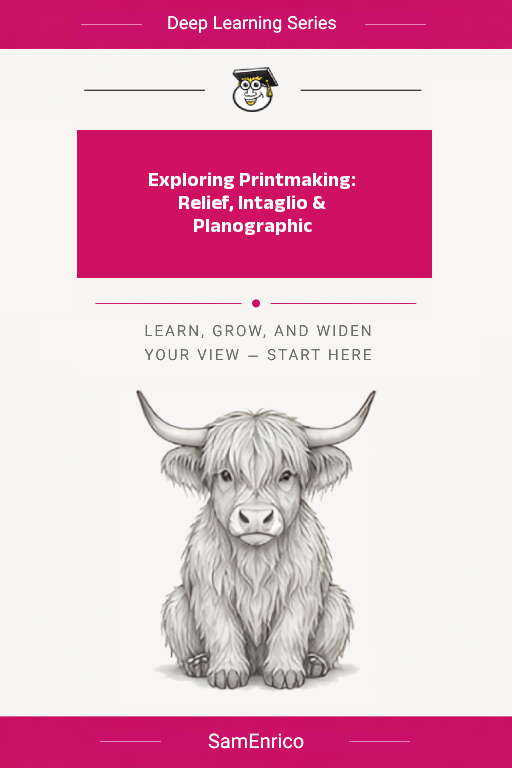
Non-FictionInformativeEducational
Exploring Printmaking: Relief, Intaglio & Planographic
This publication, published by SamEnrico, covers E
This publication, published by SamEnrico, covers Exploring Printmaking: Relief, Intaglio & Planographic
Formats
About this book
Free sample
Chapter 1: The Matrix Spring...--–- The first time you pull a print—lifting the damp paper from the inked block, peeling back the corner to reveal what the press has wrought—you experience something that no painter or draftsman ever feels. The image appears reversed, flipped like a mirror. The lines you carved with such intention now read backward, yet somehow truer. The blank spaces you thought you left empty have become dark, and the dark passages you worried over have become light. In that single moment of revelation, you understand: printmaking is not drawing by other means.
It is an entirely different language, one that speaks in multiples, in reversals, in the conversation between absence and presence.This book is about learning to speak that language. Not fluently—fluency takes years—but competently enough to say what you need to say. By the time you finish these twelve chapters, you will have pulled prints from linoleum and wood, from etched copper and scratched plastic, from limestone and aluminum foil, from silk screens and collaged cardboard. You will have made editions of ten and editions of one. You will have failed in instructive ways and succeeded in unexpected ones.
And you will understand why printmaking has survived every technological revolution—from photography to digital imaging—not as a relic, but as a vital, evolving artistic practice.But first, we must answer a question that every printmaker must answer for themselves: Why reproduce? Why go to all the trouble of carving, etching, or drawing on a matrix—only to make multiple copies of the same image? Why not simply draw the image ten times, or paint it, or photograph it? The answer is not obvious, and anyone who claims it is has not thought deeply about what printmaking actually does.The First Question: Why the Multiple?Consider a painting. A painting is singular.
It hangs on a wall, and if you want to see it, you must travel to its location or settle for a reproduction that is not the thing itself. The painting's value is tied to its uniqueness…
This is the end of the free sample. Get the eBook to keep going. Buy now
Contents
- Chapter 1
- Chapter 2
- Chapter 3
- Chapter 4
- Chapter 5
- Chapter 6
- Chapter 7
- Chapter 8
- Chapter 9
- Chapter 10
- Chapter 11
- Chapter 12
Details
- Author
- Epperson Marhta
- Publisher
- SamEnrico
- Language
- English
- Genre
- Non-Fiction, Informative, Educational
- Released
- 2026-05-08
- Pages (approx.)
- 142
- Available as
- eBook, Audiobook

Read better in the ZLOADR app
Your eBooks on your phone or tablet. Sign in with your SamEnrico account and start reading.
More by Epperson Marhta
 Scott Walker Climate HunterEpperson Marhta$11.99
 Legal Sector Talent MovementEpperson Marhta$11.99
 Imposter For Women GuideEpperson Marhta$11.99
 Investigator Case BlockingEpperson Marhta$11.99
 Founder Home Office DeductionEpperson Marhta$11.99
 Focus After Lunch SlumpEpperson Marhta$11.99
 The Polyglot Corsairs: Black Linguists Who Commanded the SeasEpperson Marhta$11.99
 Background Music for TranceEpperson Marhta$11.99
 The Hollow Smile: A Victorian Murderess in the Shadows of LondonEpperson Marhta$11.99
 Cabbage: Head Harvesting GuideEpperson Marhta$11.99
 How to Produce DoorsEpperson Marhta$11.99
 Turkish Stock Option Withholding RequirementsEpperson Marhta$12.99
You may also like
 Hong Kong Handover 1997Dunn Johnnie$11.99
 Zumba For Postnatal Recovery CourseNeal Christian$11.99
 Zumba for BeginnersLadner Nikia$11.99
 YouTube Comment Mining GuideHumes Pandora$12.99
 Worry Box MeditationCarlin Rudy$11.99
 Workplace Stress MeditationNguyen Lynn$11.99
 Workplace Stress and Sleep RepairHawley Ivory$11.99
 Workplace Perfectionism CureDelaney Jeffry$11.99
 Workplace Injustice Anger GuideWallen Isabelle$11.99
 Work Addiction and Burnout LinkGreenwood Ester$11.99
 Women in Yoga and WellnessBeattie Galina$11.99
 Women in Stand Up ComedyChun Evangeline$11.99