
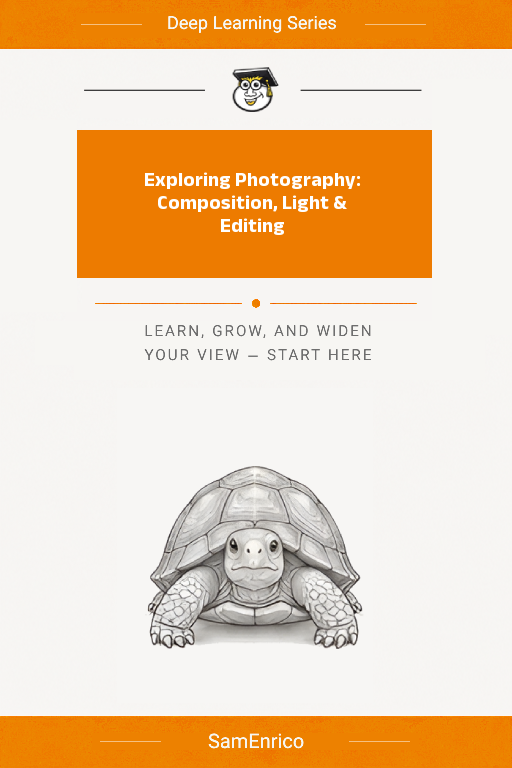
Non-FictionInformativeEducational
Exploring Photography: Composition, Light & Editing eBook
This publication, published by SamEnrico, covers E
This publication, published by SamEnrico, covers Exploring Photography: Composition, Light & Editing
Formats
Free sample
Chapter 1: The Obvious Lie...--Every beginner photographer has heard the same promise: learn the Rule of Thirds, master leading lines, frame your subject correctly, and your photos will transform from snapshots into art. It is the most widely repeated, sincerely believed, and demonstrably false statement in all of photography.You have felt the disappointment yourself. You carefully placed your subject at the intersection points. You found a beautiful leading line—a fence, a river, a path—pointing straight at them. You framed them through a window, an archway, a gap in the leaves.
You followed every rule in every tutorial you have ever watched. And when you looked at the resulting image, something was missing. It was technically correct. It was compositionally flawless by any textbook standard. And it was utterly, profoundly boring.This chapter exists because that disappointment is not your fault.
It is the fault of the rules themselves—or rather, the way they are taught. The standard rules of composition (Rule of Thirds, Leading Lines, Framing, Symmetry, Patterns, and the rest) are not wrong. They are simply incomplete. They are training wheels, not an engine. They teach you where to put things, but they do not teach you how to feel.
They teach you geometry, but they do not teach you intention. And until you understand the difference between following rules and making choices, you will continue to produce technically correct photographs that nobody remembers five seconds after scrolling past them.This chapter will do something most photography books refuse to do: it will teach you the rules, then immediately show you why breaking them is often better. More importantly, it will introduce a different way of seeing altogether—what I call Advanced Seeing—that prioritizes visual weight, balance, and emotional intention over rigid grids. By the end of this chapter, you will stop asking "Am I following the rules?" and start asking a much more useful question: "What am I trying to make the viewer feel?"The Gateway Rules: What They Are and Why They Work (For About Five Minutes)Before we break the rules, we need to be honest about what they actually do well. The standard composition rules are not arbitrary.
They were not invented by some long-dead painter to torment photography students. They emerged from centuries of visual art because they describe something real about how human eyes and brains process images.The Rule of Thirds imagines a 3x3 grid over your frame and suggests placing important elements along those lines or at their intersections. It works because human eyes rarely rest at the exact center of an image. We scan. We wander.
The Rule of Thirds creates asymmetry that feels dynamic and natural. A horizon line on the bottom third feels expansive; a subject on the left third feels like it has somewhere to go.Leading Lines are exactly what they sound like: lines within your image (roads, fences, arms, rivers, shadows) that point toward your main subject. They work because human attention follows contrast and direction. A line that points at something is almost impossible for the viewer to ignore. It is visual gravity.Framing means using elements in your scene (windows, doorways, tree branches, archways) to create a border around your subject.
It works because frames create depth and context. A subject seen through a window feels more intimate than the same subject standing in an open field. The frame says: "Look here. This matters."These rules work. They are not scams or shortcuts.
If you have never used them before, practicing them for an afternoon will genuinely improve your photography. You will take images that feel more balanced, more directed, more intentional. That is real progress.The problem is not that the rules fail. The problem is that they succeed so reliably that most photographers stop there. They learn the Rule of Thirds, see immediate improvement, and assume that the rules are the destination rather than the bus that takes you to the destination.
They spend years asking "Is my subject on a third?" when they should be asking "What am I trying to say about this subject?"The gateway rules get you to competence. They do not get you to voice. And voice—the unmistakable sense that a photograph could only have been made by you—is the only thing that separates a technically correct image from a memorable one.The Record Shot vs. The Interpretation Here is the single most useful distinction you will learn in this entire book. Every photograph you have ever taken falls into one of two categories, and most beginners spend 90% of their time in the first category without even realizing the second exists.The Record Shot is what happens when you point your camera at something interesting and press the shutter.
You see a beautiful tree. You photograph the beautiful tree. You show your friend, who says, "Oh, that is a beautiful tree." The photograph is a document. It says: this thing existed, and I was there. Record shots are not bad.
They are useful for real estate listings, product documentation, and vacation memories. But they are not art, and they are not memorable. They communicate information, not feeling.The Interpretation is what happens when you point your camera at something interesting and ask yourself: "What did it feel like to be here?" A record shot of a forest shows trees. An interpretation of a forest shows the silence, the dappled light, the sense of smallness, the green hush. A record shot of a crowded street shows people.
An interpretation shows the energy, the anonymity, the rhythm of footsteps, the collision of strangers.Here is the crucial insight: the same scene, photographed from the same position with the same camera settings, can be either a record shot or an interpretation. The difference is not in your gear. It is in your intention. It is in what you choose to include, what you choose to exclude, where you place the horizon, whether you wait for the person to walk into the light or photograph them in shadow.Most photographers take record shots and wonder why they do not feel moved by their own work. You are not moved because you did not put anything in the image to be moved by.
You documented. You did not interpret.The exercises in this chapter and throughout this book are designed to pull you out of record-shot mode and into interpretation mode. It is uncomfortable at first because it requires you to make choices that cannot be reduced to a checklist. No rule tells you whether a scene feels lonely or peaceful. You have to decide.
That is the work.Advanced Seeing: Beyond the Grid If the gateway rules are about geometry, Advanced Seeing is about psychology. It asks three questions before any question about grids, lines, or frames.Question One: What is the visual weight of every element in this frame?Visual weight is the measure of how much attention an element demands. Large objects have more weight than small ones. Bright objects have more weight than dark ones. High-contrast edges have more weight than smooth gradients.
Faces have enormous weight—we cannot help but look at eyes. Red has more weight than blue. Sharp focus has more…
This is the end of the free sample. Get the eBook to keep going. Buy now
About this book
Details
- Author
- Stanton Deidra
- Publisher
- SamEnrico
- Language
- English
- Genre
- Non-Fiction, Informative, Educational
- Released
- 2026-06-02
- Pages (approx.)
- 135
- Available as
- eBook, Audiobook

Read better in the ZLOADR app
Your eBooks on your phone or tablet. Sign in with your SamEnrico account and start reading.
More by Stanton Deidra
 James Brown Godfather SoulStanton Deidra$11.99
 Success Ownership WorkbookStanton Deidra$11.99
 Deep Work For AccountantsStanton Deidra$11.99
 Retiree Talent Migration PatternsStanton Deidra$11.99
 Writer Time Blocking GuideStanton Deidra$11.99
 Theme Days Scheduling GuideStanton Deidra$11.99
 The Startup Audit Prep GuideStanton Deidra$11.99
 The Great Spruce Heist: How One Tree Changed a NationStanton Deidra$11.99
 PT Master GuideStanton Deidra$11.99
 The Golden Road of Axum: Africa's Forgotten Maritime EmpireStanton Deidra$11.99
 How to Produce Pool and SPA Chlorine GeneratorsStanton Deidra$11.99
 Brown Mustard: Seed HarvestingStanton Deidra$11.99
You may also like
 Hong Kong Handover 1997Dunn Johnnie$11.99
 Zumba For Postnatal Recovery CourseNeal Christian$11.99
 Zumba for BeginnersLadner Nikia$11.99
 YouTube Comment Mining GuideHumes Pandora$12.99
 Worry Box MeditationCarlin Rudy$11.99
 Workplace Stress MeditationNguyen Lynn$11.99
 Workplace Stress and Sleep RepairHawley Ivory$11.99
 Workplace Perfectionism CureDelaney Jeffry$11.99
 Workplace Injustice Anger GuideWallen Isabelle$11.99
 Work Addiction and Burnout LinkGreenwood Ester$11.99
 Women in Yoga and WellnessBeattie Galina$11.99
 Women in Stand Up ComedyChun Evangeline$11.99