
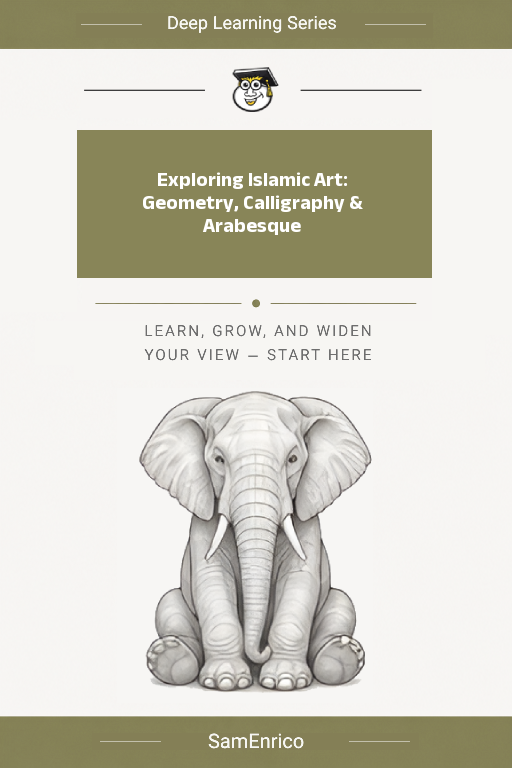
Non-FictionInformativeEducational
Exploring Islamic Art: Geometry, Calligraphy & Arabesque
This publication, published by SamEnrico, covers E
by Bunn Randell
This publication, published by SamEnrico, covers Exploring Islamic Art: Geometry, Calligraphy & Arabesque
Formats
About this book
Free sample
Chapter 1: The Unseen Icon...–- In the winter of 1910, a young Spanish architect named Antonio Gaudí stood in the courtyard of the Alhambra in Granada, running his fingers along the carved stucco walls. He was not looking at the famous lions or the fountains. He was tracing a single, repeating star. Years later, the undulating geometry of Islamic tilework would appear in the serpentine benches of Park Güell and the skeletal arches of the Sagrada Família. Gaudí understood something that Western art history would spend most of the 20th century catching up to: that the absence of the human figure in Islamic sacred art was not a void waiting to be filled, but a door opening onto infinity.This chapter establishes the philosophical and theological foundation that sets Islamic sacred art apart from much of Western and Byzantine religious visual culture.
Rather than viewing the avoidance of human or divine figural representation as a limitation—a “prohibition” that stifled creativity—we will argue that the concept of aniconism, particularly in religious contexts, redirected creative energy toward the abstract, the mathematical, and the lyrical. The result is one of the most sophisticated visual traditions in human history, one rooted not in the imitation of nature but in the revelation of cosmic order.The Theological Root: Tawhid and the Problem of Likeness To understand Islamic art, one must first understand the Islamic conception of God. The central theological pillar is Tawhid — the absolute, uncompromising oneness and unity of Allah. This is not merely monotheism in the sense of believing in one God rather than many. Tawhid goes deeper: it asserts that God is utterly transcendent, infinite, and unlike anything within creation.
As the Qur’an states in Surah 112, “Say: He is Allah, the One. Allah, the Eternal Refuge. He neither begets nor is born, nor is there to Him any equivalent.”The critical phrase is the last: “nor is there to Him any equivalent.” If God has no equivalent, then any attempt to depict Him visually is not merely inadequate—it is inherently false. A painting or sculpture of the divine, no…
This is the end of the free sample. Get the eBook to keep going. Buy now
Contents
- Chapter 1
- Chapter 2
- Chapter 3
- Chapter 4
- Chapter 5
- Chapter 6
- Chapter 7
- Chapter 8
- Chapter 9
- Chapter 10
- Chapter 11
- Chapter 12
Details
- Author
- Bunn Randell
- Publisher
- SamEnrico
- Language
- English
- Genre
- Non-Fiction, Informative, Educational
- Released
- 2026-06-02
- Pages (approx.)
- 137
- Available as
- eBook, Audiobook

Read better in the ZLOADR app
Your eBooks on your phone or tablet. Sign in with your SamEnrico account and start reading.
More by Bunn Randell
 Congressional Primary ChallengesBunn Randell$11.99
 Spotify Wrapped Comparison GuideBunn Randell$11.99
 Beyonce Lemonade FormationBunn Randell$11.99
 No Meeting Day StrategyBunn Randell$11.99No Meeting Day StrategyBunn Randell$11.99
 Social Media Blocking AppsBunn Randell$11.99
 Weekly Review SchedulingBunn Randell$11.99
 Email Can It Be An FAQBunn Randell$11.99
 Scripting for OCD ManagementBunn Randell$11.99
 The Druids of Healing: Celtic Medicine in the Iron AgeBunn Randell$11.99
 The Great Brink's Job: The Heist That Shook Prohibition AmericaBunn Randell$11.99
 Arrowroot: How to Harvest Rhizomes For Starch ProductionBunn Randell$11.99
You may also like
 Hong Kong Handover 1997Dunn Johnnie$11.99
 Zumba For Postnatal Recovery CourseNeal Christian$11.99
 Zumba for BeginnersLadner Nikia$11.99
 YouTube Comment Mining GuideHumes Pandora$12.99
 Worry Box MeditationCarlin Rudy$11.99
 Workplace Stress MeditationNguyen Lynn$11.99
 Workplace Stress and Sleep RepairHawley Ivory$11.99
 Workplace Perfectionism CureDelaney Jeffry$11.99
 Workplace Injustice Anger GuideWallen Isabelle$11.99
 Work Addiction and Burnout LinkGreenwood Ester$11.99
 Women in Yoga and WellnessBeattie Galina$11.99
 Women in Stand Up ComedyChun Evangeline$11.99