
Non-FictionInformativeEducational
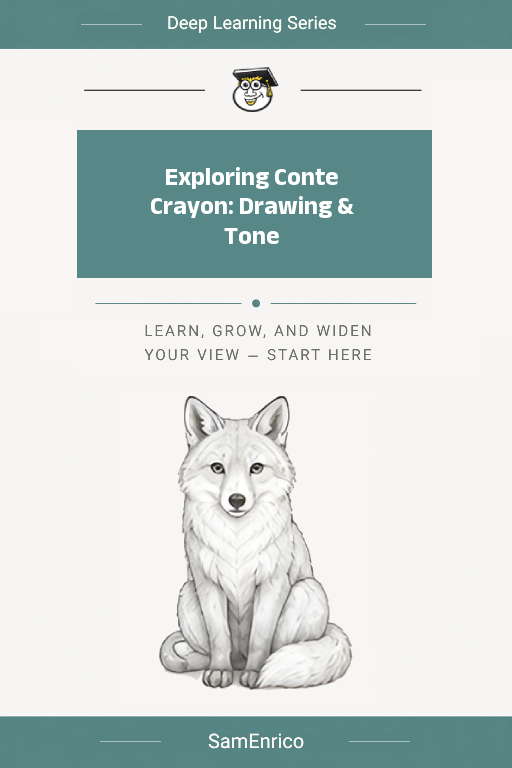
Exploring Conte Crayon: Drawing & Tone eBook
This publication, published by SamEnrico, covers E
This publication, published by SamEnrico, covers Exploring Conte Crayon: Drawing & Tone
Formats
Free sample
Chapter 1: The Grey Revolution...--–- Most beginners believe that mastering an art medium begins with learning to draw. They buy a pencil, a pad of white paper, and an eraser. They sketch outlines. They shade. They erase.
They try again. And then, somewhere between the third and fourth attempt, they quit. Not because they lack talent, but because the white page is a tyrant. It demands perfection. Every mistake glares back.
Every uncertain line screams for correction.But what if the page itself could do half the work? What if the medium you chose forced you to think not in outlines, but in masses of light and shadow? What if you could never erase, never fiddle, never lose yourself in the deadly trap of "fixing" a drawing until it dies?That is the promise of Conte crayon.This book is called Exploring Conte Crayon: Drawing & Tone, but this first chapter is not about Conte. Not yet. It is about a revolution in how you see, how you begin, and why everything you have been taught about drawing on white paper has been making your life harder than it needs to be.Welcome to the Grey Revolution.The Tyranny of the White Page White paper is beautiful.
It is also a liar.When you place a mark on a pure white sheet, every stroke is judged against an impossible standard: absolute brightness. Your lightest grey, no matter how carefully applied, looks dark compared to the untouched paper. Your mid-tones shift and muddy because you have no anchor. Your darks feel weak because you are afraid to commit. And that blank rectangle of bleached cellulose stares back at you like a courtroom judge waiting for you to fail.This is not your fault.
It is physics.The human eye can distinguish roughly 10,000 distinct values of light and dark. Your Conte crayon, no matter how skillfully handled, can reproduce perhaps 20 of those values on a good day. The white page demands that you create the entire illusion of volume, depth, and atmosphere using only those 20 steps, starting from the brightest possible white and working down into darkness.That is like trying to build a mountain range by removing dirt from a flat plain. It is possible, but exhausting, and most people give up before they reach the first foothill.There is another way.The One-Hundred-Year Secret of the Old Masters Walk through any major museum. Find the drawings by Rembrandt, Degas, Watteau, or Seurat.
Look closely at the paper. You will notice something surprising: it is rarely white. It is grey, tan, buff, blue-grey, or warm brown.These artists were not being eccentric. They were being smart.The toned paper method—using a mid-value paper as the drawing's middle tone, then adding only lights and darks—was the secret workhorse of European drawing for centuries. It appears in the workshop practices of the Renaissance, the sketchbooks of the Dutch Golden Age, and the finished studies of the French Impressionists.
But somewhere around the mid-twentieth century, art education forgot this method. Students were handed bright white sketchbooks and told to "shade from light to dark." The old wisdom was lost.This book is designed to bring it back.The core principle is almost insultingly simple: Stop fighting the paper. Let it be your friend. Choose a paper that is already grey (or tan, or blue-grey, or cream). That middle value becomes your starting point—your home base.
Then, instead of trying to create an entire range of values from white to black, you only need to add two things:Darks (black or sanguine Conte) to push certain areas down toward shadow.Lights (white Conte) to pull certain areas up toward highlight.Everything else—the vast middle range of the drawing—is already there, waiting for you, in the paper itself.This is not a shortcut. It is a fundamental shift in thinking. You stop being a "shader" and become a sculptor of light. You add darkness where you want it. You add brightness where you want it.
You leave everything else alone.The One-Minute Demonstration That Will Change Your Drawing Life Do not read this section. Do the exercise.What you need:One sheet of grey or tan paper (if you have nothing else, a brown paper bag works)One black Conte crayon (or a soft pencil if Conte has not arrived yet)One white Conte crayon or white chalk A desk lamp A simple object—an orange, an apple, or a coffee mug The exercise (60 seconds, timed):Place the object under the lamp so the light hits it from one side.Look at the object. Do not see an apple. See three things: a dark side, a middle side, and a light side.Using only the black Conte, roughly scribble the dark side onto the paper. Do not outline.
Just block. Let it be messy.Using only the white Conte, roughly scribble the light side onto the paper. Again, no outlines. Just block.Leave the middle of the paper empty. That is the paper's own tone.Stop.Look at what you have just made.It is not a masterpiece.
It is probably ugly, smudged, and imprecise. But I guarantee you this: it looks like a three-dimensional object sitting in real space. It has weight. It has volume. It has atmosphere.
And it took you sixty seconds.That is the power of the toned paper method. That is why this chapter comes first. Not because you need to master materials, but because you need to experience success immediately. That messy, sixty-second drawing is more convincing than most beginner drawings that take an hour of careful shading on white paper.Welcome to the Grey Revolution. You are already winning.Why Conte Crayon Specifically?Charcoal can do this.
So can soft pastel. So can a 6B pencil. Why devote an entire book to Conte crayon?Because Conte occupies a unique position on the spectrum of dry drawing media, and that position makes it the perfect teacher for the toned paper method.Compared to charcoal: Charcoal is soft, dusty, and smudges at a glance. It is beautiful but imprecise. A charcoal drawing on toned paper can feel atmospheric and poetic, but it resists control.
Conte is harder, waxier, and more stable. It holds a sharp edge. It layers without obliterating what is underneath. It can be erased without turning into a grey ghost. Conte is the medium for artists who want the speed of charcoal but the precision of graphite.Compared to graphite (pencil): Graphite is shiny.
On toned paper, graphite reflects light and reads as metallic, not as a true dark. Graphite also resists layering; after two or three passes, the paper's tooth fills up and the pencil skates over the surface. Conte is matte. It absorbs light. It reads as true black or true sanguine or true white.
And Conte can be layered ten or twelve times before the paper gives up.Compared to soft pastel: Pastel is pure pigment suspended in minimal binder. It is lush, vibrant, and fragile. A pastel drawing on toned paper is a beautiful thing, but it requires fixative after every layer and crumbles under any pressure. Conte is pastel's…
This is the end of the free sample. Get the eBook to keep going. Buy now
About this book
Details
- Author
- Redden Emeline
- Publisher
- SamEnrico
- Language
- English
- Genre
- Non-Fiction, Informative, Educational
- Released
- 2026-06-02
- Pages (approx.)
- 143
- Available as
- eBook, Audiobook

Read better in the ZLOADR app
Your eBooks on your phone or tablet. Sign in with your SamEnrico account and start reading.
More by Redden Emeline
 Divorce and Reinvention After FiftyRedden Emeline$11.99
 Menopause Empowerment JournalRedden Emeline$11.99
 The Thought Leadership BrandRedden Emeline$11.99
 Weekly Wins and LossesRedden Emeline$11.99
 Email Notification Silence ProtocolRedden Emeline$11.99
 Rejection Resilience HypnosisRedden Emeline$11.99
 Color Coded Time BlockingRedden Emeline$11.99
 Love Letters from the Trenches: The Secret Romance of Vera Brittain and Roland LeightonRedden Emeline$11.99
 Titian: The Venetian Sun That Painted HeavenRedden Emeline$11.99
 Chinese Supplier Design Ownership BlueprintRedden Emeline$12.99
 Exit Strategy SnapshotRedden Emeline$12.99
 How to Produce Disposable GlovesRedden Emeline$11.99
You may also like
 Hong Kong Handover 1997Dunn Johnnie$11.99
 Zumba For Postnatal Recovery CourseNeal Christian$11.99
 Zumba for BeginnersLadner Nikia$11.99
 YouTube Comment Mining GuideHumes Pandora$12.99
 Worry Box MeditationCarlin Rudy$11.99
 Workplace Stress MeditationNguyen Lynn$11.99
 Workplace Stress and Sleep RepairHawley Ivory$11.99
 Workplace Perfectionism CureDelaney Jeffry$11.99
 Workplace Injustice Anger GuideWallen Isabelle$11.99
 Work Addiction and Burnout LinkGreenwood Ester$11.99
 Women in Yoga and WellnessBeattie Galina$11.99
 Women in Stand Up ComedyChun Evangeline$11.99