
Non-FictionInformativeEducational
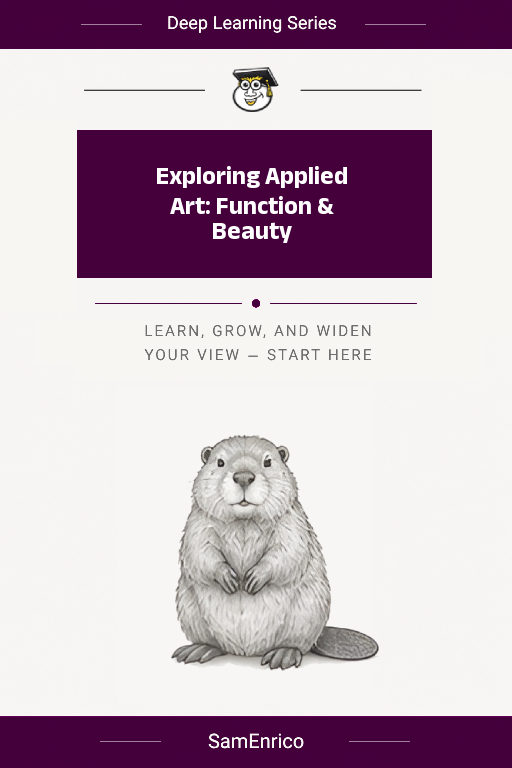
Exploring Applied Art: Function & Beauty eBook
This publication, published by SamEnrico, covers E
by Rivera Guy
This publication, published by SamEnrico, covers Exploring Applied Art: Function & Beauty
Formats
Free sample
Chapter 1: The Teapot Paradox...--–- Every morning, millions of people around the world perform a small miracle. They walk into their kitchens, fill a metal or ceramic vessel with water, place it over heat, and wait. When the water boils, they pour it over dried leaves, let it steep, and then lift a cup to their lips. In that ordinary sequence of actions—heating, pouring, steeping, drinking—they participate in an aesthetic experience that has occupied philosophers, artists, and craftspeople for centuries. The teapot in their hands is not merely a tool.
It is not merely a decoration. It is something that lives in the borderlands between function and beauty, between use and contemplation, between the hand and the eye. And understanding exactly what that something is—and why it matters—is the work of this book.This chapter dismantles the shallow definition of applied art as merely "decorated utility" or "fine art for the home." It establishes a robust, three-part framework to distinguish between Applied Art, Craft, and Design—but immediately notes that these categories are best understood as fluid positions on a spectrum rather than rigid boxes. It then deeply interrogates the concept of "function," expanding it beyond simple physical utility to include social function and ceremonial or symbolic function. Using the teapot as the book's central recurring example, the chapter asks: how does the spout's pour (function) affect our judgment of the glaze and profile (beauty)?
The conclusion positions applied art as the space where these categories overlap and dialogue, refusing to be reduced to any single one.Why We Need a New Framework For most of Western history, the objects we now call applied art existed in a kind of conceptual shadow. They were too useful to be treated as serious art, too beautiful to be treated as mere tools, and too various to be captured by any single discipline. A medieval chalice lived in a cathedral, used in the most sacred ritual of the faith, but it was also made by a goldsmith who worked with his hands—and in the Renaissance hierarchy of the arts, working with your hands was intellectually inferior to painting or sculpture, which were understood to emerge from the mind (the disegno, or design, of the intellect). A Qing dynasty vase lived in an emperor's palace, admired for its glaze and form, but it was also a container for flowers. A Shaker chair lived in a communal dwelling, valued for its honest construction and perfect utility, but it was also an object of such refined proportion that museums now display it alongside paintings.This shadow existence has produced a peculiar problem.
We have many words for these objects—craft, decorative art, applied art, design, studio craft, artisanal work—but the words often overlap, contradict, or obscure more than they reveal. A potter who throws a hundred identical mugs for a restaurant order is doing something different from a potter who throws a single vessel over the course of a month, fires it multiple times, and signs it on the bottom. Yet both are called "craft." An industrial designer who sketches a chair that will be manufactured in thousands of copies is doing something different from a cabinetmaker who builds a single chair over two hundred hours, shaping each joint by hand. Yet both are called "design." A glass artist who blows a vessel that can hold water but is too fragile to ever be used is doing something different from a glassblower who produces drinking glasses for a hotel. Yet both are called "applied art."The first task of this book, then, is to bring clarity to confusion.
We need a framework that respects the real differences between these practices while also recognizing that the most interesting work happens at their borders. And we need that framework to be practical—something a student, a practitioner, or an enthusiast can actually use to see the world of objects more clearly.The Three-Part Framework: Applied Art, Craft, and Design Let us begin with the simplest possible distinction. Imagine three objects.Object A is a ceramic bowl, thrown on a potter's wheel, glazed in a complex tenmoku glaze that the potter spent years developing, fired in a kiln that the potter built herself, and signed on the bottom. She made exactly twelve of them, each slightly different, and she sells them in a gallery for a price that reflects the hundreds of hours she spent learning her craft and the three weeks she spent on this particular batch. You could eat soup from this bowl.
It functions perfectly well. But the potter does not think of herself primarily as a bowl-maker. She thinks of herself as an artist who works in clay.Object B is a ceramic mug, wheel-thrown by a production potter in a studio with three assistants. They make five hundred mugs a week, all identical, sold through a catalog to restaurants and cafes. The glaze is a standard recipe.
The firing is electric and predictable. The potter takes pride in the consistency and durability of the mugs—a customer once reported dropping one on a concrete floor without breakage—but she does not sign them. She thinks of herself as a craftsperson who makes reliable, beautiful tools for everyday use.Object C is a ceramic espresso cup, designed by a famous industrial designer who has never touched clay in his life. He drew the shape on a computer, specified the exact radius of the handle's curve, and sent the digital file to a factory in Portugal. The factory produces fifty thousand of them.
They are sold in a design museum's gift shop for a moderate price. The designer thinks of himself as a problem-solver who created an elegant solution to the challenge of holding a small amount of very hot liquid without burning the user's fingers.Three objects. Three different relationships to making, to uniqueness, to the market, and to the idea of art. What distinguishes them?The framework this book proposes has three poles: Applied Art, Craft, and Design. Each is defined by a different center of gravity.Applied Art is oriented toward the aesthetic and the unique.
The applied artist is working in a tradition of fine art practice—she has a signature style, she produces limited editions or one-of-a-kind pieces, she exhibits in galleries and museums, and she is judged by critics and collectors according to criteria that overlap significantly with those used for painting and sculpture. The fact that her work is functional is almost incidental; she could just as easily make purely sculptural work, and she often does. When the applied artist makes a teapot, the teapot is a vehicle for her artistic vision. The question "Does it pour well?" is secondary to "Does it express something meaningful?"Craft is oriented toward skill and tradition. The craftsperson is working in a lineage of material practice—she learned her skills through apprenticeship or extended study, she values mastery of technique for its own sake, and her work is judged primarily by how well it performs its intended function and by the quality of its making.
The craftsperson may produce unique pieces or production runs, but in either case, the object's identity is tied to the…
This is the end of the free sample. Get the eBook to keep going. Buy now
About this book
Details
- Author
- Rivera Guy
- Publisher
- SamEnrico
- Language
- English
- Genre
- Non-Fiction, Informative, Educational
- Released
- 2026-06-02
- Pages (approx.)
- 145
- Available as
- eBook, Audiobook

Read better in the ZLOADR app
Your eBooks on your phone or tablet. Sign in with your SamEnrico account and start reading.
More by Rivera Guy
 Menopause Oral Health GuideRivera Guy$11.99
 Sunday Planning Ritual GuideRivera Guy$11.99
 Stress and TachycardiaRivera Guy$11.99
 Email Marketing Compliance GuideRivera Guy$11.99
 Age Gap Relationship StressRivera Guy$11.99
 Dorothy Hodgkin Chemistry PioneerRivera Guy$11.99
 Self Compassion HypnosisRivera Guy$11.99
 ABCDE for JournalistsRivera Guy$11.99
 The Siege of Fort Jesus: The Prohibition-Era Prison Break That Shook East AfricaRivera Guy$11.99
 The Derby Duel: How Rivalry Forged Modern Football's Greatest ClubsRivera Guy$11.99
 How to Produce Plastic TubingRivera Guy$11.99
 Transport Cooperative Model GuideRivera Guy$12.99
You may also like
 Hong Kong Handover 1997Dunn Johnnie$11.99
 Zumba For Postnatal Recovery CourseNeal Christian$11.99
 Zumba for BeginnersLadner Nikia$11.99
 YouTube Comment Mining GuideHumes Pandora$12.99
 Worry Box MeditationCarlin Rudy$11.99
 Workplace Stress MeditationNguyen Lynn$11.99
 Workplace Stress and Sleep RepairHawley Ivory$11.99
 Workplace Perfectionism CureDelaney Jeffry$11.99
 Workplace Injustice Anger GuideWallen Isabelle$11.99
 Work Addiction and Burnout LinkGreenwood Ester$11.99
 Women in Yoga and WellnessBeattie Galina$11.99
 Women in Stand Up ComedyChun Evangeline$11.99