
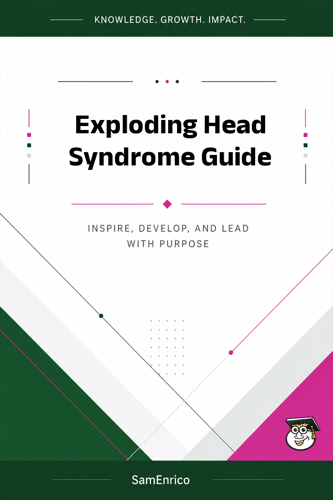
Non-FictionHealth & WellnessParasomnia
Exploding Head Syndrome Guide eBook
Loud imaginary noises at sleep onset are harmless.
Loud imaginary noises at sleep onset are harmless.
Formats
Free sample
Chapter 1: The Midnight Bang--The first time it happened, I was twenty-three years old, living in a cramped studio apartment with paper-thin walls, and I was absolutely certain someone had fired a gun through my window. I hit the floor before my eyes were fully open—a tangle of sheets, a bruised elbow, a heart slamming against my ribs like a prisoner demanding release. I lay there on the cold hardwood for what felt like five minutes, waiting for the next shot, for the sound of sirens, for the pain of a bullet I was sure had already found me. Nothing came. Just silence.
Just my own ragged breathing. Just the distant hum of the refrigerator and the soft tick of the clock on my nightstand.When I finally crawled back into bed, my hands were shaking so badly I couldn't hold my phone. I checked the window anyway. No cracks. No blood.
No police outside. I checked the news. No reports of nearby shootings. I checked my body for wounds. Nothing.
And then I lay there, wide awake until dawn, absolutely convinced that either I had had a stroke or I was losing my mind. I didn't tell anyone for months. I was embarrassed. I was scared. And I was completely, utterly alone with a secret I couldn't explain.That secret has a name.
It has a medical classification, a neurological mechanism, and a surprisingly large community of people who experience the exact same thing. It is called Exploding Head Syndrome, and the only thing more frightening than the name is how many people suffer through it in silence, convinced they are the only one.This chapter is an invitation to stop suffering alone. Before we dive into the neurobiology, before we talk about triggers and treatments and the vicious cycle of anxiety, we need to start with the most basic question of all: What actually is this thing? And just as importantly, what is it not?The Name Is Terrible. Let's Talk About That First.Let me address the elephant in the room immediately.
Exploding Head Syndrome sounds like a made-up condition from a late-night horror movie or a heavy metal band name. It is absurd. It is dramatic. It is, frankly, the worst possible name for something that is completely harmless. And yet, that is the official medical term.The name originated in 1988 when British neurologist J.M.S.
Pearce published a case series describing fifty patients who reported sudden, loud, imagined noises at the moment of falling asleep or waking up. He called it "exploding head syndrome" because that is precisely what his patients described: the sensation that their head had exploded from the inside. The name stuck, not because it is accurate (no heads actually explode), but because it is unforgettable. And in medicine, unforgettable names help doctors remember rare conditions.But here is the crucial thing to understand: the name describes the sensation, not the reality. You feel like your head exploded.
It did not. You hear a gunshot. There was no gun. A voice screams your name. No one spoke.
The entire event happens inside your brain, and it leaves no physical trace whatsoever. Think of it this way: if you have ever been jolted awake by a dream of falling, you know that the sensation of falling was vivid and real, even though you remained safely in your bed. Exploding Head Syndrome is exactly that—except instead of a falling sensation, you get a sound. A very, very loud sound. A sound that, in the moment, feels absolutely real.The technical medical name, by the way, is "episodic cranial sensory shock," which is more accurate but far less memorable.
I will stick with EHS for the rest of this book because that is what people search for, what people fear, and what people eventually learn to live with.The Official Definition (As Boring As It Is Important)The International Classification of Sleep Disorders, Third Edition (ICSD-3) is the global standard for diagnosing sleep conditions. It is not light reading—it is a dense, thousand-page textbook filled with Latin terms and flowcharts. But buried in its pages is a definition of EHS that is actually quite useful. According to the ICSD-3, EHS has the following diagnostic criteria:A. The patient reports a sudden, loud, imagined noise or sensation of explosion in the head that occurs at sleep onset or upon awakening.B.
The experience causes abrupt awakening, often with a feeling of fear or confusion that resolves quickly.C. There is no significant pain associated with the event. (If there is pain, you are dealing with something else.)D. The event is not better explained by another sleep disorder, medical condition, or substance use.That is it. Four criteria.
And the most important one for our purposes is letter C: no significant pain. EHS is startling. It is frightening. It can make your heart race and your palms sweat. But it does not hurt.
If you are experiencing actual head pain with these sounds, you need to see a doctor, because that is not EHS. We will cover those rare alternatives in Chapter 6, but for now, take comfort in knowing that pain is the dividing line between EHS and almost everything dangerous.The Sensory Spectrum: What People Actually Hear Here is where things get interesting. When most people hear the term "exploding head syndrome," they imagine a single specific sound: a bomb, a gunshot, a thunderclap. But the reality is far more varied. Over the past three decades, researchers have collected hundreds of patient descriptions, and the sensory spectrum of EHS is surprisingly broad.The most common sounds reported include:Explosions (fireworks, bombs, gas leaks igniting)Gunshots (pistols, rifles, sometimes entire volleys)Cymbals crashing (like a drum kit falling down stairs)Slamming doors (so real that people check their front door)Electrical buzzing or zapping (like a broken transformer or a taser)Loud ringing (similar to tinnitus but much louder and instantaneous)Crashing glass (windows, dishes, picture frames)But that is only the beginning.
Some people hear more unusual sounds:A voice shouting a single word (often their own name, sometimes a nonsense word like "hey" or "stop")A scream (either their own voice or someone else's)Paper tearing (oddly common in older adults)A loud click (like a camera shutter the size of a car)Ripping fabric (often described as "a sheet being torn in half")Static electricity (like touching a Van de Graaff generator)And then there are the sounds that seem almost personal. I have spoken with people who hear the specific creak of their childhood bedroom door, the exact ringtone of a deceased parent's phone, or the bark of a dog that died twenty years ago. These meaningful sounds are not coincidences; they appear to be the brain pulling from deep memory banks during the hypnagogic state. We will explore this fascinating phenomenon in Chapter 12, but for now, know that even strange, specific, or emotionally charged sounds are still just EHS.Less commonly, some people experience visual components along with the sound. Flashes of light (white, blue, or green) are the most frequent visual accompaniment, described as "a camera flash inside the skull" or "lightning behind the…
This is the end of the free sample. Get the eBook to keep going. Buy now
About this book
Details
- Author
- Dotson Sterling
- Publisher
- SamEnrico
- Language
- English
- Genre
- Non-Fiction, Health & Wellness, Parasomnia
- Released
- 2026-06-09
- Pages (approx.)
- 155
- Available as
- eBook, Audiobook

Read better in the ZLOADR app
Your eBooks on your phone or tablet. Sign in with your SamEnrico account and start reading.
More by Dotson Sterling
 Handling Bad News DeliveryDotson Sterling$11.99
 Email Priority Inbox GuideDotson Sterling$11.99
 Teen Public Speaking ConfidenceDotson Sterling$11.99
 The Delirium Tremens GuideDotson Sterling$11.99
 The Timbuktu Calculators: Africa's Forgotten Math RevolutionariesDotson Sterling$11.99
 Kate Middleton: The Palace PR CrisisDotson Sterling$11.99
 Understanding Xanthomatosis CerebrotendinousDotson Sterling$17.99
 How to Start a Barley Processing (blocked, Flaked, Puffed or Pearled) Business (Beginners Guide)Dotson Sterling$11.99
 User Testing Rejection RecoveryDotson Sterling$12.99
 Healthtech CAC StrategiesDotson Sterling$12.99
You may also like
 Hong Kong Handover 1997Dunn Johnnie$11.99
 Zumba For Postnatal Recovery CourseNeal Christian$11.99
 Zumba for BeginnersLadner Nikia$11.99
 YouTube Comment Mining GuideHumes Pandora$12.99
 Worry Box MeditationCarlin Rudy$11.99
 Workplace Stress MeditationNguyen Lynn$11.99
 Workplace Stress and Sleep RepairHawley Ivory$11.99
 Workplace Perfectionism CureDelaney Jeffry$11.99
 Workplace Injustice Anger GuideWallen Isabelle$11.99
 Work Addiction and Burnout LinkGreenwood Ester$11.99
 Women in Yoga and WellnessBeattie Galina$11.99
 Women in Stand Up ComedyChun Evangeline$11.99