
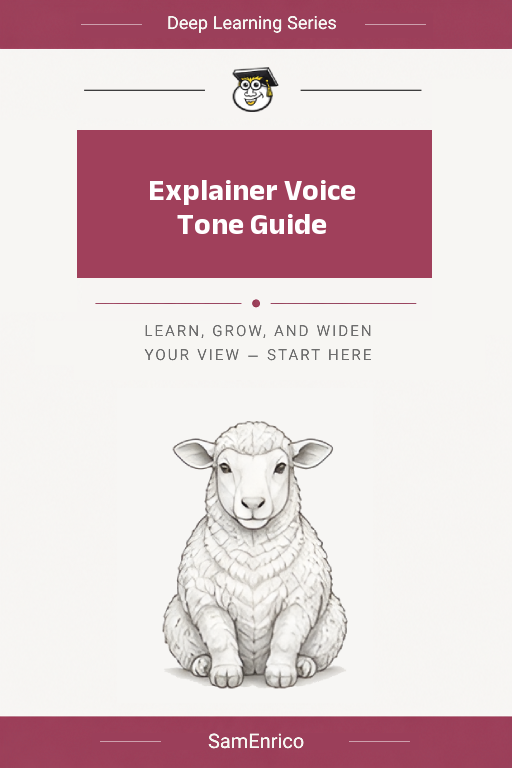
Non-FictionSide Hustle ArchitectToneStyle
Explainer Voice Tone Guide eBook
Match voice tone to explainer video style includin
Match voice tone to explainer video style including corporate friendly and conversational approaches.
Formats
Free sample
Chapter 1: The Three-Second Graveyard--–- You have already lost them.Before you read the second sentence of this chapter, a viewer somewhere has clicked away from your explainer video. Not because your product is bad. Not because your animation is cheap. Not because your script lacks facts. They clicked away because your voice—specifically, the tone of your voice—triggered an ancient, unconscious alarm in their brain that said: Do not trust this person.This is not hyperbole.
This is neuroscience wrapped in analytics, and it is the single most expensive misunderstanding in the explainer video industry today.Let me give you the number that should scare you: three seconds. That is the average time a viewer takes to decide whether to keep watching or scroll past. Three seconds is less time than it takes to tie a shoelace. It is less time than it takes to read this sentence aloud. And in that sliver of attention, your viewer is not evaluating your value proposition, your unique selling points, or your call to action.
They are evaluating you—specifically, whether your voice sounds like a truth-teller or a time-waster.I have consulted with companies that spent fifty thousand dollars on animated explainer videos only to watch them fail because the voice actor sounded like a used car salesman from 1987. I have seen startup pitch videos raise millions after a single voice re-recording—same script, same animation, different human. The difference was never the words. The difference was always the tone.This chapter is called The Three-Second Graveyard because that is where most explainer videos go to die: not in the boardroom, not in the budget meeting, but in the silent, unremarkable space between a viewer's thumb and a scroll. By the end of this chapter, you will understand exactly why viewers judge you in three seconds, what they are listening for, and—most importantly—how to stop burying your own work before it has a chance to breathe.The Explainer Paradox: Smart Enough to Trust, Simple Enough to Understand Here is the dilemma that haunts every explainer video creator.
Call it the Explainer Paradox.You need to sound smart. If you sound uncertain, hesitant, or uninformed, the viewer will assume your product or service is equally uncertain. Credibility is the currency of explanation, and you cannot spend what you do not have. So you prepare. You research.
You write a script packed with accurate, valuable information. You want to sound like an expert.But here is the trap: if you sound too smart—too polished, too rehearsed, too distant—the viewer will feel stupid. And humans hate feeling stupid more than they hate almost anything else. When a viewer feels stupid, they do not blame themselves. They blame you.
They click away, and they tell themselves the video was "boring" or "too corporate" or "talking down to me."So you need to sound simple. Approachable. Like a friend explaining something over coffee. But if you sound too simple—too casual, too loose, too unpolished—the viewer will doubt your expertise. They will wonder if you actually know what you are talking about or if you are just winging it.This is the paradox: smart enough to trust, simple enough to understand.
And the only way out of this paradox is not through your words—it is through your voice tone.Every word in your script could be perfect. Every fact could be verified. Every benefit could be crystal clear. And none of it will matter if your tone signals the wrong emotional contract with the viewer. Because here is the truth that most explainer video producers refuse to accept: Your voice tone is not a delivery mechanism for your words.
Your voice tone is the message.The viewer does not hear your words first. They hear your affect—your emotional state, your confidence level, your relationship to the material. Only after they have judged your tone do they decide whether to invest the cognitive energy required to parse your actual sentences. By the time they get to your brilliant third paragraph about integration protocols, they have already decided whether you are worth listening to.The Three-Second Judgment: What the Viewer Is Actually Listening For What happens in those first three seconds? Let me slow it down for you.Second one: The video starts.
The viewer's brain performs a rapid genre classification. Is this an ad? A tutorial? A sales pitch? A story?
The voice tone is the primary signal. A deep, slow, resonant voice says authority. A fast, high, breathy voice says friend. A flat, monotone voice says do not waste my time.Second two: The viewer performs a trust calculation. This is not logical; it is limbic.
The amygdala—the ancient part of the brain responsible for threat detection—is asking one question: Is this person safe to listen to? A voice that sounds uncertain (uptalk, hedge words, breathiness without intention) triggers a low-grade threat response. A voice that sounds over-rehearsed (robotic pacing, no vocal variety, perfect enunciation) triggers a different threat response: this person is hiding something.Second three: The viewer makes a go/no-go decision. They will either settle in (lean back, relax their shoulders, open their attention) or reach for the scroll (thumb moving, eyes already drifting to the next thumbnail). Once the scroll begins, it is over.
You do not get a second chance at first three seconds.Here is what makes this so brutal: the viewer is not even aware they are doing this. Ask them why they clicked away, and they will say something vague like "it just didn't grab me" or "I wasn't in the mood." They will not say "the voice actor's pitch rose at the end of declarative sentences, which subconsciously signaled uncertainty, and my amygdala interpreted that as a potential waste of time." But that is exactly what happened.This is why the best explainer videos in the world—the ones with millions of views, the ones that actually convert—all share a secret that most producers never notice: they sound exactly like they are supposed to sound for that specific audience in that specific context. Not "professional." Not "casual." Not "friendly" or "authoritative" in the abstract. They sound right.And "right" is what this entire book will teach you to recognize, replicate, and ultimately embody.The Trinity of Trust: Accuracy, Delivery, Empathy Over the course of researching this book—synthesizing insights from Ros Atkins' The Art of Explanation, Jefferson Fisher's communication frameworks, and decades of vocal pedagogy—I have identified three non-negotiable pillars that support every successful explainer video. I call these the Trinity of Trust.
Remove any one pillar, and the entire structure collapses.Pillar One: Accuracy (Clarity)The information in your explainer video must be factually correct and logically structured. This seems obvious, but you would be surprised how many explainer videos prioritize entertainment over accuracy. If you tell the viewer something that is even slightly wrong—or even something that feels wrong because it is poorly explained—you will lose trust instantly and permanently.Accuracy is not just about facts. It is about the shape of your explanation. Do you start with what the viewer already knows and build toward…
This is the end of the free sample. Get the eBook to keep going. Buy now
About this book
Details
- Author
- Pollard Amparo
- Publisher
- SamEnrico
- Language
- English
- Genre
- Non-Fiction, Side Hustle Architect, Tone, Style
- Released
- 2026-06-01
- Pages (approx.)
- 148
- Available as
- eBook, Audiobook

Read better in the ZLOADR app
Your eBooks on your phone or tablet. Sign in with your SamEnrico account and start reading.
More by Pollard Amparo
 Personal Ing For Success PromotionPollard Amparo$11.99
 Sales Presentation Closing GuidePollard Amparo$11.99
 Hypnotic Disassociation TechniquesPollard Amparo$11.99
 Menstrual Health for SwimmersPollard Amparo$11.99
 Email Distraction Control WorkbookPollard Amparo$11.99
 The Silk Code: How a Forgotten Chinese Inventor Outwitted the WestPollard Amparo$11.99
 The Lost Footprints of the San: Tracking Africa's First StorytellersPollard Amparo$11.99
 UK GDPR Breach GuidePollard Amparo$12.99
 Cyber-Security ArchitectPollard Amparo$11.99
 Understanding DystrophinopathyPollard Amparo$17.99
 How to Become a Automobile Rental ClerkPollard Amparo$11.99
You may also like
 Hong Kong Handover 1997Dunn Johnnie$11.99
 Zumba For Postnatal Recovery CourseNeal Christian$11.99
 Zumba for BeginnersLadner Nikia$11.99
 YouTube Comment Mining GuideHumes Pandora$12.99
 Worry Box MeditationCarlin Rudy$11.99
 Workplace Stress MeditationNguyen Lynn$11.99
 Workplace Stress and Sleep RepairHawley Ivory$11.99
 Workplace Perfectionism CureDelaney Jeffry$11.99
 Workplace Injustice Anger GuideWallen Isabelle$11.99
 Work Addiction and Burnout LinkGreenwood Ester$11.99
 Women in Yoga and WellnessBeattie Galina$11.99
 Women in Stand Up ComedyChun Evangeline$11.99