
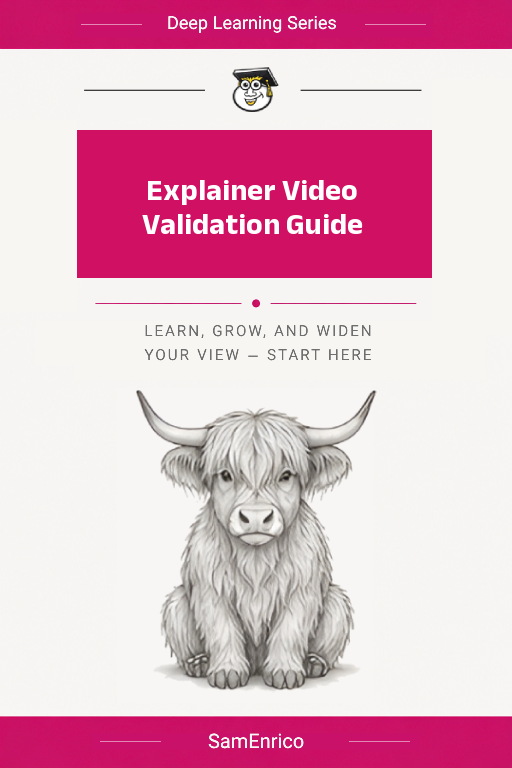
Non-FictionStartup GuideVideo TestingEngagement
Explainer Video Validation Guide eBook
Create free explainer video using mobile phone to
Create free explainer video using mobile phone to describe your idea and measure viewer interest through engagement.
Formats
Free sample
Chapter 1: The $47,000 Selfie--My phone rang on a Tuesday afternoon. It was my business partner, and his voice had that flat, hollow quality people use when they’re about to deliver bad news but have decided to pretend it’s fine.“We have two hundred and fourteen views,” he said.“That’s not terrible,” I replied, already knowing it was.“Fourteen views are mine,” he said. “I’ve watched it fourteen times. Trying to figure out what went wrong.”I did the math anyway, because that’s what you do when you’re in denial. Two hundred fourteen total views.
Subtract fourteen from my partner. Subtract another seven from our two interns who were required to watch it. Subtract three from my mother, who would watch anything I made. That left approximately one hundred ninety strangers who had clicked on our video. And of those one hundred ninety strangers, exactly zero had clicked the link to learn more.
Zero had signed up for the waitlist. Zero had replied to the email sequence we’d spent three weeks building.The video cost forty-seven thousand dollars.Let me say that again, because the number still makes me angry when I think about it. Forty-seven thousand dollars. We had hired a professional animation studio. They created custom characters, original music, a voiceover artist with that warm, trustworthy tone that sounds like a grandfather who also happens to sell luxury cars.
The script went through eleven rounds of revisions. The color palette was workshopped. The pacing was mathematically optimized for attention spans.And it failed. Completely. Spectacularly.
The kind of failure that leaves a stain.I sat in my home office for two hours after that phone call, staring at the wall. Not thinking. Just feeling the weight of the money we had burned. Forty-seven thousand dollars could have paid my rent for two years. It could have bought a car.
It could have funded ten other ideas, each with a real chance of success. Instead, it had been converted into a three-minute animation that exactly zero human beings cared about.That was the moment I decided I would never trust my own opinion about an idea again.The Myth of the Great Idea Here is a lie that entrepreneurship sells you: if you have a truly great idea, the market will recognize it. Build it, and they will come. The good ideas rise. The bad ideas fall.
This is the meritocracy of capitalism, and it is beautiful and just.None of that is true.The market does not recognize great ideas. The market recognizes what it already understands. There is a profound difference. A truly novel idea—something genuinely new—looks like noise to most people. It doesn’t fit into their existing mental categories, so they ignore it.
Or worse, they dismiss it as stupid.I learned this the hard way with that forty-seven-thousand-dollar video. The idea was not bad. In fact, the idea was excellent. We had built a software tool that solved a genuine, painful problem for a specific group of professionals. We had interviewed dozens of potential customers.
We had validated the problem. Everyone we spoke to said, “Yes, this is a real pain point. Yes, I would pay for a solution.”But when we made the video—the beautiful, expensive, professional video—nobody watched it. Or rather, people watched the first few seconds, decided it was an ad, and scrolled past.Here is what I learned in the aftermath, after I had stopped feeling sorry for myself and started actually looking at the data: my opinion about the idea was worthless. My partner’s opinion was worthless.
The eleven rounds of script revisions from well-paid professionals? Worthless. The only opinion that mattered belonged to the anonymous stranger with a thumb on a screen. And that stranger had voted with absolute clarity: no.I spent three weeks being angry at the video. Then I spent three days being angry at myself.
Then, finally, I did something useful. I pulled out my phone—the same phone I used to order food and scroll through Twitter—and I filmed a new video.It was terrible.The lighting was bad because I was sitting in my kitchen at night. The audio was worse because I didn’t have a microphone. I stumbled over my words three times and didn’t bother to re-record because I was tired and frustrated. The entire video was fifty-two seconds long.
I explained a different idea—a smaller idea, one I hadn’t spent any money on yet—in the most plain, direct language I could find.I uploaded it to You Tube at eleven o’clock at night. I set it to public, mostly because I didn’t care anymore. Then I went to sleep.When I woke up the next morning, the video had eleven thousand views.Eleven thousand.Not from my mother. Not from my partner watching on repeat. Eleven thousand strangers had watched my terrible, poorly lit, badly audio’d, fifty-two-second kitchen video.
And four hundred of them had clicked the link to join the waitlist.Four hundred people gave me their email addresses because of a video I filmed in twenty minutes with zero budget.I sat on my bed and laughed for a solid minute. Not because I was happy—though I was—but because the absurdity was overwhelming. I had spent forty-seven thousand dollars on a professional video that failed. I had spent zero dollars on a terrible video that succeeded. The only difference was the approach.The expensive video tried to sell.
The cheap video tried to explain.The 60-Second Rule That experience taught me what I call the 60-Second Rule. It is simple, and it will save you more money than any other principle in this book.If you cannot explain your idea clearly in sixty seconds, using nothing but your phone and your face, then you do not have an idea ready to build. You have a hallucination.Sixty seconds is not arbitrary. It is the approximate attention span of a human being who is scrolling through their phone while also watching television, half-listening to a podcast, and wondering what they should eat for dinner. Your idea will never receive more attention than that.
It will receive less. Much less.The sixty-second constraint forces clarity. When you have three minutes, you can ramble. You can include background information, tangential context, and multiple features. You can explain why the problem exists, how it evolved, and what other people have tried before.
You can tell a story with a slow burn and a satisfying payoff.When you have sixty seconds, you cannot do any of that. You have time for exactly three things: the problem, the pain, and the solution. Nothing else.Here is what most entrepreneurs get wrong. They believe that the goal of an explainer video is to persuade. They think they need to build a case, present evidence, overcome objections, and close the sale.
This is what salespeople do in hour-long meetings. It is what landing pages do with two thousand words of copy. It is not what a sixty-second video can do, and trying to fit…
This is the end of the free sample. Get the eBook to keep going. Buy now
About this book
Details
- Author
- Grice Genevie
- Publisher
- SamEnrico
- Language
- English
- Genre
- Non-Fiction, Startup Guide, Video Testing, Engagement
- Released
- 2026-06-01
- Pages (approx.)
- 132
- Available as
- eBook, Audiobook

Read better in the ZLOADR app
Your eBooks on your phone or tablet. Sign in with your SamEnrico account and start reading.
More by Grice Genevie
 Collaboration Tools For Teams HandbookGrice Genevie$11.99
 Calisthenics Bicep Building GuideGrice Genevie$11.99
 Australian Skilled Migration OutlookGrice Genevie$11.99
 The Travel Sleep Survival GuideGrice Genevie$11.99
 Commuter Stress Relief StrategiesGrice Genevie$11.99
 The Masterstroke: How a Forger Outsmarted the Art WorldGrice Genevie$11.99
 Ironclad Loyalty: The Secret War of James Armistead LafayetteGrice Genevie$11.99
 Understanding Chromosome 22, Microdeletion 22 Q11Grice Genevie$17.99
 Contract Template for ClientsGrice Genevie$12.99
 How to Start a Hobby in Painting and DrawingGrice Genevie$11.99
 Head of ProductGrice Genevie$11.99
You may also like
 Hong Kong Handover 1997Dunn Johnnie$11.99
 Zumba For Postnatal Recovery CourseNeal Christian$11.99
 Zumba for BeginnersLadner Nikia$11.99
 YouTube Comment Mining GuideHumes Pandora$12.99
 Worry Box MeditationCarlin Rudy$11.99
 Workplace Stress MeditationNguyen Lynn$11.99
 Workplace Stress and Sleep RepairHawley Ivory$11.99
 Workplace Perfectionism CureDelaney Jeffry$11.99
 Workplace Injustice Anger GuideWallen Isabelle$11.99
 Work Addiction and Burnout LinkGreenwood Ester$11.99
 Women in Yoga and WellnessBeattie Galina$11.99
 Women in Stand Up ComedyChun Evangeline$11.99