
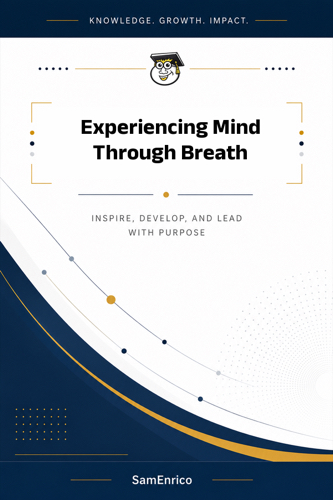
Non-FictionSelf-HelpMind StatesObservation
Experiencing Mind Through Breath eBook
Observe mental states and moods as they arise duri
by Colwell Mary
Observe mental states and moods as they arise during breath meditation.
Formats
Free sample
Chapter 1: The Posture of Possibility--–- You have likely opened this book because something in your inner life feels unmanageable. Perhaps it is the low-grade anxiety that hums behind your ribs like a refrigerator you cannot unplug. Perhaps it is the irritability that leaks into your voice before you can catch it, leaving you apologizing to people you love for reasons you cannot explain. Or perhaps it is something more subtle—a vague sense of flatness, a feeling that you are going through the motions of your own life without actually being present for any of it. Whatever brought you here, know this: you did not arrive by accident.
You arrived because some part of you already suspects that the answers you seek are not in another app, another certification, another vacation, or another relationship. They are closer than that. They are inside your own ribcage, moving in and out twenty thousand times a day, completely unnoticed.This book will teach you to notice. But before we get anywhere near the breath itself, we must first prepare the container in which all of this work will happen. That container is your body.
And the way you position it—how you sit, stand, or walk—will determine whether this practice becomes a lifelong companion or a chore you abandon after eleven days.Most meditation books begin with posture as a footnote. Sit up straight, they say. Cross your legs. Close your eyes. And then they rush off to the more exciting territory of enlightenment, bliss, and emotional freedom.
This book does the opposite. We will spend an entire chapter on posture, attitude, and intention because the top ten best-selling books on mindfulness all share a dirty little secret: they assume you already know how to be with yourself. But you do not. No one taught you. You were taught to sit still in school as an act of compliance, not as an act of curiosity.
You were taught to breathe when a doctor pressed a stethoscope to your chest, not as a way to read your own mental weather. So let us begin at the very beginning.The Three Foundations of Inner Work Every meditation practice rests on three invisible pillars. If any of them cracks, the entire structure collapses. These pillars are posture, attitude, and intention. Notice what is missing here.
I did not say willpower. I did not say discipline. I did not say hours of practice. The self-help industry has sold you a lie that transformation requires grinding effort. It does not.
Transformation requires alignment. When your body is positioned with alert comfort, when your attitude is curious rather than critical, and when your intention is clear rather than demanding, the practice unfolds almost by itself.Let us examine each pillar in depth.Pillar One: Posture as a Question, Not an Answer The first question new meditators always ask is: How should I sit? The assumption behind the question is that there is a right answer. There is not. There is only a useful question: What posture keeps me awake, comfortable, and stable enough to observe my breath for the duration of this practice?
Notice the three criteria. Awake. Comfortable. Stable.Awake means you are not slumped. A slumped spine compresses your diaphragm, which shallow your breath, which signals your nervous system that you are in rest-and-digest mode.
That is fine for sleeping. It is terrible for observing mental states, because dullness and sleepiness will feel exactly like calm. You will think you are meditating beautifully when you are actually half-conscious. I have seen this happen hundreds of times. A student sits, closes their eyes, feels peaceful, and assumes they have achieved advanced concentration.
In reality, they have fallen into what neuroscientists call local sleep—brief micro-episodes of unconsciousness that feel remarkably pleasant. The solution is not to tense up. It is to align your spine such that your head balances easily on top of your neck, your ribs are not compressed, and your belly can expand fully on the inhale.Comfortable means you are not fighting your body. Pain is not a virtue. The ancient yogis who sat for hours on stone floors did so after years of preparation, and even they complained about it.
You are not a yogi from the third century. You are a person with perhaps tight hips, a curved spine from sitting at a desk, shoulders that round forward from holding a phone, and a neck that has learned to crane toward screens. Forcing yourself into a lotus position would be not only unnecessary but potentially injurious. Instead, find a posture that you could hold for the duration of your practice without counting the minutes until it ends. For most people, this means sitting on a chair with feet flat on the floor, hands resting on thighs, and spine self-supported.
If you prefer the floor, use cushions to elevate your hips slightly above your knees. Lying down is permitted only for those who do not struggle with sleepiness, dissociation, or depression. If any of those apply to you, Appendix C offers specific guidance. For everyone else, choose sitting or standing.Stable means you are not wobbling. Each breath creates subtle movements in the torso.
That is natural. But if you are constantly readjusting, crossing and uncrossing your legs, scratching your nose, or shifting your weight, you will never develop the continuity of attention required to observe moods as they arise. Stability does not mean rigidity. It means the body has settled into a position it can maintain without conscious effort. You will know you have found stability when you forget about your body entirely and simply notice the breath moving.A note on eyes.
You may close them. You may keep them open with a soft downward gaze. Both work. Closed eyes help beginners turn inward. Open eyes help those prone to sleepiness or dissociation stay grounded.
Experiment and see what serves you.Before we move to attitude, a critical warning. If you struggle with trauma, panic attacks, or dissociation, please turn to Appendix C now. The practices in this book are gentle, but any inward attention can sometimes surface difficult material. Read the troubleshooting guide first. Then return here.Pillar Two: The Three Attitudes That Change Everything You can sit in perfect lotus posture for forty years and accomplish nothing if your attitude is wrong.
Attitude is the flavor of your attention. It is the difference between a scientist examining a specimen with curiosity and a judge delivering a verdict with contempt. One opens possibilities. The other closes them.The first attitude is curiosity. Curiosity treats every mood as a discovery, not a problem.
When you notice irritability rising, curiosity says: Oh, interesting. What does that feel like in the body? Where did it come from? How does it change when I breathe? Criticism says: There you go again.
You are always irritable. Why can you not just relax? Notice the difference. Curiosity expands your field of awareness. Criticism contracts it into a loop of shame and repetition.
For the duration of this book, you will practice curiosity so relentlessly that it becomes your default setting.The second attitude is non-judgment. This…
This is the end of the free sample. Get the eBook to keep going. Buy now
About this book
Details
- Author
- Colwell Mary
- Publisher
- SamEnrico
- Language
- English
- Genre
- Non-Fiction, Self-Help, Mind States, Observation
- Released
- 2026-06-08
- Pages (approx.)
- 139
- Available as
- eBook, Audiobook

Read better in the ZLOADR app
Your eBooks on your phone or tablet. Sign in with your SamEnrico account and start reading.
More by Colwell Mary
 Upper Back Flexibility GuideColwell Mary$11.99
 Franchise Builder's Royalty ReductionColwell Mary$11.99
 Step Four Harm To OthersColwell Mary$11.99
 Silicon Bloodlines: The Untold Legacy of Ada Lovelace’s Digital HeirsColwell Mary$11.99
 The Last Ride of the Iron Horse: The Forgotten Railroad Workers Who Built AmericaColwell Mary$11.99
 Understanding Hypertensive RetinopathyColwell Mary$17.99
 Nonprofit To Social Enterprise Switch HandbookColwell Mary$12.99
 Fintech Long Term Outlook 2035Colwell Mary$12.99
 How to Start a Castor Oil Processing Business (Beginners Guide)Colwell Mary$11.99
 Enrollment SpecialistColwell Mary$11.99
You may also like
 Hong Kong Handover 1997Dunn Johnnie$11.99
 Zumba For Postnatal Recovery CourseNeal Christian$11.99
 Zumba for BeginnersLadner Nikia$11.99
 YouTube Comment Mining GuideHumes Pandora$12.99
 Worry Box MeditationCarlin Rudy$11.99
 Workplace Stress MeditationNguyen Lynn$11.99
 Workplace Stress and Sleep RepairHawley Ivory$11.99
 Workplace Perfectionism CureDelaney Jeffry$11.99
 Workplace Injustice Anger GuideWallen Isabelle$11.99
 Work Addiction and Burnout LinkGreenwood Ester$11.99
 Women in Yoga and WellnessBeattie Galina$11.99
 Women in Stand Up ComedyChun Evangeline$11.99