
Non-FictionBusiness BriefAutomation Guide
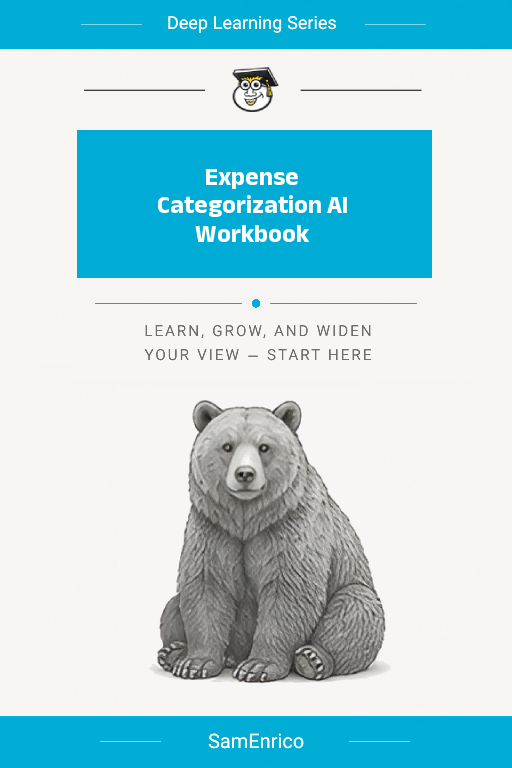
Expense Categorization AI Workbook eBook
Train machine learning models to automatically cla
Train machine learning models to automatically classify small business expenses. Reduce manual entry time by 90% while improving tax deduction tracking.
Formats
Free sample
Chapter 1: The 300-Hour Leak...--–- It begins not with a crash or a warning light, but with a quiet, repetitive motion. You log into your bank account. You download the CSV. You open your accounting software. You copy the vendor name.
You paste it. You glance at the amount. You hesitate. You think, “Was that lunch with a client or just takeout?” You guess. You move to the next line.
You do this fifty times. Then a hundred. Then, if you are a busy small business owner or a dedicated bookkeeper, you do this thousands of times per year.Each individual transaction takes only thirty seconds. Sometimes a full minute if the vendor name is ambiguous—and they usually are. “POS Debit” tells you nothing.
“Amazon Marketplace” could be office supplies, software, shipping, or a new office chair. Each decision is a tiny pebble of mental friction. But friction accumulates. And what accumulates is not just time. It is focus, drained drop by drop.
It is accuracy, eroded by boredom. And it is money, leaking out through missed deductions that you never even knew you missed.This chapter is not a pep talk. It is a financial and operational autopsy of manual expense categorization. By the time you finish the exercises here, you will know exactly how many hours per week you lose to this hidden tax. More importantly, you will understand why shifting from “billable hours” to “scalable systems”—a concept borrowed from the modern accounting movement—is the only rational response.
And you will meet the tool that will save you: supervised machine learning for text classification.The Quiet Mathematics of Manual Entry Let us begin with a simple calculation. Assume you process one hundred expenses per week. This is conservative for many service businesses, agencies, and e-commerce operators. Each expense requires you to:Open your bank feed or credit card statement (5 seconds)Read the vendor name and amount (5 seconds)Recall or infer the business purpose (10 seconds)Navigate to the category dropdown in your accounting software (3 seconds)Scroll or type to find the right category (5 seconds)Click save or move to the next line (2 seconds)That totals thirty seconds per transaction. At one hundred transactions per week, that is fifty minutes per week.
Just under one hour. But this is the best-case scenario. In reality, you also spend time:Hunting for receipts when a vendor name is unrecognizable Correcting miscategorized transactions at month end Answering questions from your tax preparer about vague entries Second-guessing yourself on categories like “Meals & Entertainment” versus “Travel Meals”Training new employees or assistants to follow your categorization logic When you add these hidden layers, the average small business owner spends between two and five hours per week on expense categorization. Over a year, that is between one hundred and two hundred sixty hours. Let us take the midpoint: one hundred eighty hours.
That is four and a half forty-hour workweeks. That is an entire month of your professional life, spent copying and pasting and guessing.Now multiply that by your hourly rate. If you bill at one hundred dollars per hour, one hundred eighty hours equals eighteen thousand dollars per year. If you are a bookkeeper or an employee, your salary includes that time. If you are an owner, that is time you could have spent selling, strategizing, or sleeping.The Broken Focus Tax Time is only part of the cost.
The other part is cognitive friction. Every time you switch from a high-value task—a client presentation, a product design, a strategic plan—to a low-value task like data entry, you pay a “switching cost.” Research consistently shows that it takes an average of twenty-three minutes to fully refocus after an interruption. When you process expenses in small batches throughout the day, you are not losing thirty seconds per transaction. You are losing twenty-three minutes of deep work every time you toggle over to your accounting software.This is the broken focus tax. It is invisible because it never appears on a profit and loss statement.
But it is real. And it is insidious.Consider a typical Tuesday. You are writing a proposal for a new client. Your phone buzzes: a bank alert that a new transaction has posted. You tell yourself you will just check it quickly.
You open the app. You see five new expenses. You categorize them. You close the app. You return to your proposal.
But now your brain is no longer in the flow. You have to reread the last paragraph. You have to recall the argument you were building. Fifteen minutes later, you are back up to speed. That single interruption cost you far more than the ninety seconds you spent categorizing.Now multiply that by two hundred interruptions per year.
The broken focus tax alone often exceeds the direct time cost of the data entry itself.The Deduction Leakage Problem There is a third cost, and it is the one that hurts most directly: missed tax deductions. According to multiple surveys of small business owners, the average business misses between ten and twenty percent of eligible deductions simply because expenses are miscategorized or never recorded properly.Here is how it happens. You buy something from a vendor that could be either a current expense (fully deductible this year) or an asset (depreciated over several years). Without clear notes, you guess “Supplies.” You miss the opportunity to take a Section 179 deduction, which could have given you an immediate tax benefit. Or you buy a piece of software that includes both monthly subscription fees and an annual support contract.
You categorize the whole thing as “Software” and miss the separate deduction for the support portion.Manual categorization is prone to these errors because human beings are pattern-matching machines—but we are lazy pattern-matchers. When we see “Amazon,” we pick the most common category we have used before, even if this particular purchase is different. When we see a familiar vendor name, we stop reading the memo field. We rely on habit, not accuracy.An automated system, by contrast, never gets bored. It never assumes.
It looks at every available clue: vendor name, memo, amount, date, even the time of day. It applies the same rules to the thousandth transaction as it did to the first. And it can be trained to flag ambiguous cases for human review, rather than guessing incorrectly.The Shift from Billable Hours to Scalable Systems The accounting profession is undergoing a quiet revolution. For decades, the dominant model was billable hours: you paid for every minute a human spent on your books. This created a perverse incentive: the slower and more manual the process, the more revenue for the service provider.
But a new generation of firms, like those profiled in The Automated Accounting Firm, has flipped the model. They charge flat fees based on value, not hours. And they achieve profitability by automating the repetitive work.This shift is possible because of scalable systems—processes that handle ten transactions no differently than ten thousand. Manual categorization is not scalable. Adding more transactions means adding more human hours, linearly.
Machine learning categorization is radically scalable. The first five hundred transactions require significant setup. The next five thousand require almost…
This is the end of the free sample. Get the eBook to keep going. Buy now
About this book
Details
- Author
- Schroeder Paris
- Publisher
- SamEnrico
- Language
- English
- Genre
- Non-Fiction, Business Brief, Automation Guide
- Released
- 2026-06-01
- Pages (approx.)
- 107
- Available as
- eBook, Audiobook

Read better in the ZLOADR app
Your eBooks on your phone or tablet. Sign in with your SamEnrico account and start reading.
More by Schroeder Paris
 The Nicotine Freedom HandbookSchroeder Paris$11.99
 Emotional Regulation in RelationshipsSchroeder Paris$11.99
 Framing for ConversionsSchroeder Paris$11.99
 Workplace Stress and Financial WorrySchroeder Paris$11.99
 The Iron Kings of Meroë: Forging an EmpireSchroeder Paris$11.99
 How to Become a Paper-reel OperatorSchroeder Paris$11.99
 Analytics ArchitectSchroeder Paris$11.99
 How to Produce Art and Craft PaintSchroeder Paris$11.99
You may also like
 Hong Kong Handover 1997Dunn Johnnie$11.99
 Zumba For Postnatal Recovery CourseNeal Christian$11.99
 Zumba for BeginnersLadner Nikia$11.99
 YouTube Comment Mining GuideHumes Pandora$12.99
 Worry Box MeditationCarlin Rudy$11.99
 Workplace Stress MeditationNguyen Lynn$11.99
 Workplace Stress and Sleep RepairHawley Ivory$11.99
 Workplace Perfectionism CureDelaney Jeffry$11.99
 Workplace Injustice Anger GuideWallen Isabelle$11.99
 Work Addiction and Burnout LinkGreenwood Ester$11.99
 Women in Yoga and WellnessBeattie Galina$11.99
 Women in Stand Up ComedyChun Evangeline$11.99