
Non-FictionSelf-HelpExpectation Management
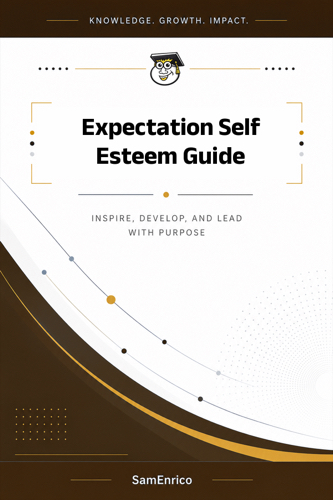
Expectation Self Esteem Guide eBook
Stop setting unrealistic standards that guarantee
by Byrnes Gail
Stop setting unrealistic standards that guarantee disappointment and adjust to reality.
Formats
Free sample
Chapter 1: The Perfectionism Trap--–- You have been taught that your perfectionism is a virtue. Your teachers praised it. Your parents admired it. Your employers rewarded it. You have likely even listed it as a “weakness-that-is-actually-a-strength” in job interviews, secretly proud that you care enough to demand excellence from yourself.
But here is the truth that no one told you: perfectionism is not a pursuit of excellence. It is a fear-based avoidance system disguised as high standards, and it is systematically destroying your self-esteem one unmet expectation at a time.The most dangerous quality of perfectionism is its camouflage. It shows up wearing the uniform of ambition, discipline, and attention to detail. It speaks in the language of “I just care more than other people” and “I refuse to settle for mediocrity.” But beneath that respectable exterior, perfectionism is running a different operation entirely. Its real job is to protect you from the terrifying possibility that you might be fundamentally flawed—that if you ever produced something less than flawless, the world would discover what you secretly believe about yourself: that you are not enough.This chapter will pull back the curtain on that operation.
You will learn why your “high standards” are actually keeping you stuck, how the pursuit of perfection leads to the opposite of excellence, and why the voice in your head that demands flawless performance is not your ally but your warden. Most importantly, you will begin the process of dismantling perfectionism and replacing it with something far more effective: healthy striving.The Great Masquerade: When Virtue Becomes Vice Let us start with a distinction that will save you years of therapeutic work. There are two completely different creatures that share the same name. One is healthy striving. The other is toxic perfectionism.
They look similar from a distance, but up close, they could not be more different.Healthy striving sounds like this: “I want to do excellent work because I value mastery and contribution. I will give this my best effort, and I will learn from whatever happens. Mistakes are part of the process, not judgments of my worth. I can be satisfied with a job well done even if it is not absolutely flawless, because flawless does not exist.”Toxic perfectionism sounds like this: “I must do this perfectly, or I am a failure. If anyone finds a mistake, they will see that I am actually incompetent.
I cannot submit this until it is absolutely flawless, which means I may never submit it at all. Anything less than perfect is unacceptable, and unacceptable is another word for worthless.”Notice the difference? Healthy striving is driven by values—curiosity, growth, contribution. Toxic perfectionism is driven by fear—fear of judgment, fear of exposure, fear of worthlessness. One pulls you toward a goal.
The other pushes you away from shame. And that difference changes everything.The psychologist Brene Brown, who has spent two decades researching shame and vulnerability, puts it bluntly: “Perfectionism is not the same thing as striving to be your best. Perfectionism is the belief that if we live perfect, look perfect, and act perfect, we can minimize or avoid the pain of blame, judgment, and shame.” In other words, perfectionism is not about excellence. It is about safety. It is a twenty-pound armor suit you wear to protect yourself from criticism, but the armor is so heavy that you can barely move.The Five Faces of Toxic Perfectionism Based on decades of research summarized in The Perfectionism Workbook by Taylor Newendorp, toxic perfectionism shows up in five distinct patterns.
Read each one carefully. You will likely recognize yourself in several of them.1. Concern Over Mistakes This is the tendency to catastrophize small errors as if they define your entire character. You miss a deadline by two hours, and your brain says, “I am unreliable and unprofessional.” You make a typo in an email, and you hear, “I am careless and stupid.” You forget a colleague’s name, and you conclude, “I am a bad person who does not care about others.”The problem is not the mistake. The problem is the meaning you attach to it.
People with high concern over mistakes cannot distinguish between “I made an error” and “I am an error.” Every small failure feels like a referendum on their worth as a human being. This is exhausting, and it is also completely inaccurate. No reasonable person would conclude that a typo makes you a bad person. But the perfectionist’s inner critic is not reasonable. It is a terrorist with a microphone.2.
Impossibly High Personal Standards This is the tendency to set bars that no human could consistently clear. You expect yourself to work fourteen hours a day, seven days a week, without burnout. You expect yourself to be a perfect parent, partner, and professional simultaneously. You expect yourself to learn new skills instantly, without the awkward fumbling that all beginners experience.These standards are not “high.” They are impossible. And here is the cruel irony: impossible standards guarantee failure.
Not occasional failure. Not “sometimes” failure. Guaranteed, inevitable, 100-percent-certain failure. Because no human being can consistently achieve the impossible. So you fail, and then you feel shame, and then—because you are a perfectionist—you raise the standards even higher to compensate.
This is the Expectation–Shame Loop we introduced in the preface, and it is a machine designed to produce suffering.3. Parental Expectations Even if you are forty years old, living in your own home, paying your own bills, the voice of your parents’ expectations may still be running the show. Parental expectations are the internalized demands you absorbed as a child: “You must get straight A’s.” “You must be the best.” “You must not disappoint us.”The tragedy is that these expectations rarely retire. They continue operating long after your parents have stopped enforcing them, long after your parents may have even apologized for them. You are living by rules that were imposed on you before you had the cognitive ability to question them.
And those rules may have nothing to do with what you actually value.4. Parental Criticism Even more damaging than high expectations is the internalization of parental criticism. This is the voice that says, “You are not trying hard enough,” “What is wrong with you?” “Other children can do this—why can’t you?” This voice becomes your inner critic’s primary weapon. It speaks in your parents’ tone, using their phrases, delivering their judgments—but now you are the one holding the whip.The cruelest aspect of parental criticism is that it often comes from parents who loved you and wanted the best for you. They were not monsters.
They were anxious, imperfect humans who believed that pushing you harder would make you stronger. But their good intentions did not prevent the damage. And now you carry their voices inside your head, long after they have stopped speaking.5. Doubts About Actions This is the tendency to never trust your own work. You check emails seven times before sending them.
You reread paragraphs until the words lose all meaning. You ask for reassurance from colleagues, partners, and friends—and then doubt their reassurance.Doubts about…
This is the end of the free sample. Get the eBook to keep going. Buy now
About this book
Details
- Author
- Byrnes Gail
- Publisher
- SamEnrico
- Language
- English
- Genre
- Non-Fiction, Self-Help, Expectation Management
- Released
- 2026-06-09
- Pages (approx.)
- 122
- Available as
- eBook, Audiobook

Read better in the ZLOADR app
Your eBooks on your phone or tablet. Sign in with your SamEnrico account and start reading.
More by Byrnes Gail
 Faith Crisis Terminal IllnessByrnes Gail$11.99
 The Silent Meditation StarterByrnes Gail$11.99
 The Salvation Army ChristmasByrnes Gail$11.99
 Ninety in Ninety GuideByrnes Gail$11.99
 Tome AI StorytellingByrnes Gail$11.99
 Strength Training For PostureByrnes Gail$11.99
 Amazon Subscribe and Save TrapByrnes Gail$11.99
 Assertiveness For NonprofitsByrnes Gail$11.99
 Whispers in the Quilt: The Secret Codes of Harriet Tubman’s Freedom MapsByrnes Gail$11.99
 Silent Echoes: The Lost Language of the Indus ValleyByrnes Gail$11.99
 Frozen Fury: The Great Blizzard of 1888 That Buried New YorkByrnes Gail$11.99
 White Label Course LicensingByrnes Gail$11.99
You may also like
 Hong Kong Handover 1997Dunn Johnnie$11.99
 Zumba For Postnatal Recovery CourseNeal Christian$11.99
 Zumba for BeginnersLadner Nikia$11.99
 YouTube Comment Mining GuideHumes Pandora$12.99
 Worry Box MeditationCarlin Rudy$11.99
 Workplace Stress MeditationNguyen Lynn$11.99
 Workplace Stress and Sleep RepairHawley Ivory$11.99
 Workplace Perfectionism CureDelaney Jeffry$11.99
 Workplace Injustice Anger GuideWallen Isabelle$11.99
 Work Addiction and Burnout LinkGreenwood Ester$11.99
 Women in Yoga and WellnessBeattie Galina$11.99
 Women in Stand Up ComedyChun Evangeline$11.99