
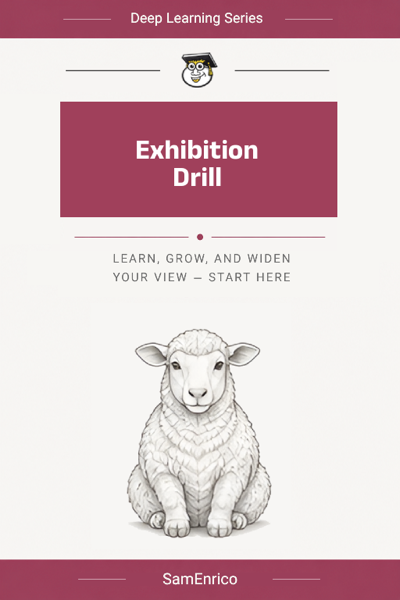
Non-FictionInformativeEducational
Exhibition Drill eBook
A Coursebook on Exhibition Drill
by Witt Hassan
A Coursebook on Exhibition Drill
Formats
Free sample
Chapter 1: The Silent Before the Sound--–- The air in the convention center is neither warm nor cool. It is the temperature of anticipation, which is to say it has no temperature at all—only pressure. Sixteen young men and women stand in two perfect lines at the edge of a polished concrete floor that stretches forty feet wide and sixty feet deep. They wear matching uniforms: crisp shirts tucked into dark trousers, hats angled at the same precise degree, shoes buffed to a mirror shine that catches the overhead fluorescents and throws back small, sharp stars of light. Their rifles rest against their shoulders, wooden stocks worn smooth by thousands of hours of contact, metal fittings burnished to a dull glow.
No one speaks. No one fidgets. The only sound is the soft, almost subaudible whisper of fabric shifting as someone adjusts their weight from one foot to the other.Three minutes remain before they march onto the competition deck.The team commander stands at the front of the formation, her spine aligned so perfectly that a plumb line dropped from the crown of her head would pass through the center of her pelvis and exit between her heels. Her eyes move slowly across each face, checking not for uniform violations—those were corrected an hour ago—but for something harder to name. Readiness.
Presence. The particular stillness that precedes extraordinary motion. She gives a single nod, almost imperceptible. Sixteen heads nod back.This is the silent before the sound. And in exhibition drill, this silence is not empty.
It is heavier than any rifle, denser than any crowd noise, more consequential than any music that will soon fill the arena. This silence is where routines are won or lost, where months of preparation either crystallize into confidence or dissolve into nerves. The drillers in this formation have practiced for an average of three hundred hours each. They have spun rifles until their palms blistered, then spun until the blisters became calluses, then spun until they forgot they had hands at all. They have marched until their shins ached, then marched until the ache became a rhythm, then marched until the rhythm became involuntary.
They have fallen. They have failed. They have been yelled at and have yelled at themselves. And now, in this silence, all of that disappears. There is only the next step.
There is only the deck.What This Chapter Is—And What It Is Not This is not a history lesson, though history matters. This is not a technical manual, though technique will fill the pages that follow. This is an invitation. If you have never seen exhibition drill performed at its highest level, you might imagine something stiff and militaristic—robotic humans performing robotic movements to robotic commands. You would be wrong.
What happens on that competition deck is closer to dance than to drill, closer to athletics than to ceremony, closer to art than to either. The rifles spin so fast they blur into circles of light. The formations shift and flow like schools of fish turning in unison. The music swells and the drillers move with it, not as followers but as collaborators, their bodies translating sound into motion so precisely that the audience forgets to breathe.This chapter exists to answer a single question: why? Why would anyone spend three hundred hours learning to spin a rifle?
Why would a teenager choose to spend their weekends marching on a concrete floor in a convention center instead of doing anything else? Why do audiences weep at championship performances? Why do judges sometimes pause, pen hovering over score sheet, unable to find words adequate to what they have just witnessed? The answer is not simple, but it is true: exhibition drill, at its core, is the pursuit of perfect motion. And perfect motion, when achieved even for a moment, touches something fundamental in both the performer and the observer.
It is the place where intention and execution become indistinguishable. It is the place where thinking stops and doing begins. It is the place where a human being, a rifle, and an empty floor become, for a few precious minutes, a single harmonious system.The First Misconception: Drill Is Not Combat Let us begin by clearing away the most persistent misunderstanding about exhibition drill. It is not combat training. It is not a simulation of combat.
It is not even particularly useful preparation for combat, except insofar as it teaches discipline and teamwork. The movements that make up a championship routine—the spins, the tosses, the intricate exchanges between drillers—would be suicidal on a battlefield. No soldier has ever faced an enemy and thought, "I will now spin my rifle around my neck three times in rapid succession." The rifle in exhibition drill is not a weapon. It is a prop. More precisely, it is an instrument.
It is to the exhibition driller what a cello is to a cellist or a brush is to a painter. It exists to be manipulated, to be extended, to become an extension of the body that holds it.This distinction matters because it changes everything about how we understand the activity. A soldier trains to eliminate threat. A dancer trains to express emotion. An exhibition driller trains to do both at once?
No. An exhibition driller trains to do neither. An exhibition driller trains to achieve precision for its own sake, to make the body and the rifle move exactly as intended, not because that movement serves any external purpose but because the achievement of precision is itself the purpose. This is not a utilitarian activity. It is not about winning wars or impressing superiors or even, ultimately, about winning trophies.
It is about the relationship between intention and action. It is about the gap between what you imagine and what you can make your body do. And it is about closing that gap until it disappears.The Three Faces of Drill To understand exhibition drill, you must first understand how it differs from its cousins. There are three distinct forms of drill practiced in the modern world, and they are not the same. Confusing them is like confusing ballet with ballroom dancing—related, yes, sharing some vocabulary, but fundamentally different in purpose and execution.Regulation Drill is the oldest form, the one from which the others evolved.
It is functional. It serves a purpose beyond itself. When soldiers learn to march in formation, to execute facing movements, to handle their weapons according to standardized procedures, they are learning regulation drill. The goal is not beauty but efficiency and uniformity. A unit that can move together can fight together.
A soldier who can handle a weapon without thinking can handle it under fire. Regulation drill is about creating automaticity, about embedding movements so deeply in muscle memory that conscious thought becomes unnecessary. It is practical. It is essential. And it is not what this book is about.Ceremonial Drill occupies the middle ground.
It retains the structure and vocabulary of regulation drill but adds an aesthetic dimension. When the Silent Drill Platoon performs at the Marine Corps Barracks in Washington, D.C., they are performing ceremonial drill.…
This is the end of the free sample. Get the eBook to keep going. Buy now
About this book
Details
- Author
- Witt Hassan
- Publisher
- SamEnrico
- Language
- English
- Genre
- Non-Fiction, Informative, Educational
- Released
- 2026-06-02
- Pages (approx.)
- 153
- Available as
- eBook, Audiobook

Read better in the ZLOADR app
Your eBooks on your phone or tablet. Sign in with your SamEnrico account and start reading.
More by Witt Hassan
 Elizabeth I Pardon Politics HandbookWitt Hassan$11.99
 Academic Advising GuideWitt Hassan$11.99
 Mindfulness for OCDWitt Hassan$11.99
 Financial Stress and GriefWitt Hassan$11.99
 The Cosmic Duet: How a Jazz Pianist and a Quantum Physicist Redefined TimeWitt Hassan$11.99
 Dynamic Panel Data GMM GuideWitt Hassan$12.99
 How to Produce Auto Racing Autographed ParaphernaliaWitt Hassan$11.99
 How to Start a Ferro Titanium Business (Beginners Guide)Witt Hassan$11.99
You may also like
 Hong Kong Handover 1997Dunn Johnnie$11.99
 Zumba For Postnatal Recovery CourseNeal Christian$11.99
 Zumba for BeginnersLadner Nikia$11.99
 YouTube Comment Mining GuideHumes Pandora$12.99
 Worry Box MeditationCarlin Rudy$11.99
 Workplace Stress MeditationNguyen Lynn$11.99
 Workplace Stress and Sleep RepairHawley Ivory$11.99
 Workplace Perfectionism CureDelaney Jeffry$11.99
 Workplace Injustice Anger GuideWallen Isabelle$11.99
 Work Addiction and Burnout LinkGreenwood Ester$11.99
 Women in Yoga and WellnessBeattie Galina$11.99
 Women in Stand Up ComedyChun Evangeline$11.99