
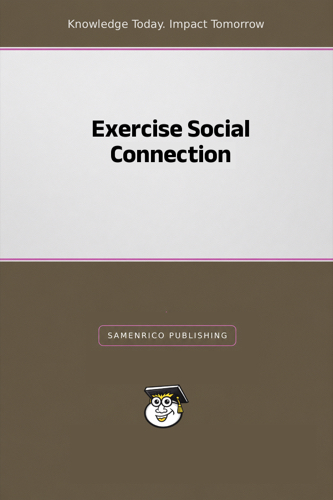
Exercise Social Connection eBook
Make friends through group fitness activities.
by Mchugh Ping
Make friends through group fitness activities.
Formats
Free sample
Chapter 1: The Social Atrophy...--–- Mark is forty-two years old, runs three times a week, tracks his macros in an app, and has a resting heart rate of fifty-two beats per minute. By every clinical metric, he is the picture of health. Last Tuesday, after setting a personal record on a 5K run, he sat in his parked car for twenty-three minutes. Not stretching. Not cooling down.
Not checking his phone. He just sat there, staring at the steering wheel, because no one was there to high-five. No one texted “nice work.” No one asked about his weekend or noticed that he had shaved ninety seconds off his previous best time. Mark is not dying of a heart attack. He is dying of something slower, quieter, and arguably more dangerous.
He is suffering from social atrophy.This is not a story about a lonely man in a parking lot. This is a story about you, about me, and about millions of people who have been sold a dangerous lie. The lie is this: that you can be perfectly healthy while being perfectly alone. The lie is that needing other people is weakness. The lie is that your fitness journey is yours and yours alone, and that any interruption from another human being is a distraction from your goals.
We call this lie by many names—“self-reliance,” “independence,” “the grind,” “loner mentality”—but in this book, we will name it precisely. It is The Myth of Solo Self-Sufficiency, and it is killing us more slowly but no less surely than any disease.You have been taught, explicitly or implicitly, that your body is a machine to be optimized. Calories in, calories out. Steps taken, miles run, pounds lifted. Sleep tracked, heart rate monitored, recovery measured.
In this worldview, other people are variables you cannot control. They are late. They talk too much. They want to go to brunch when you are in a caloric deficit. So you optimize them out of the equation.
You buy the Peloton. You download the guided run app. You invest in noise-canceling headphones. You build a home gym in your garage. You become, in the modern fitness lexicon, a “lone wolf.”And here is the devastating irony: you have never been in worse company.The Epidemic We Refuse to Name Let us look at the numbers, because numbers do not lie, but they do require interpretation.
In 2023, the United States Surgeon General issued an advisory declaring loneliness a public health epidemic. The report stated that even before the COVID-19 pandemic, approximately half of U.S. adults reported measurable levels of loneliness. Among young adults aged eighteen to twenty-five, the rates were even higher—seventy-nine percent. But here is the number that should stop you cold: the health risk of chronic loneliness is comparable to smoking fifteen cigarettes per day.
Let that land. Fifteen cigarettes per day. That is not a metaphor. That is a clinical finding from a meta-analysis of 148 studies involving over 300,000 participants. Loneliness increases your risk of premature death by twenty-six percent.
It is more dangerous than obesity, more dangerous than air pollution, and on par with the most well-documented behavioral risk factor in human history.But we do not treat it that way. We treat loneliness as a character flaw, a personal failing, something that happens to weak people who simply do not try hard enough to make friends. When someone says “I am lonely,” we do not rush them to a doctor. We suggest a hobby, or a dating app, or a therapist. We do not say, “You need an immediate intervention equivalent to quitting smoking.” And so the epidemic continues, silent and invisible, because loneliness has no cough, no tumor, no rash.
It has only the slow, creeping atrophy of the human heart.The Fitness Industry Sold You a Lie The fitness industry is worth more than thirty billion dollars annually in the United States alone. That money buys you gym memberships, equipment, apparel, supplements, coaching, and increasingly, technology. The dominant narrative of the past decade has been the rise of “connected fitness”—Peloton, Mirror, Tonal, Strava, Zwift, and a thousand apps that promise to bring the gym to your living room. These products are not neutral. They come with an implicit philosophy: you do not need other people to get fit.
In fact, other people might hold you back. The app will be your coach. The leaderboard will be your competition. The comment section will be your community.But here is the uncomfortable truth that the fitness industry does not want you to examine: screens cannot replace biological needs. The human body is not designed to receive oxytocin from a notification.
Oxytocin, the so-called “bonding hormone,” is released through eye contact, physical touch, and synchronized movement. You cannot get it from a like. You cannot get it from a comment that says “you crushed it.” You cannot get it from a high-five emoji. Your vagus nerve, the longest nerve in your autonomic nervous system, calms down when it receives input from real human faces, real human voices, real human touch. A Peloton instructor shouting encouragement from a screen does not activate the same neural pathways as a running partner panting beside you.
It simply does not.This is not Luddite nostalgia. This is neuroscience. And it is why the digital village is failing you.The Myth of Solo Self-Sufficiency: A Closer Look We need to spend a moment on the villain of this book, because you cannot defeat an enemy you refuse to name. The Myth of Solo Self-Sufficiency is the cultural belief that a fully realized adult should be able to meet all of their own needs—physical, emotional, social, and psychological—without depending on others. It is the voice that says “I don’t need anyone” with pride rather than pain.
It is the motto of the “hustle culture” that celebrates the founder who sleeps in their office, the athlete who trains alone before dawn, the parent who never asks for help.This myth has deep roots in Western individualism, but it has been supercharged by three modern forces. First, capitalism, which profits from your isolation because isolated people buy more stuff (home gyms, delivery apps, streaming services). Second, technology, which offers the illusion of connection without its biological benefits. And third, wellness culture, which has taught you to treat your body as a project to be optimized and your social life as a distraction from that project.The Myth of Solo Self-Sufficiency tells you that needing other people is weakness. It tells you that loneliness is a problem you should solve by yourself.
It tells you that group fitness is for extroverts, for beginners, for people who cannot handle the discipline of solo training. It tells you that the loud music and the high-fives and the group warm-ups are “fluff” that gets in the way of real work.Every single one of these beliefs is not just wrong—it is dangerous.The Science of Social Atrophy Let us return to Mark in his car. Mark did not become socially atrophied overnight. His social muscles weakened gradually, through years of disuse, just as a bicep atrophies in a cast. Social…
This is the end of the free sample. Get the eBook to keep going. Buy now
About this book
Details
- Author
- Mchugh Ping
- Publisher
- SamEnrico
- Language
- English
- Genre
- Non-Fiction, Self-Help, Fitness
- Released
- 2026-06-08
- Pages (approx.)
- 139
- Available as
- eBook, Audiobook

Read better in the ZLOADR app
Your eBooks on your phone or tablet. Sign in with your SamEnrico account and start reading.
More by Mchugh Ping
 Road Rage and PerfectionismMchugh Ping$11.99
 Forgiveness for Activist BurnoutMchugh Ping$11.99
 Self Esteem After Long LeaveMchugh Ping$11.99
 Commemorative Speech WritingMchugh Ping$11.99
 Business Credit for Financial AdvisorsMchugh Ping$11.99
 Former Members Escape StoriesMchugh Ping$11.99
 Growth Mindset for Real EstateMchugh Ping$11.99
 The Green and the Grey: Frederick the Great's Forgotten WarMchugh Ping$11.99
 Tane’s Whispering Forest: The Birth of the First CanoeMchugh Ping$11.99
 How to Produce a TrowelMchugh Ping$11.99
 Service Providers Guide to CalligraphyMchugh Ping$11.99
 How to Start a Co-polymer Plastics Business (Beginners Guide)Mchugh Ping$11.99
You may also like
 Hong Kong Handover 1997Dunn Johnnie$11.99
 Zumba For Postnatal Recovery CourseNeal Christian$11.99
 Zumba for BeginnersLadner Nikia$11.99
 YouTube Comment Mining GuideHumes Pandora$12.99
 Worry Box MeditationCarlin Rudy$11.99
 Workplace Stress MeditationNguyen Lynn$11.99
 Workplace Stress and Sleep RepairHawley Ivory$11.99
 Workplace Perfectionism CureDelaney Jeffry$11.99
 Workplace Injustice Anger GuideWallen Isabelle$11.99
 Work Addiction and Burnout LinkGreenwood Ester$11.99
 Women in Yoga and WellnessBeattie Galina$11.99
 Women in Stand Up ComedyChun Evangeline$11.99