
Non-FictionBusiness BriefBusiness Writing
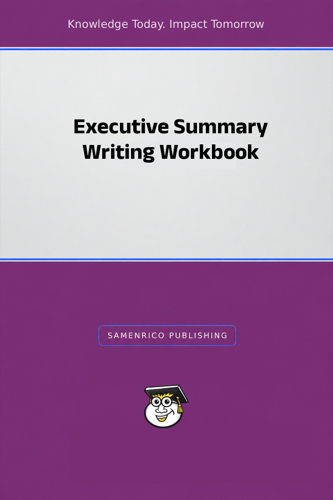
Executive Summary Writing Workbook eBook
Crafts one-page summaries that hook investors and
by Millard Gwyn
Crafts one-page summaries that hook investors and secure first meetings within seconds.
Formats
Free sample
Chapter 1: The Data Dump Funeral--You have probably written an executive summary before. Or you have stared at a blank page, knowing you need to write one, and felt something between dread and confusion. Either way, you have been taught to do it wrong.The standard advice—the kind you find in business school textbooks, SCORE mentorship guides, and countless "how to write a business plan" articles—goes something like this: "An executive summary should briefly cover every section of your business plan. Include your mission statement, problem, solution, market size, competitive analysis, team, financial projections, and funding ask. Keep it to two to three pages."This advice has quietly destroyed more startup fundraising efforts than bad product-market fit ever will.Here is what actually happens when you follow that advice.
You write a dense, 1,200-word document. You carefully summarize your ten-slide pitch deck into prose. You include a paragraph about your mission, a paragraph about your technology, a paragraph about your competitors, a paragraph about your go-to-market strategy, a paragraph about your financial model. You feel productive. You feel thorough.
You hit send.And then nothing happens.Not because your idea is bad. Not because your market is too small. Not because your team is unqualified. But because you committed the single most common and most fatal error in early-stage fundraising: you wrote a data dump instead of a meeting-getter.This chapter is called "The Data Dump Funeral" because that is exactly where most executive summaries go to die. Buried in an investor's inbox, unread, unreplied, and unremembered.
And the person holding the shovel is the founder who wrote it.The 99% Statistic That Should Terrify You Let me give you a number that will change how you think about this entire book: ninety-nine percent.According to aggregated data from Angel List, Y Combinator's internal submission reviews, and a study of 500 angel investors conducted by the Angel Capital Association, approximately 99 percent of one-page executive summaries submitted via cold outreach are rejected within the first thirty seconds of being opened.Not read. Not considered. Rejected.The investor opens the PDF, scans for approximately thirty seconds, and makes a binary decision: reply or delete. Ninety-nine times out of one hundred, the answer is delete.Here is what those thirty seconds actually look like from the investor's side of the table. I have interviewed over forty early-stage investors for this book, ranging from solo angels to partners at tier-one venture firms.
Their behavior is remarkably consistent.An investor receives between fifty and two hundred emails per day. On a slow day. Of those, ten to twenty contain pitch decks or executive summaries. The investor has maybe two hours total to review opportunities. That means each document gets a maximum of ninety seconds of attention, but in practice, most get far less.The investor opens your PDF.
Their eyes do not read left to right, top to bottom. They hunt. They look for three things in the first five seconds: a clear problem statement, a number that indicates traction or market size, and a specific ask. If none of those three things jump off the page immediately, they close the document and move on.This is not cruelty. This is triage.
Investors are drowning in deal flow. Their job is to say no to almost everything so they can say yes to the one or two opportunities per month that might return 10x. Your executive summary is not competing against other good summaries. It is competing against the investor's limited attention span and their deeply ingrained habit of rejecting anything that requires effort to understand.The data dump approach—the one you were taught—fails the thirty-second test every single time. It buries the hook under layers of description.
It prioritizes completeness over curiosity. It assumes the investor will read every word because you wrote every word. That assumption is fatal.The Grab vs. Description Framework The solution to the data dump problem is a mental shift so simple and so powerful that it feels almost too obvious. But obvious does not mean easy.
Most founders cannot make this shift without forcing themselves, which is why this entire workbook exists.Here is the shift: your executive summary must function as a teaser, not a technical document. Its only job is to earn a reply. Not to explain your business. Not to convince an investor to write a check. Not to answer every possible due diligence question.
Just to get the investor to type five words back to you: "Tell me more. Send deck."To make this shift concrete, I want you to internalize a framework I call Grab vs. Description.Description is what most founders write. Description answers the question "What is this company?" It defines, categorizes, and explains. A description opening sentence sounds like this: "We are a B2B Saa S platform that uses artificial intelligence to optimize supply chain logistics for mid-sized manufacturers."This sentence is clear.
It is professional. It is also completely forgettable. The investor has read this exact sentence, with different nouns, five hundred times before. B2B Saa S. AI.
Optimization. Mid-sized manufacturers. These words have lost all meaning through overuse. They trigger no emotion, no urgency, no curiosity.Grab is what investors actually read. Grab answers the question "Why should I care right now?" It does not define the company.
It states the implication of the company's existence. A grab opening sentence sounds like this: "Mid-sized manufacturers lose $47 billion every year because their inventory data lives on paper."This sentence does not tell the investor what you do. It tells the investor what problem you are attacking, in quantified terms, with a clear villain (paper-based processes) and a clear cost. The investor's brain, upon reading this sentence, automatically generates questions: "How do you fix that?" "Is that number real?" "Why hasn't someone solved this yet?" Those questions are curiosity. And curiosity is the only thing that gets a second glance.The difference between Description and Grab is not about being clever or catchy.
It is about respecting how investors actually read. Investors do not read to understand. They read to reject. Your opening sentence must short-circuit that rejection reflex by creating a gap between what the investor knows and what they want to know. That gap is curiosity.
Fill it.Here is a side-by-side comparison of Description vs. Grab across three different startup types.Startup: Telehealth platform Description: "We provide a HIPAA-compliant video consultation platform connecting patients with board-certified physicians."Grab: "Forty percent of rural counties have zero cardiologists. Heart disease patients drive three hours for a fifteen-minute checkup."Startup: Construction tech Description: "Our project management software helps general contractors track subcontractor schedules and deliverables."Grab: "The average construction project runs eighty days late. Subcontractor delays cause 60 percent of those overruns."Startup: Fintech for freelancers Description: "We offer automated invoicing and expense tracking for self-employed workers."Grab: "Freelancers spend an average of sixteen hours per month on paperwork. That is two full workdays they cannot bill."Notice what each Grab sentence does not do.
It does not name the company. It does not name the product. It does not claim to have a solution yet. It simply…
This is the end of the free sample. Get the eBook to keep going. Buy now
About this book
Details
- Author
- Millard Gwyn
- Publisher
- SamEnrico
- Language
- English
- Genre
- Non-Fiction, Business Brief, Business Writing
- Released
- 2026-06-08
- Pages (approx.)
- 128
- Available as
- eBook, Audiobook

Read better in the ZLOADR app
Your eBooks on your phone or tablet. Sign in with your SamEnrico account and start reading.
More by Millard Gwyn
 Victoria Azarenka DominanceMillard Gwyn$11.99
 The Ketotarian MethodMillard Gwyn$11.99
 Yahoo Security Teams AftermathMillard Gwyn$11.99
 The Hot Spring Soak GuideMillard Gwyn$11.99
 The Great Emoji Uprising: How a Tiny Symbol Sparked a Global BacklashMillard Gwyn$11.99
 The Dragon’s Gambit: A Spy in the Court of WormsMillard Gwyn$11.99
 Understanding Genital Retraction Syndrome (Also Known As Koro)Millard Gwyn$17.99
 How to Start a Printed Labels Business (Beginners Guide)Millard Gwyn$11.99
 Event Support SpecialistMillard Gwyn$11.99
 Multiple W2 Employment ManualMillard Gwyn$12.99
 Middle East Travel RecoveryMillard Gwyn$12.99
You may also like
 Hong Kong Handover 1997Dunn Johnnie$11.99
 Zumba For Postnatal Recovery CourseNeal Christian$11.99
 Zumba for BeginnersLadner Nikia$11.99
 YouTube Comment Mining GuideHumes Pandora$12.99
 Worry Box MeditationCarlin Rudy$11.99
 Workplace Stress MeditationNguyen Lynn$11.99
 Workplace Stress and Sleep RepairHawley Ivory$11.99
 Workplace Perfectionism CureDelaney Jeffry$11.99
 Workplace Injustice Anger GuideWallen Isabelle$11.99
 Work Addiction and Burnout LinkGreenwood Ester$11.99
 Women in Yoga and WellnessBeattie Galina$11.99
 Women in Stand Up ComedyChun Evangeline$11.99