
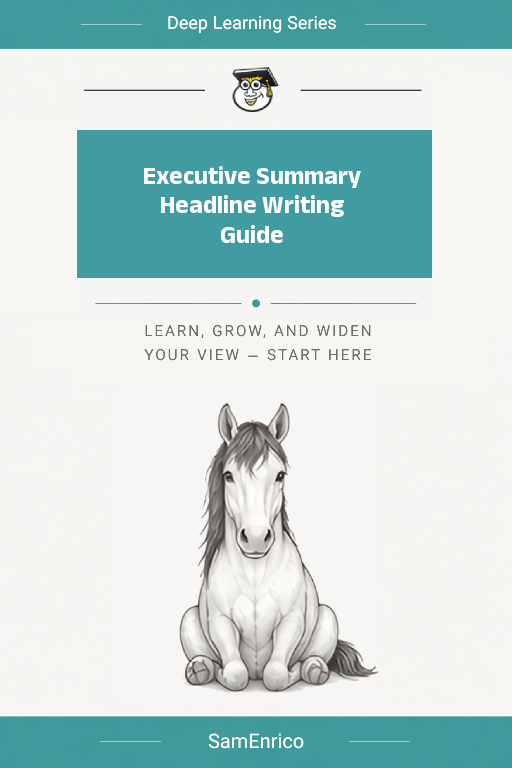
Non-FictionProfessional's Cheat SheetInformation Architecture
Executive Summary Headline Writing Guide eBook
Craft section headers that tell the story alone, a
by Henry Jesus
Craft section headers that tell the story alone, allowing executives to grasp your case by reading only the bold text.
Formats
Free sample
Chapter 1: The Scanning Curse--You have approximately ninety seconds to save your idea.That is not an estimate or a motivational exaggeration. It is a measured, observed, and frankly terrifying reality drawn from dozens of workplace studies, eye-tracking experiments, and interviews with senior executives across Fortune 500 companies. The modern executive does not read your report. They never have. They never will.
What they do instead is far more ruthless and far faster: they scan.Let me repeat that distinction because it is the single most important sentence in this entire book. Executives do not read. They scan. Reading implies a linear, word-by-word, sentence-by-sentence consumption of information. Scanning is a predatory act.
It is the eye moving across a page in a Z-shaped pattern, hunting for threats, opportunities, anomalies, and decisions. When you send a forty-page report with twelve chapters and eight appendices, your executive does not settle into a comfortable chair with a cup of coffee and read it cover to cover. They open the PDF, press Command-F, search for their own name or the name of their priority initiative, and then make a judgment in under two minutes.The implications of this behavioral reality are brutal but liberating. Brutal because most of the writing you have been taught to produce—the careful introductions, the methodical background sections, the nuanced literature reviews—is functionally invisible to the people who hold the budget authority. Liberating because once you accept that your audience is scanning rather than reading, you can stop writing documents and start designing scan paths.
You can stop hoping that someone will read your brilliant analysis and start guaranteeing that someone will see your conclusion before their phone buzzes with the next urgent email.This chapter is called The Scanning Curse not because scanning is a problem to be solved—it is not, and you cannot change executive behavior any more than you can change the weather—but because scanning places a curse on traditional business writing. The curse is simple: your document will be judged not on its total content but on its most visible fragments. And the most visible fragments are your bolded section headers.If those headers tell a coherent, persuasive, decision-driving story, your idea lives. If they do not, your idea dies. Not because the data was wrong.
Not because the analysis was flawed. But because the executive never saw the data or the analysis. They saw only the headers, made a judgment, and moved on.This is the scanning curse. This book is the cure.The Swamped CEO Problem To understand why scanning has become the dominant mode of executive information consumption, you must first understand the sheer volume of information that lands on a senior leader's desk every single day. The numbers are staggering and have only grown worse with the shift to remote and hybrid work.According to a 2023 study by the Harvard Business Review, the average C-suite executive receives 248 emails per day.
That is 248 separate requests for attention, action, or information. Add to that the daily intake of Slack messages, Teams pings, Whats App threads, text messages, calendar invitations, meeting agendas, pre-read documents, post-meeting summaries, analyst reports, competitive intelligence briefings, industry newsletters, and internal dashboards. The total number of discrete information units that compete for an executive's attention each day exceeds five hundred.Now do the math. A standard workday contains 480 minutes. Subtract meetings—generously assume four hours of meetings, which is a low estimate for most senior roles—and you have 240 minutes remaining for everything else.
Five hundred information units divided by 240 minutes means the executive has approximately thirty seconds to spend on each email, message, document, and alert. That is not a typo. Thirty seconds per item.But wait. That math assumes the executive processes information continuously without breaks, bathroom trips, lunch, or strategic thinking time. In reality, the executive has perhaps ninety minutes of uninterrupted focus time per day.
Five hundred items divided by ninety minutes gives you ten seconds per item.This is the Swamped CEO problem, and it is not hyperbole. It is simple arithmetic.Given this reality, no rational executive reads anything longer than a text message in its entirety. Instead, they have developed a sophisticated set of scanning behaviors that allow them to triage information with remarkable speed. They look for names—their own, their boss's, their top competitor's. They look for numbers that seem wrong, either too high or too low.
They look for deadlines. They look for the word "recommendation" or "decision required." And they look for the bold text.The bold text is the executive's lifeline. It is the visual anchor that tells them where to stop scanning and start paying attention. If the bold text suggests a threat, they will read the paragraph beneath it. If the bold text suggests an opportunity, they will flag the document for later (which usually means never).
If the bold text is vague, generic, or obviously descriptive—"Introduction," "Background," "Methodology"—they will skip the entire section without a moment's guilt.You cannot change this behavior. You can only adapt to it. And adaptation begins with understanding that your bold headers are not a summary of your argument. They are your argument.What This Book Means by "Bold Text"Before we go any further, we need to establish a precise definition of a term that will appear in every subsequent chapter. In this book, "bold text" refers exclusively to section headers—the typographically emphasized lines that divide your document into major sections and subsections.
This includes H1 headers (the main chapter or section titles), H2 headers (subsections within a chapter), and H3 headers (sub-subsections when necessary). It does not include bolded words within a paragraph, bolded bullet points, or bolded phrases used for emphasis inside a sentence.Why this narrow definition? Because the core thesis of this book is that an executive should be able to grasp your entire case, including the problem, the evidence, and the required action, by reading only the bolded section headers from top to bottom. If you also bold phrases inside paragraphs, you create a second, competing visual hierarchy that confuses the scanning eye. The executive does not know whether to read the bolded headers or the bolded inline text.
In most cases, they will read neither.Therefore, reserve bold typography exclusively for your section headers. Use italics, underlining, or color for inline emphasis if you absolutely must highlight something inside a paragraph. But do not bold it. Keep the bold text pure. Keep the bold text sacred.
Keep the bold text as the single narrative thread that runs through your entire document.Throughout this book, we will refer to "supporting emphasis" as the category that includes bullet points, numbered lists, bolded inline phrases, and italicized sentences. Supporting emphasis is useful. It adds evidence. It provides detail. But it is not the story.
The bold headers are the story. If a reader skips every word that is not a bold header, they should still understand your problem, your analysis, your recommendation, and your request.That is the standard. It is a high standard. Meeting it will require you to unlearn nearly everything you were taught about business writing.The 92% Sales Drop Case…
This is the end of the free sample. Get the eBook to keep going. Buy now
About this book
Details
- Author
- Henry Jesus
- Publisher
- SamEnrico
- Language
- English
- Genre
- Non-Fiction, Professional's Cheat Sheet, Information Architecture
- Released
- 2026-05-29
- Pages (approx.)
- 150
- Available as
- eBook, Audiobook

Read better in the ZLOADR app
Your eBooks on your phone or tablet. Sign in with your SamEnrico account and start reading.
More by Henry Jesus
 Podcast Interview Nerves GuideHenry Jesus$11.99
 Cocaine Recovery Exercise GuideHenry Jesus$11.99
 Disabled Hostage SurvivorHenry Jesus$11.99
 Panic Disorder Nocturnal Attacks HandbookHenry Jesus$11.99
 Narcotics Anonymous Step GuideHenry Jesus$11.99
 The Vanishing Billion: The Heist That Shook Wall StreetHenry Jesus$11.99
 The Great Gathering: How 2 Million People Converged for Woodstock 94Henry Jesus$11.99
 How to Start a Hobby in Insect collectingHenry Jesus$11.99
 Understanding Brachydactyly HypertensionHenry Jesus$17.99
 Sony Remote Entertainment InternHenry Jesus$12.99
 Dialysis NurseHenry Jesus$11.99Dialysis NurseHenry Jesus$11.99
You may also like
 Hong Kong Handover 1997Dunn Johnnie$11.99
 Zumba For Postnatal Recovery CourseNeal Christian$11.99
 Zumba for BeginnersLadner Nikia$11.99
 YouTube Comment Mining GuideHumes Pandora$12.99
 Worry Box MeditationCarlin Rudy$11.99
 Workplace Stress MeditationNguyen Lynn$11.99
 Workplace Stress and Sleep RepairHawley Ivory$11.99
 Workplace Perfectionism CureDelaney Jeffry$11.99
 Workplace Injustice Anger GuideWallen Isabelle$11.99
 Work Addiction and Burnout LinkGreenwood Ester$11.99
 Women in Yoga and WellnessBeattie Galina$11.99
 Women in Stand Up ComedyChun Evangeline$11.99