
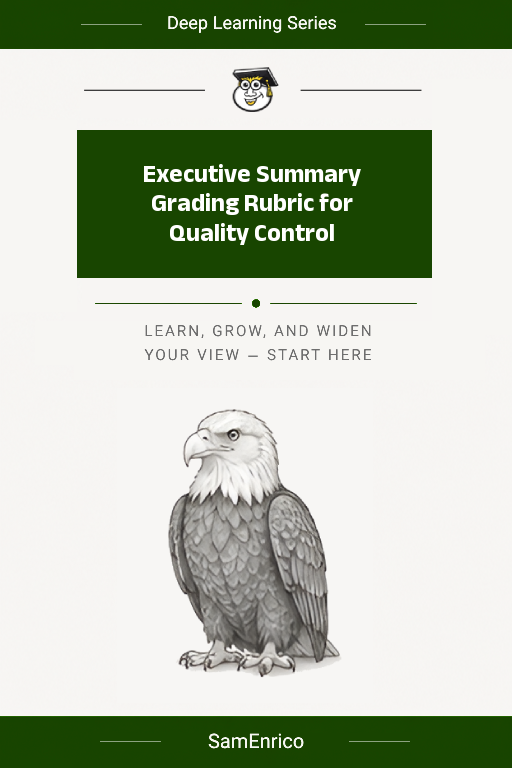
Non-FictionQuality ControlAssessment Guide
Executive Summary Grading Rubric for Quality Control Audiobook
Score any executive summary across eight dimension
Score any executive summary across eight dimensions including brevity, actionability, evidence quality, risk disclosure, and sign-off clarity. Apply the same rubric before sending and during post-mortem reviews.
Formats
Free sample
Chapter 1: The Pre-Mortem Bet--–- Most rubrics are written after the document they are meant to grade. This is like building a fire extinguisher after the building has burned down. The executive summary has already been sent. The decision has already been made. The money has already been spent.
And now someone says, "Let's create a rubric to grade these summaries going forward." That person means well. But they have just guaranteed that the rubric will fail.The reason is simple: a rubric built after writing is a post-hoc justification, not a design constraint. When you build the rubric before you write, it forces you to answer hard questions: What does a 10 out of 10 look like for this specific decision? What is the minimum acceptable score on risk disclosure? Is brevity more important than actionability for a board deck?
These questions are uncomfortable before you write. They feel like拖延. But answering them before you write saves hours of revision, eliminates entire categories of error, and most importantly, prevents the single most common failure mode in executive communication: sending a summary that no one can act on.This chapter introduces the concept of the Pre-Mortem Bet. It is called a bet because you are wagering your time, your credibility, and your organization's decision quality on the proposition that designing the rubric first will produce a better summary faster. The bet is not theoretical.
It has been tested in Fortune 500 companies, venture capital firms, and government agencies. The results are consistent: teams that fill out the rubric before writing produce their final draft in half the time, require one-third as many clarifying emails, and report 40 percent fewer post-decision surprises. The teams that write first and grade later spend twice as long on revisions and still miss risks that the pre-mortem group caught before they ever typed a word.The Pre-Mortem Bet is not complicated. It consists of four steps, each of which takes less than ten minutes. The entire process fits comfortably into a thirty-minute block before any writer starts drafting.
Organizations that skip these thirty minutes routinely spend weeks untangling the consequences of a bad summary. The bet is that thirty minutes of prevention is worth more than weeks of cure. The data says it is.Step one is to identify the decision type. Not all executive summaries are the same. A board deck about a potential acquisition has a different risk…
This is the end of the free sample. Get the Audiobook to keep going. Buy now
About this book
Details
- Author
- Matson Jeremy
- Publisher
- SamEnrico
- Language
- English
- Genre
- Non-Fiction, Quality Control, Assessment Guide
- Released
- 2026-06-01
- Pages (approx.)
- 109
- Available as
- eBook, Audiobook

Listen in the VoxFlicks app
Audiobooks and audio dramas wherever you go. Sign in with your SamEnrico account and press play.
More by Matson Jeremy
 Post Work Eating GuideMatson Jeremy$11.99
 Flare Up Meditation KitMatson Jeremy$11.99
 Self Esteem for Disorganized Attachment WorkbookMatson Jeremy$11.99
 The Medical Professional NetMatson Jeremy$11.99
 Self Esteem After MiscarriageMatson Jeremy$11.99
 The Forgotten Navigator: Diogo Cão and the Congo’s Uncharted DepthsMatson Jeremy$11.99
 Silk Road Whispers: The Opium War That Never WasMatson Jeremy$11.99
 How to Become a Monitor Car OperatorMatson Jeremy$11.99
 Orthopedic CastingMatson Jeremy$11.99
 Procurement Benchmarking GuideMatson Jeremy$12.99
 Understanding Exudative Retinopathy, FamilialMatson Jeremy$17.99
You may also like
 Hong Kong Handover 1997Dunn Johnnie$11.99
 Zumba For Postnatal Recovery CourseNeal Christian$11.99
 Zumba for BeginnersLadner Nikia$11.99
 YouTube Comment Mining GuideHumes Pandora$12.99
 Worry Box MeditationCarlin Rudy$11.99
 Workplace Stress MeditationNguyen Lynn$11.99
 Workplace Stress and Sleep RepairHawley Ivory$11.99
 Workplace Perfectionism CureDelaney Jeffry$11.99
 Workplace Injustice Anger GuideWallen Isabelle$11.99
 Work Addiction and Burnout LinkGreenwood Ester$11.99
 Women in Yoga and WellnessBeattie Galina$11.99
 Women in Stand Up ComedyChun Evangeline$11.99