
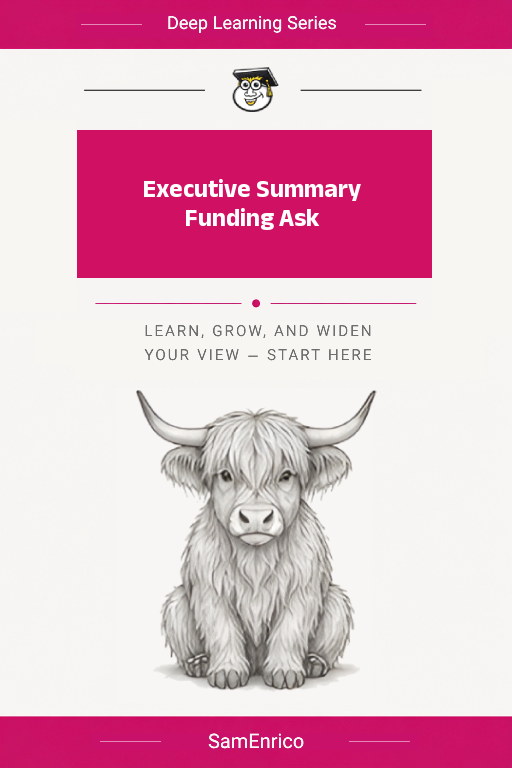
Non-FictionProfessional's Cheat SheetFundraising
Executive Summary Funding Ask eBook
State your funding request clearly when writing ex
State your funding request clearly when writing executive summaries with use of funds and milestones.
Formats
Free sample
Chapter 1: The Sixty-Second Death Sentence--–- The email arrived at 9:47 AM on a Tuesday. Maya had spent three weeks crafting her executive summary—tweaking every sentence, adjusting every margin, perfecting every number. She had run it past her co-founder, her mentor, and a friendly angel investor. Everyone said it was ready. She attached the PDF, wrote a short cover note, and clicked send.
Twenty-two investors received her masterpiece. By 10:15 AM, nineteen of them had already decided to say no. They did not read her market analysis. They did not study her financial projections. They did not finish the document.
They read the first paragraph, skimmed the second, and hit archive. The three who replied asked for more information, but even they would ultimately pass. Maya never got a single meeting.This is the sixty-second death sentence. It is the brutal reality of how investors actually read executive summaries. Not slowly.
Not carefully. Not with an open mind. They read fast, they judge quickly, and they are looking for a reason to reject you. Your job is not to convince them that you are the next unicorn. Your job is to survive the first sixty seconds.
Everything else is noise.This chapter introduces the single most important concept in this book: the executive summary is not a story about your company. It is a contract proposal disguised as a narrative. The reader must finish the first page knowing exactly three things: how much you want, what you will do with it, and when you will deliver measurable results. Anything else is a distraction. This chapter will teach you why investors read the way they do, how to structure your summary to survive the sixty-second scan, and the three questions you must answer before any other words hit the page.The Sixty-Second Rule: How Investors Actually Read Let me tell you something no founder wants to hear.
The average investor spends less than sixty seconds on an executive summary before making a preliminary decision. Many spend less than thirty. They are not being cruel. They are being efficient. A top-tier venture capital firm receives thousands of executive summaries every year.
Partners have limited time. Associates have even less. The screening process is designed to eliminate quickly, not to discover slowly.The First Thirty Seconds: Looking for a Reason to Say No In the first thirty seconds, the investor is not looking for reasons to say yes. They are looking for reasons to say no. This is the opposite of what most founders assume.
You think they are reading with an open mind, searching for the spark that could become the next great company. They are not. They are reading with a filter, searching for any red flag that justifies moving to the next email.What are they looking for? A buried ask. A vague market size.
A team with no relevant experience. A solution in search of a problem. A document that is too long, too dense, or too sloppy. Any one of these can trigger the death sentence. The investor clicks archive and never thinks about you again.The Second Thirty Seconds: Skimming for the Three Questions If you survive the first thirty seconds—if your opening paragraph is clear, your formatting is professional, and your concept is coherent—the investor will spend the next thirty seconds skimming for answers to three specific questions.
These are the only questions that matter in the first pass. Answer them clearly, and you might get a second look. Bury them, and you are dead.Question One: How much are you raising? This must be a single number, not a range. It must appear in the first paragraph.
It must be precise enough to signal that you have done the math.Question Two: What will you do with it? You do not need to provide a full breakdown in the first paragraph—that comes later—but the investor needs to see that the money will be deployed toward something specific. "Growth" is not specific. "Product development and sales expansion" is better. "Hiring three engineers and launching a marketing campaign" is best.Question Three: By when will you deliver measurable results?
Investors do not fund expenses. They fund outcomes. You must tell them what you will achieve with their money and how long it will take. "Within 12 months, we will achieve 10,000 monthly active users" is an outcome. "We will build a great product" is not.These three questions form the backbone of this book.
I call them the Ask Triangle—Amount, Use, Milestone. Every chapter in this book will return to these three corners. Master them, and you master the executive summary.The Case Study: The Founder Who Buried the Ask Let me tell you about a founder I worked with several years ago. I will call her Sarah. Sarah had built a promising B2B software company.
She had revenue, a growing team, and a clear path to product-market fit. She needed $2 million to expand her sales team and launch in three new markets. Her executive summary was eight pages long.Eight pages.I asked her why. She said she wanted to tell the full story. She wanted investors to understand the market size, the competitive landscape, the technical architecture, the go-to-market strategy, the five-year financial projections.
She had worked hard on all of it, and she was proud of the document.I asked her to send me the executive summary. I opened it. The first page was all market size and competitive analysis. The second page was all product features and technical specifications. The third page was all team bios and advisory board credentials.
The fourth page mentioned a "funding requirement" in passing—but only as a footnote, and only as a range ($1.5-2.5 million). The detailed use of funds did not appear until page six. The milestones were scattered across the document, never summarized in one place.I asked Sarah: "How many investors have you sent this to?""About forty," she said."How many meetings have you gotten?""None."I was not surprised. I told her to imagine an investor opening her executive summary at 9:00 AM on a Tuesday. They have thirty seconds.
They scan the first page. They see market size (interesting but not urgent), competitive analysis (every company has competitors), and product features (too early for that level of detail). They do not see a funding ask. They do not see a use of funds. They do not see a milestone.
They have no reason to keep reading. They click archive. Forty times.We rewrote her executive summary from scratch. One page. First paragraph: "We are raising 2milliontoexpandoursalesteamfromthreetoeightpeopleandlaunchinthe Chicago,Austin,and Denvermarkets.Within12months,wewillachieve2 million to expand our sales team from three to eight people and launch in the Chicago, Austin, and Denver markets.
Within 12 months, we will achieve 2milliontoexpandoursalesteamfromthreetoeightpeopleandlaunchinthe Chicago,Austin,and Denvermarkets.Within12months,wewillachieve3 million in annual recurring revenue." The rest of the page supported that opening with brief sections on problem, solution, traction, and team. She sent the new version to ten investors. She got meetings with four. She closed the round in ninety days.The difference was not the quality of her company. The difference was the clarity of her…
This is the end of the free sample. Get the eBook to keep going. Buy now
About this book
Details
- Author
- Franco Vernetta
- Publisher
- SamEnrico
- Language
- English
- Genre
- Non-Fiction, Professional's Cheat Sheet, Fundraising
- Released
- 2026-06-01
- Pages (approx.)
- 130
- Available as
- eBook, Audiobook

Read better in the ZLOADR app
Your eBooks on your phone or tablet. Sign in with your SamEnrico account and start reading.
More by Franco Vernetta
 Legacy Letter Writing CourseFranco Vernetta$11.99
 Uber Driver Vehicle MaintenanceFranco Vernetta$11.99
 Anger De escalation Communication GuideFranco Vernetta$11.99
 The Montenegro Digital Nomad Visa GuideFranco Vernetta$11.99
 Audience Scan for AlliesFranco Vernetta$11.99
 The Battle of Saratoga: Turning Point of the American RevolutionFranco Vernetta$11.99
 Understanding Lutz–richner–landolt SyndromeFranco Vernetta$17.99
 Head of Business DevelopmentFranco Vernetta$11.99
 How to Become a Larry OperatorFranco Vernetta$11.99
 EV Lithium Battery Value ChainFranco Vernetta$12.99
You may also like
 Hong Kong Handover 1997Dunn Johnnie$11.99
 Zumba For Postnatal Recovery CourseNeal Christian$11.99
 Zumba for BeginnersLadner Nikia$11.99
 YouTube Comment Mining GuideHumes Pandora$12.99
 Worry Box MeditationCarlin Rudy$11.99
 Workplace Stress MeditationNguyen Lynn$11.99
 Workplace Stress and Sleep RepairHawley Ivory$11.99
 Workplace Perfectionism CureDelaney Jeffry$11.99
 Workplace Injustice Anger GuideWallen Isabelle$11.99
 Work Addiction and Burnout LinkGreenwood Ester$11.99
 Women in Yoga and WellnessBeattie Galina$11.99
 Women in Stand Up ComedyChun Evangeline$11.99