
Non-FictionProfessional's Cheat SheetBusiness Writing
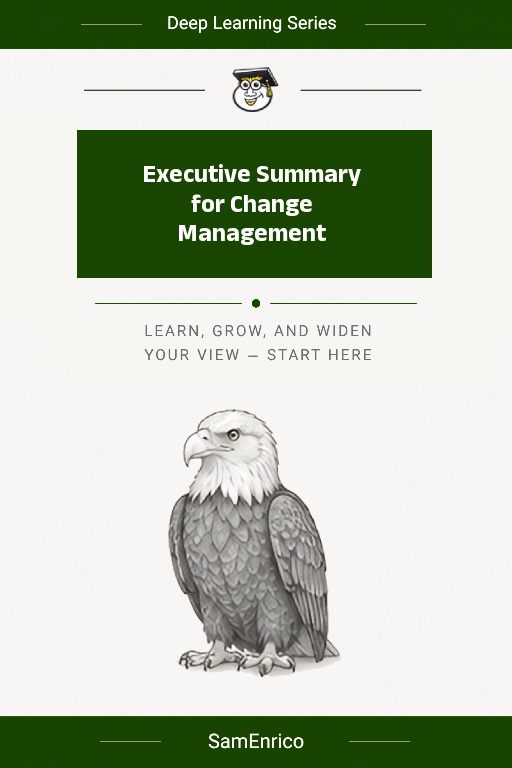
Executive Summary for Change Management eBook
Summarize organizational change initiatives. Impac
by Frost Duncan
Summarize organizational change initiatives. Impact, communication plan, and success metrics.
Formats
Free sample
Chapter 1: The Filter Paradox...--Every executive has felt it. The slow, suffocating weight of a fifty-seven-slide deck titled “Change Initiative Q3 Readout.” The email thread that forks into eighteen different directions, none of which answer the question “Are we doing this or not?” The project plan with twelve color-coded tabs and a timeline that already looks fictional on page one.You close your laptop. You rub your eyes. You think: I have no idea if this change is working.Here is the uncomfortable truth that change management consultants rarely admit to their clients: most change initiatives do not fail because of bad ideas, poor strategy, or even incompetent execution. They fail because no one can summarize what is actually happening.
The raw material of the change—the data, the plans, the stakeholder feedback, the risks—exists in overwhelming abundance. But the signal has been buried so deep under the noise that even the people leading the change cannot tell you, in one page, what they are trying to accomplish, why it matters, and what success looks like.This book is called Executive Summary for Change Management for a reason. The phrase “executive summary” is often dismissed as bureaucratic wallpaper—the thing you write last, after the real work is done, because someone in finance requires it. That understanding is precisely backward. The executive summary is not the garnish on the plate of change management.
It is the plate itself. Without it, you do not have a meal; you have ingredients scattered across a counter.This chapter introduces the foundational problem that the entire book exists to solve: the failure of filtration. It then provides the single most important tool in the book—the Master Executive Summary Canvas—which will serve as the backbone for every subsequent chapter. And it establishes three principles that will not be repeated in later chapters (because repetition is the enemy of executive attention), but that will be referenced constantly: the difference between activity and impact, the difference between tactical updates and strategic summaries, and the three fatal errors that kill change initiatives before they begin.The Noise Epidemic: Why Your Change Initiative Is Already Drowning Let us start with a simple diagnostic question. Think about the last major change initiative you led or participated in.
How many documents, presentations, emails, chat threads, and status reports were generated in the first thirty days? If you are like most leaders in mid-sized to large organizations, the answer is: more than you could possibly read, let alone synthesize.This is not an accident. It is a structural feature of how organizations operate. Information is treated as a sign of competence. Long documents signal rigor.
Detailed project plans signal control. Frequent updates signal engagement. The unspoken reward system in most corporations incentivizes more—more slides, more data points, more meetings, more email threads—without any corresponding reward for less.But here is the paradox that this chapter calls The Filter Paradox: The more information you produce, the less clarity your stakeholders actually have.Consider the research. A landmark study of organizational communication found that when project teams produced weekly status reports exceeding ten pages, executive comprehension of key risks actually decreased compared to teams that produced one-page summaries. The reason is not that executives are lazy or inattentive (though some are).
The reason is cognitive bandwidth. The human brain has a limited capacity to hold and manipulate information. When you present fifty-seven slides, you are not providing clarity. You are providing a stress test.The Filter Paradox has three specific mechanisms that every change leader must understand:First, information overload creates false confidence. When leaders receive a thick document, they assume that the team has done thorough analysis.
Often, the thickness is a camouflage for lack of strategic clarity. Anyone can generate fifty pages of noise. It takes discipline to generate one page of signal.Second, information overload obscures disagreement. In a fifty-page plan, conflicting assumptions can hide in different sections. The finance team’s assumptions about cost savings might be in appendix C.
The operations team’s assumptions about implementation timeline might be buried on page thirty-one. No one reads the whole document. No one notices the contradiction. And the change initiative marches forward with a fundamental fracture that will explode six months later.Third, information overload destroys accountability. When the plan is too long to remember, no one can be held responsible for deviations.
The response to “Why did we miss this milestone?” becomes “Well, if you look at the footnote on page forty-two, we flagged a risk.” The purpose of the executive summary is not to capture every possible contingency. It is to capture the few things that actually matter—so that when they go wrong, everyone knows who is accountable.The Three Fatal Summary Errors Before we introduce the solution, we must name the enemy. Across the analysis of hundreds of change initiatives—from the case studies in Laurie Lewis’s Organizational Change to the post-mortems in HBR’s 10 Must Reads on Change Management—three summary errors appear again and again. Avoid these three, and you have already outperformed the majority of change leaders.Error One: Burying the Why The first error is the most common and the most devastating. The executive summary describes what the change is, how it will be implemented, who is responsible, when it will happen, and where it will roll out.
But it never answers why.Here is what “burying the why” looks like in practice. A technology leader presents a one-page summary of a new CRM implementation. The summary includes the vendor name, the budget, the timeline, the pilot departments, the training schedule, and the success metrics (adoption rate by week four). Everything looks professional. Everything looks thorough.
Everything is useless.Why? Because nowhere in that summary does it answer the question that every stakeholder is actually asking: Why should I care? For the sales team, the why might be “You will save five hours per week on data entry.” For the finance team, the why might be “We will reduce bad debt write-offs by fifteen percent.” For the customer support team, the why might be “You will see the customer’s full history without switching between three screens.”A summary without a why is a list of tasks. It generates compliance at best, resistance at worst. And it guarantees that when things get difficult—when the training takes longer than expected, when the software has bugs, when people are tired and frustrated—there will be no reservoir of commitment to draw upon.
No one knows why they are doing this. So they stop.The Fix: Every executive summary must contain, in the first paragraph, a clear statement of why this change matters to the primary stakeholders. Not to the shareholders. Not to the CEO. To the people who will have to do their jobs differently.
If you cannot articulate that in one sentence, you are not ready to lead the change.Error Two: Ignoring the Who The second error is more subtle but equally fatal. The executive summary treats all stakeholders as if they were the same. It uses phrases like “communicate the change to all employees” or “ensure…
This is the end of the free sample. Get the eBook to keep going. Buy now
About this book
Details
- Author
- Frost Duncan
- Publisher
- SamEnrico
- Language
- English
- Genre
- Non-Fiction, Professional's Cheat Sheet, Business Writing
- Released
- 2026-05-29
- Pages (approx.)
- 154
- Available as
- eBook, Audiobook

Read better in the ZLOADR app
Your eBooks on your phone or tablet. Sign in with your SamEnrico account and start reading.
More by Frost Duncan
 Nightmare Processing For Survivors Of Abuse WorkbookFrost Duncan$11.99
 Bipolar And Intellectual DisabilityFrost Duncan$11.99
 Nairobi Startup Funding GuideFrost Duncan$11.99
 The LBO Exit Multiple DatabaseFrost Duncan$11.99
 Teen Anger Triggers GuideFrost Duncan$11.99
 Subtitles and Subversion: How a UK-Based Film Platform Revolutionized Foreign CinemaFrost Duncan$11.99
 How to Become a Turkey-roll MakerFrost Duncan$11.99
 Dark Ages ReenactmentFrost Duncan$11.99
 Excel for Economics Exams GuideFrost Duncan$12.99
You may also like
 Hong Kong Handover 1997Dunn Johnnie$11.99
 Zumba For Postnatal Recovery CourseNeal Christian$11.99
 Zumba for BeginnersLadner Nikia$11.99
 YouTube Comment Mining GuideHumes Pandora$12.99
 Worry Box MeditationCarlin Rudy$11.99
 Workplace Stress MeditationNguyen Lynn$11.99
 Workplace Stress and Sleep RepairHawley Ivory$11.99
 Workplace Perfectionism CureDelaney Jeffry$11.99
 Workplace Injustice Anger GuideWallen Isabelle$11.99
 Work Addiction and Burnout LinkGreenwood Ester$11.99
 Women in Yoga and WellnessBeattie Galina$11.99
 Women in Stand Up ComedyChun Evangeline$11.99