

Non-FictionEditing GuideWriting Craft
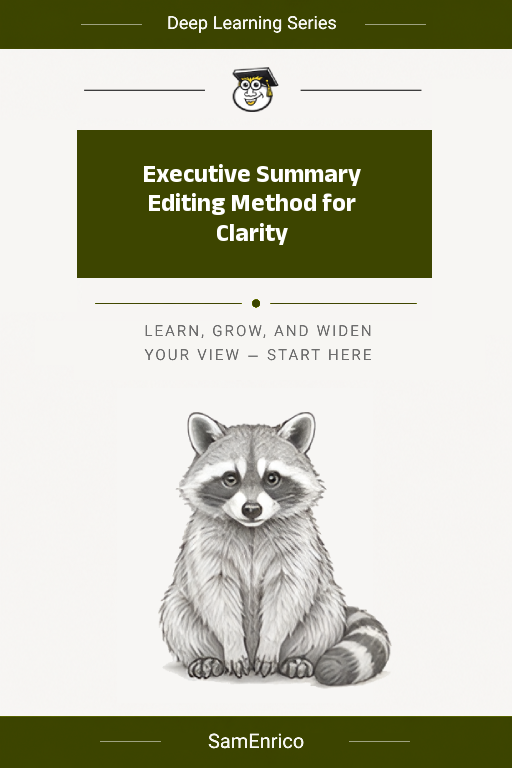
Executive Summary Editing Method for Clarity eBook
Cut your draft by forty percent without losing mea
Cut your draft by forty percent without losing meaning. Apply the fresh-eyes reset, the passive-voice eliminator, the conjunction splitter, and the so-what drill that turns observations into actionable insights.
Formats
Free sample
Chapter 1: The 40% Lie--Every first draft you have ever written contains a lie. Not a lie of fact—you are probably an honest person who would never deliberately mislead a reader. A lie of omission, disguised as completeness. The lie says: All of these words are necessary.They are not.Here is the truth that top editors at Mc Kinsey, BCG, and the major publishing houses have known for decades: approximately forty percent of the words in any given first draft are cosmetic. They are not structural.
They do not hold up the meaning. They are decorative walls built around the core insight, hiding it from the reader while creating the illusion of thoroughness. The junior consultant who adds three caveats to every recommendation is not being rigorous. She is being afraid. The manager who writes “it was determined that the budget was exceeded by the department” instead of “the department exceeded the budget” is not being formal.
He is being evasive. The executive who turns a one-page summary into a twelve-page deck is not being thorough. He is being insecure.This book exists to cure that insecurity. In the next twelve chapters, you will learn a proprietary four-method system—the Fresh Eyes Reset, the Conjunction Splitter, the Passive Voice Eliminator, and the So-What Drill—that will enable you to cut any draft by forty percent without losing a single necessary meaning. You will write less.
You will be understood more. And you will finally stop apologizing for long emails.But first, you must accept the 40% Lie for what it is: not a failure of your intelligence, but a predictable consequence of how human beings write.The Cosmetic Wall Fallacy Imagine you are an architect. You have designed a small house: two bedrooms, one bathroom, a kitchen, a living room. The walls you have drawn are structural. They hold up the roof.
They define the rooms. If you remove one of them, the house collapses.Now imagine that same house, but someone has added a second set of walls inside the existing rooms. These new walls do not hold anything up. They are purely decorative. They make the rooms feel smaller and harder to navigate.
They serve no purpose except to suggest that more walls equal more house.Your first draft is that house. The structural walls are the sentences that carry meaning, logic, and necessary instruction. The cosmetic walls are everything else: the caveats, the repetitions, the passive constructions, the throat-clearing paragraphs that say “before we begin, let me provide some context.” These cosmetic walls do not support the document. They hide its true shape. And you have been trained by years of bad corporate writing to believe that more walls mean more rigor.They do not.
They mean more noise.The Evidence: Why 40% Is Not Arbitrary You might be thinking: Forty percent sounds like a number someone made up to sell books. Fair objection. Let me give you the evidence.In 2015, a team of researchers at the Corporate Executive Board analyzed over two thousand internal memos, executive summaries, and strategy decks from Fortune 500 companies. They measured two variables: document length (in words) and the time senior executives spent reading each document before making a decision. The results were not linear.
They were cliff-shaped.Documents under five hundred words received an average of ninety seconds of attention. Documents between five hundred and one thousand words received ninety seconds of attention. Documents over one thousand words? Less than sixty seconds of attention, often skimmed diagonally or not read at all. The researchers concluded that executives do not allocate reading time proportionally to document length.
They allocate a fixed budget of attention—roughly ninety seconds—and then they stop. Any words beyond what fits into ninety seconds are not just wasted. They are counterproductive. They actively prevent the reader from finding the core message.The consulting firms understood this long before the academics caught up. Mc Kinsey’s internal editing guidelines, leaked and circulated widely in the early 2000s, include a rule called the “forty percent assumption”: assume that your first draft is forty percent longer than it needs to be, and edit accordingly.
BCG has a similar policy called the “one-page test”: if a recommendation cannot fit on one page, it is not ready for an executive audience. Both firms know that dense text is ignored. Lean text is read.Publishing houses operate on the same principle. When an editor at Knopf or Harper Collins receives a manuscript, they do not read it straight through. They perform what is called a “structural edit”: they look for the manuscript’s natural length, which is almost always thirty to forty percent shorter than the draft the author submitted.
The author’s job is to generate pages. The editor’s job is to remove them. The final published book is never as long as the first draft. It is always better.So the 40% target is not a gimmick. It is the consensus of three different industries—consulting, publishing, and academic research—that have all arrived at the same number independently.
Forty percent is the amount of cosmetic language that accumulates in every first draft. Remove it, and the structure remains. Remove it, and the meaning becomes visible.The Enemy: Bloated Drift If forty percent waste is inevitable, where does it come from? Not from malice. From a process I call bloated drift.Bloated drift is the gradual, invisible accumulation of words over the life of a document.
It works like this: You write a first draft. It is too long, but it is yours. You send it to a colleague for review. The colleague reads it, agrees with your recommendation, but adds a sentence: “However, it should be noted that these figures are preliminary pending final Q3 results.” That sentence is not wrong. It is also not necessary.
The reader already knows that Q3 results are not final. But the colleague adds it anyway, because adding a sentence costs nothing and protects everyone from hypothetical blame.You send the revised draft to a second reviewer. That reviewer, seeing the first caveat, adds another: “Of course, any projection beyond the current fiscal year carries inherent uncertainty.” Another sentence. Another layer of insulation. Another cosmetic wall.By the time the document reaches its final audience, it has passed through five or six hands.
Each reviewer has added one or two sentences. No one has deleted anything. The original one-page memo is now three pages. The core insight—the reason the document was written in the first place—is buried under a landfill of disclaimers, polite hedges, and corporate CYA (cover your ass) language.This is bloated drift. It is the single greatest enemy of executive clarity.
And it is entirely preventable.The Cost of Not Cutting What happens if you ignore the 40% rule? Let me give you a concrete example.A few years ago, I worked with a product manager at a mid-sized software company. Let’s call her Priya. Priya had written a five-page executive summary recommending a major feature overhaul. The summary contained data, customer feedback, competitive analysis, and a detailed implementation timeline.
It was thorough. It was also unreadable.Priya sent the summary to her VP of Product. The VP read the first…
This is the end of the free sample. Get the eBook to keep going. Buy now
About this book
Details
- Author
- Campos Brooks
- Publisher
- SamEnrico
- Language
- English
- Genre
- Non-Fiction, Editing Guide, Writing Craft
- Released
- 2026-05-29
- Pages (approx.)
- 115
- Available as
- eBook, Audiobook

Read better in the ZLOADR app
Your eBooks on your phone or tablet. Sign in with your SamEnrico account and start reading.
More by Campos Brooks
 Self Esteem for Stutterers HandbookCampos Brooks$11.99
 Mindfulness for Arthritis PainCampos Brooks$11.99
 Mindful Eating HandbookCampos Brooks$11.99
 Method of Loci Competition TrainingCampos Brooks$11.99
 The Consultant NetworkerCampos Brooks$11.99
 The Last Unknown Islands: Captain Cook’s Pacific Odyssey and the Birth of Modern ExplorationCampos Brooks$11.99
 Whispers of the Silk Road: The Forgotten Empress of the Han DynastyCampos Brooks$11.99
 Opportunity Canvas CreatorCampos Brooks$11.99
 Understanding Extrasystoles Short Stature Hyperpigmentation MicrocephalyCampos Brooks$17.99
 Procurement Supplier DiversityCampos Brooks$12.99
 How to Become a Monorail Crane OperatorCampos Brooks$11.99
You may also like
 Hong Kong Handover 1997Dunn Johnnie$11.99
 Zumba For Postnatal Recovery CourseNeal Christian$11.99
 Zumba for BeginnersLadner Nikia$11.99
 YouTube Comment Mining GuideHumes Pandora$12.99
 Worry Box MeditationCarlin Rudy$11.99
 Workplace Stress MeditationNguyen Lynn$11.99
 Workplace Stress and Sleep RepairHawley Ivory$11.99
 Workplace Perfectionism CureDelaney Jeffry$11.99
 Workplace Injustice Anger GuideWallen Isabelle$11.99
 Work Addiction and Burnout LinkGreenwood Ester$11.99
 Women in Yoga and WellnessBeattie Galina$11.99
 Women in Stand Up ComedyChun Evangeline$11.99