
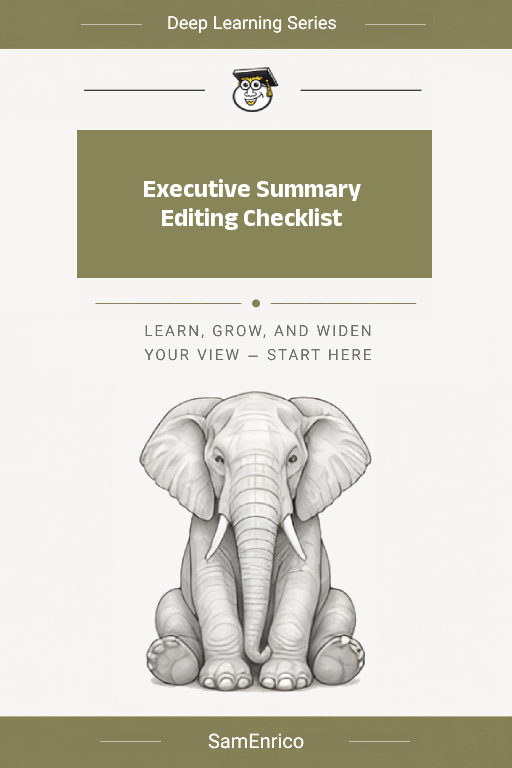
Non-FictionProfessional's Cheat SheetEditing Guide
Executive Summary Editing Checklist eBook
Edit ruthlessly when writing executive summaries w
Edit ruthlessly when writing executive summaries with a focused checklist for clarity and conciseness.
Formats
Free sample
Chapter 1: The One-Sentence North Star--–- Imagine you have fifteen seconds in an elevator with your company’s CEO. The doors close. She turns to you and says, “What does your project recommend, and why should I care?” You have no slides, no printout, no backup data. Just the time it takes for the elevator to travel ten floors. In that moment, every extra word is a liability.
Every hedge, every caveat, every “it depends” guarantees that you will walk out of that elevator having failed.That elevator ride is not a hypothetical exercise. It is the single most accurate metaphor for how senior executives actually read your executive summary. They are not settling into a leather chair with a cup of coffee and a highlighter. They are scanning your document between back-to-back meetings, thumbing through it on a phone while walking to another conference room, or glancing at it thirty seconds before a decision meeting. They are, in every meaningful sense, already in the elevator.
And you are already speaking.The vast majority of executive summaries fail not because the underlying analysis is wrong, not because the recommendations are poorly conceived, and not because the writer lacks intelligence or effort. They fail because the writer never answered a single, devastatingly simple question before typing a single word: What is my one sentence?This chapter introduces what I call the One-Sentence North Star. It is a deceptively simple discipline: before you edit a single word, before you rearrange a single paragraph, before you even open your document, you must distill your entire executive summary into one clear, declarative, specific sentence of no more than fifteen words. That sentence becomes your editing compass. Every other word in your summary either serves that sentence or dies.If this sounds too simple to matter, consider the alternative.
Most writers begin editing by hunting for typos, tweaking word order, or moving paragraphs around. That is like trying to navigate a ship across the ocean by polishing the deck railing. Without a North Star, you have no way to know whether any given sentence is necessary. You end up keeping nice-sounding phrases because they feel good, preserving background information because you worked hard to gather it, and leaving in transitional sentences because they make the document read more smoothly. All of that is editorial clutter dressed up as craft.The One-Sentence North Star changes everything because it gives you a ruthless, objective, unforgiving standard.
You no longer ask, “Is this sentence well written?” You ask, “Does this sentence directly serve my North Star?” If the answer is no, the sentence is gone. Not rewritten. Not moved to another section. Gone. The CEO in the elevator does not have time for your second-best point, your interesting side analysis, or your carefully crafted transition.
She has time for one sentence. That sentence is your North Star. Everything else is either evidence, action, or noise.Why Fifteen Words?The number fifteen is not arbitrary. Cognitive psychology research suggests that working memory can hold approximately seven to nine items for a few seconds. But an executive under stress—and almost all senior leaders are under chronic time pressure—has even less capacity.
Fifteen well-chosen words fit comfortably within that cognitive budget. Twenty words begin to strain it. Thirty words guarantee that the executive will have forgotten the beginning of your sentence by the time she reaches the end.Fifteen words also enforce a kind of savage prioritization. You cannot include your recommendation, your methodology, your caveats, your team’s qualifications, and your historical background in fifteen words. Something has to give.
That something is almost everything except the core insight plus the action you need the executive to take. Consider the difference between a weak North Star and a strong one.Weak North Star (twenty-eight words): “Based on our analysis of Q3 sales data and customer feedback surveys, we believe that implementing a new CRM system could potentially lead to improved retention rates.” This sentence is vague (“could potentially”), hedged (“we believe”), and overweighted with preamble (“based on our analysis”). It fails the fifteen-word test immediately.Strong North Star (twelve words): “Invest 500Kin CRMby Apriltocutchurn15500K in CRM by April to cut churn 15%.” Every word carries weight. The action (“invest”), the amount (“500Kin CRMby Apriltocutchurn15500K”), the deadline (“by April”), the mechanism (“CRM”), and the outcome (“cut churn 15%”). An executive can read that sentence in two seconds and know exactly what you are asking, why it matters, and when you need an answer.
That is the power of fifteen words.Throughout this chapter, you will practice distilling your own North Star. The exercise is intentionally uncomfortable. You will want to add words. You will feel that your recommendation is too nuanced for a single sentence. You will be tempted to qualify, to soften, to make room for exceptions.
Resist that temptation. The discipline of fifteen words is not about dumbing down your thinking. It is about clarifying your thinking so brutally that any executive, no matter how distracted, can grasp your argument instantly.The North Star Versus the Executive Summary A critical distinction must be made clear at this point, because confusion here has derailed more editors than any other mistake. The One-Sentence North Star is not your executive summary. It is the thesis from which your executive summary grows.
Your final executive summary will be longer—approximately 225 to 250 words, or about ninety seconds of reading aloud, as we will cover in Chapter 9. The North Star is the seed; the summary is the tree. You do not hand the CEO a seed in the elevator. You hand her a single, perfectly ripe fruit. The seed is for you, the editor, to plant before you grow anything else.This distinction resolves a common anxiety.
Writers often protest, “But my recommendation is too complex for one sentence! We have three options, each with different risk profiles, and the executive needs to understand the trade-offs.” That is entirely correct. Your final executive summary will lay out those options, compare risks, and make a nuanced case. But none of that nuance matters if the executive cannot remember your core ask thirty seconds after putting down the document. The North Star gives her a hook to hang all that nuance on.
She reads your summary, sees Option A, Option B, and Option C, but your North Star was “Option A cuts risk 40% with lowest cost.” Now she evaluates every detail through that lens. You have framed the decision. That is the difference between informing an executive and leading one.Think of the North Star as the headline of a newspaper article. The headline is not the article. It does not contain all the facts, quotes, or context.
But a reader who only reads the headline still knows the essential story. A reader who reads the entire article will understand the nuance, but that understanding is organized around the headline’s claim. Your executive summary works exactly the same way. Some executives will read only your North Star and your bullet points. That is fine—they still know what you need.
Others will read every word. They will have your North Star in mind as they do. Either way, you win.Step…
This is the end of the free sample. Get the eBook to keep going. Buy now
About this book
Details
- Author
- Hayden Kirsten
- Publisher
- SamEnrico
- Language
- English
- Genre
- Non-Fiction, Professional's Cheat Sheet, Editing Guide
- Released
- 2026-05-30
- Pages (approx.)
- 160
- Available as
- eBook, Audiobook

Read better in the ZLOADR app
Your eBooks on your phone or tablet. Sign in with your SamEnrico account and start reading.
More by Hayden Kirsten
 Senior Grief Self Esteem WorkbookHayden Kirsten$11.99
 Pre Talk Caffeine CutoffHayden Kirsten$11.99
 Fiverr Cancelation PreventionHayden Kirsten$11.99
 Anger Time Out Protocol GuideHayden Kirsten$11.99
 The Geo Arbitrage Coworking DirectoryHayden Kirsten$11.99
 Pandora's Box: The Unseen CurseHayden Kirsten$11.99
 Understanding Lyme DiseaseHayden Kirsten$17.99
 Solar Energy Development GuideHayden Kirsten$12.99
 How to Become a Drawer-in - Stitch-bonding MachineHayden Kirsten$11.99
 Health Insurance SpecialistHayden Kirsten$11.99
You may also like
 Hong Kong Handover 1997Dunn Johnnie$11.99
 Zumba For Postnatal Recovery CourseNeal Christian$11.99
 Zumba for BeginnersLadner Nikia$11.99
 YouTube Comment Mining GuideHumes Pandora$12.99
 Worry Box MeditationCarlin Rudy$11.99
 Workplace Stress MeditationNguyen Lynn$11.99
 Workplace Stress and Sleep RepairHawley Ivory$11.99
 Workplace Perfectionism CureDelaney Jeffry$11.99
 Workplace Injustice Anger GuideWallen Isabelle$11.99
 Work Addiction and Burnout LinkGreenwood Ester$11.99
 Women in Yoga and WellnessBeattie Galina$11.99
 Women in Stand Up ComedyChun Evangeline$11.99