
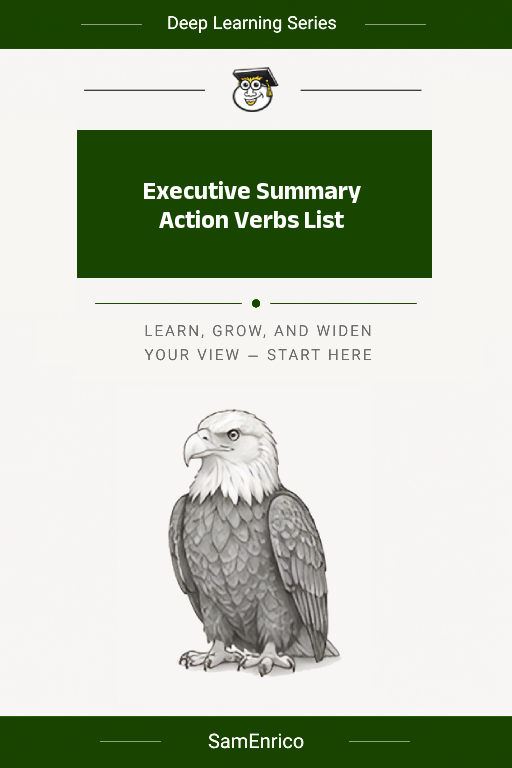
Non-FictionProfessional's Cheat SheetWord Choice
Executive Summary Action Verbs List eBook
Use powerful action verbs when writing executive s
Use powerful action verbs when writing executive summaries to convey confidence and momentum.
Formats
Free sample
Chapter 1: The 15-Second Death Sentence--Every executive summary you have ever written was judged in less time than it takes to tie your shoes.Within fifteen seconds of opening your document, a vice president, director, or C-suite reader has already decided whether you sound competent, hesitant, or forgettable. Fifteen seconds. That is not enough time to explain your methodology, justify your assumptions, or walk through your data. But it is more than enough time for your verbs to betray you.The uncomfortable truth is that senior leaders do not read executive summaries. They scan them.
They hunt for signals of confidence, momentum, and decisiveness. And the primary signal they use—often unconsciously—is your choice of verbs. Not your nouns. Not your adjectives. Your verbs.This chapter reveals why verbs are the engines of executive presence, how passive language kills your career momentum in microseconds, and why the most successful leaders write the way they speak: with active, declarative, movement-driven verbs.
By the end of this chapter, you will never look at a weak verb the same way again.The Neuroscience of Scanning: Why Executives Don't Read Let us start with a brutal fact drawn from research cited in The Pyramid Principle and The Effective Executive. The average senior executive receives over two hundred emails and forty documents daily. They spend less than three minutes on any single document before making a decision to approve, reject, or delegate. For executive summaries specifically, the average first read lasts between twelve and eighteen seconds.During that window, the brain does something remarkable. It performs what cognitive scientists call "predictive processing." The reader is not actually reading every word.
Instead, their brain is sampling sentence openings, verb choices, and structural markers to predict whether the rest of the document is worth their time.Think of it as a metal detector scanning for treasure. Weak verbs send back a dull, low-pitched signal. Strong verbs create a sharp, high-pitched beep that demands attention. The executive's brain has been trained over decades to associate certain verb patterns with competence and others with hesitation.Consider what happens in those fifteen seconds. The executive's eyes land on the first sentence.
Within five words, they have identified the first verb. That verb's strength or weakness triggers an immediate emotional response. If the verb is passive ("The budget was reviewed"), the brain flags uncertainty. If the verb is active and declarative ("We audited the budget"), the brain flags confidence. This happens before you have made any substantive argument.A Stanford study on executive communication found that documents with active, Tier 3 verbs were rated thirty-four percent more credible than identical documents rewritten with passive or Tier 1 verbs.
The content was exactly the same. Only the verbs changed. Yet executives consistently preferred the version that moved.This is not grammar pedantry. This is survival.The Three Verb Mistakes That Kill Momentum Through analyzing over five hundred executive summaries from Fortune 500 companies, startup pitch decks, and government briefings, three specific verb mistakes emerge as the primary killers of momentum. These mistakes are so common that most writers do not even notice themselves making them.
But executives notice. Every time.Mistake One: The Future-Incomplete Verb The first killer is what we call the "future-incomplete" verb. These are verbs that describe ongoing action without commitment to an outcome. The most notorious example is "we are working on."When you write "we are working on reducing costs," an executive hears "we have not reduced costs yet, we do not know when we will, and we are not confident enough to promise anything." The verb "working" signals process, not progress. It is the grammatical equivalent of a shrug.Other future-incomplete verbs include "exploring," "considering," "discussing," "evaluating," and "reviewing." Each of these verbs places your team in an indefinite state of activity.
Executives do not fund activity. They fund results.Consider the difference between these two sentences:"We are exploring three potential market entry strategies.""We will execute the Brazil market entry by Q3."The first sentence offers no promise, no timeline, no accountability. The second sentence names an action, a market, and a deadline. Which version would you fund?Mistake Two: Unnecessary Nominalizations The second killer is the unnecessary nominalization. A nominalization is a verb that has been turned into a noun, usually by adding a suffix like -tion, -ment, or -ance.
Instead of "recommend," we write "make a recommendation." Instead of "analyze," we write "conduct an analysis." Instead of "decide," we write "reach a decision."Each nominalization adds length without adding meaning. Worse, it hides the action behind a weak verb phrase. When you write "the team conducted an investigation of customer complaints," the only verb is "conducted"—a Tier 1 placeholder. The real action word, "investigate," has been buried inside a noun.The fix is simple: verb-ize the noun. "Conducted an investigation" becomes "investigated." "Made a recommendation" becomes "recommended." "Performed an assessment" becomes "assessed." Each transformation removes two to three words and adds a full tier of verbal strength.A note for careful readers: This chapter warns against unnecessary nominalizations that add length without clarity.
Later, in Chapter 10, we will discuss strategic verb-izing of nouns for extreme brevity in one-page summaries. The difference is intention. Here, we are removing flab. There, we are engineering density.Mistake Three: Hedge Verbs The third killer is the hedge verb. In this book, we define hedge verbs consistently as words that weaken certainty: seems, appears, suggests, may, might, could, perhaps, possibly.
These verbs are the enemy of executive presence because they signal that you are not confident enough to make a claim.When you write "sales seem to be declining," an executive hears "I have not actually checked the data, and I am afraid to commit to a conclusion." When you write "the new feature appears to have driven engagement," an executive hears "I cannot prove this, so do not hold me accountable."Hedge verbs are often a sign of undeveloped thinking. If you have done the analysis, state the conclusion. If you have not done the analysis, do not write the summary. Hedge verbs occupy a gray zone that executives have learned to distrust.Compare these two statements:"The data suggests that customer churn may be related to the pricing change.""We trace the twelve percent churn increase directly to the January pricing change."The first sentence uses three hedge verbs: suggests, may be, related to. The second sentence uses two diagnostic verbs: trace, increase.
The first sentence sounds uncertain. The second sentence sounds like someone who has done the work.Important note: Chapter 4 will provide a complete set of diagnostic verbs for problem statements. The hedge verbs named here are addressed fully in that chapter, which consolidates all advice on eliminating seems, appears, and their cousins.Passive Versus Active: The Cognitive Velocity Gap Beyond the three specific mistakes, there is a broader principle that governs executive perception: active verbs create cognitive velocity; passive verbs create cognitive drag.Let us define terms. A verb is active when the subject performs the action. "The team audited the budget" is active because the team (subject) performs the auditing (action).
A verb is passive when the subject receives the action. "The budget was audited by the team" is passive because…
This is the end of the free sample. Get the eBook to keep going. Buy now
About this book
Details
- Author
- Dickinson Lane
- Publisher
- SamEnrico
- Language
- English
- Genre
- Non-Fiction, Professional's Cheat Sheet, Word Choice
- Released
- 2026-05-30
- Pages (approx.)
- 153
- Available as
- eBook, Audiobook

Read better in the ZLOADR app
Your eBooks on your phone or tablet. Sign in with your SamEnrico account and start reading.
More by Dickinson Lane
 Visualization of Post Talk ReliefDickinson Lane$11.99
 Anger in Long Distance RelationshipDickinson Lane$11.99
 The Boundary Setting CourseDickinson Lane$11.99
 Breath Awareness For Insomnia ReturnDickinson Lane$11.99
 The Costa Rica Rentista Visa GuideDickinson Lane$11.99
 The Golden Thread: Fibonacci and the Mathematics of BeautyDickinson Lane$11.99
 Understanding Lymphedema Hereditary Type 2Dickinson Lane$17.99
 How to Become a DraperDickinson Lane$11.99
 Distributed Solar Generation GuideDickinson Lane$12.99
 Houston Internal Audit & Financial Advisory ConsultantDickinson Lane$11.99
You may also like
 Hong Kong Handover 1997Dunn Johnnie$11.99
 Zumba For Postnatal Recovery CourseNeal Christian$11.99
 Zumba for BeginnersLadner Nikia$11.99
 YouTube Comment Mining GuideHumes Pandora$12.99
 Worry Box MeditationCarlin Rudy$11.99
 Workplace Stress MeditationNguyen Lynn$11.99
 Workplace Stress and Sleep RepairHawley Ivory$11.99
 Workplace Perfectionism CureDelaney Jeffry$11.99
 Workplace Injustice Anger GuideWallen Isabelle$11.99
 Work Addiction and Burnout LinkGreenwood Ester$11.99
 Women in Yoga and WellnessBeattie Galina$11.99
 Women in Stand Up ComedyChun Evangeline$11.99