
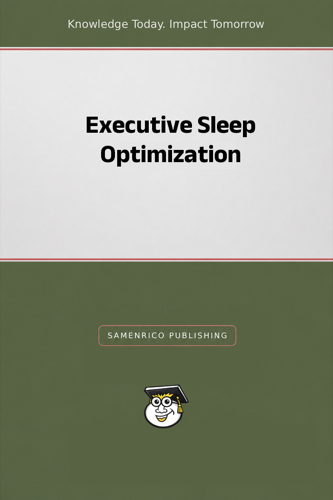
Executive Sleep Optimization eBook
High performance rest for busy professionals with
High performance rest for busy professionals with limited time.
Formats
Free sample
Chapter 1: The Performance Paradox--–- The email arrived at 11:47 PM on a Tuesday. Sarah, a forty-two-year-old private equity partner, had just reviewed her sixth term sheet of the day. Her toddler had woken at 4:00 AM. She had skipped lunch to take a client call from Tokyo. As she typed her response—sharp, coherent, she thought—her thumb hovered over send.
What she didn't know was that her brain was operating at the equivalent of a blood alcohol concentration of 0.05 percent. The email contained a mathematical error that would cost her firm $340,000. It would take three weeks to unravel.This is not a story about incompetence. Sarah is one of the most meticulous dealmakers in her sector. The error did not occur because she lacked skill, experience, or motivation.
It occurred because her prefrontal cortex—the executive center of her brain responsible for complex reasoning, impulse control, and error detection—was chemically compromised by sleep debt. She was, in every meaningful sense, performing her job while under the influence of exhaustion. And she had no idea.The Myth of the Tireless Leader For decades, the corporate world has worshipped a dangerous idol: the executive who thrives on four hours of sleep, who answers emails at midnight and boards flights at 5:00 AM, who wears exhaustion as a badge of honor. This figure appears in business biographies, in Linked In posts about "the grind," in every whisper network that equates sleep deprivation with dedication. The message is consistent and seductive: sleep is for the weak.
The successful conquer rest.This is not merely wrong. It is catastrophically wrong.The evidence against this mythology has become so overwhelming that continuing to ignore it qualifies not as toughness but as willful self-sabotage. Consider the data: after seventeen hours of wakefulness, cognitive performance drops to levels equivalent to a 0.05 percent blood alcohol concentration—legally impaired in most jurisdictions. After twenty-four hours, performance matches 0.10 percent, the threshold for drunk driving in all fifty states. No executive would dream of drinking a bottle of wine before a board presentation.
Yet millions routinely make decisions after twenty hours awake, believing themselves sharp, when their brains are chemically incapacitated.The truth, which this book will demonstrate through every subsequent chapter, is that the most successful executives in the world are not the ones who sleep the least. They are the ones who recover the most strategically. The difference between a high-performer and a burnout statistic is not work ethic. It is sleep architecture.Welcome to the Performance Paradox: the counterintuitive reality that reducing rest does not increase output, but rather collapses it. The executive who sacrifices sleep to gain two hours of work loses three hours of productivity the next day—a net negative of one hour.
The leader who "pushes through" exhaustion makes errors that require twice the time to correct. The organization that glorifies sleep deprivation generates decisions that cost months of remediation.This book is not an appeal for more sleep. It is a strategic manual for better rest. It is written for the executive who has no intention of leaving the battlefield, but who recognizes that fighting with a depleted weapon is not courage—it is suicide. By the time you finish this chapter, you will understand why sleep is not a luxury line item to be cut, but a performance asset to be optimized.
And by the time you finish this book, you will have a complete system for turning rest into your most powerful competitive advantage.The Cost Analysis: What One Hour of Lost Sleep Really Costs Let us be precise, because executives deal in numbers, not exhortations. The question is not whether sleep is "good for you." The question is: what is the return on investment of one additional hour of sleep versus one additional hour of work?The answer, derived from decades of sleep research conducted at institutions like the University of Pennsylvania, the Walter Reed Army Institute of Research, and Stanford's Sleep Medicine Center, is startling. A single hour of lost sleep reduces cognitive throughput the following day by approximately 25 to 30 percent. More concretely: one hour of lost sleep creates three hours of inefficient, error-prone work.This 1:3 ratio—one hour lost, three hours wasted—serves as the foundational metric for this entire book. Let us trace its logic.When you lose one hour of sleep, you do not simply "feel tired." Your brain undergoes specific, measurable degradation across three domains:First, your attention fragments.
The brain begins to experience micro-sleeps—involuntary 2-3 second lapses in consciousness that you do not perceive. During these micro-sleeps, you are functionally blind. You will read an email and comprehend nothing. You will listen to a colleague and register silence. You will stare at a spreadsheet and see only shapes.
These micro-sleeps occur approximately every ninety seconds after significant sleep debt. Multiply that by an eight-hour workday, and you have lost nearly ten minutes of conscious awareness—plus the additional time required to reorient and repeat missed tasks.Second, your working memory shrinks. The prefrontal cortex, which normally holds approximately seven pieces of information simultaneously (the famous "seven plus or minus two" rule), loses half its capacity after sleep restriction. You can now hold only three or four variables in mind. Complex analyses become impossible not because you lack intelligence, but because your brain literally cannot keep the relevant factors active.Third, your error rate doubles.
Sleep-deprived individuals make twice as many mistakes as their rested counterparts on identical tasks. But here is the insidious part: they do not know it. Sleep deprivation impairs not only performance but also meta-cognition—the ability to assess one's own performance. A tired executive will confidently make errors, defend them, and double down on bad decisions, never realizing that their brain has betrayed them.Now calculate the cost. If your typical workday produces ten units of value, a sleep-deprived day produces approximately seven.
But because errors require rework, you must spend additional time correcting mistakes. The typical correction cycle consumes 1.5 times the original effort. Thus, the seven units of flawed output require 10.5 units of correction time—netting a total of 16.5 units of time for 7 units of value, compared to 10 units of time for 10 units of value. Efficiency drops by nearly 40 percent.This is the hidden math of exhaustion. The executive who brags about sleeping four hours is not gaining a four-hour advantage.
They are losing the equivalent of an entire workday each week.The Tired Leader Trap: Emotional Regulation, Strategic Risk, and Creative Collapse The Cost Analysis above addresses quantitative productivity. But executives are not paid solely to produce units of output. They are paid to lead. And leadership requires three capacities that are exquisitely vulnerable to sleep debt: emotional regulation, strategic risk assessment, and creative insight.The Tired Leader Trap is the phenomenon whereby an exhausted executive, believing themselves to be "powering through," actually becomes a liability to their organization across all three domains.Emotional Regulation: The Explosive Executive Sleep deprivation amplifies negative emotions by approximately 60 percent while simultaneously suppressing the brain's ability to regulate them. This is not a matter of "personality" or "willpower." It is a matter of neurochemistry.The amygdala, the brain's emotional threat detector, becomes hyperactive after sleep…
This is the end of the free sample. Get the eBook to keep going. Buy now
About this book
Details
- Author
- Heffner Kareem
- Publisher
- SamEnrico
- Language
- English
- Genre
- Non-Fiction, Self-Help, Business
- Released
- 2026-06-11
- Pages (approx.)
- 146
- Available as
- eBook, Audiobook

Read better in the ZLOADR app
Your eBooks on your phone or tablet. Sign in with your SamEnrico account and start reading.
More by Heffner Kareem
 Mindful Gardening Practice ManualHeffner Kareem$11.99
 Emotion Regulation Eating GuideHeffner Kareem$11.99
 Awkward Silence Rescue GuideHeffner Kareem$11.99
 Parent Death and Adoption ReunionHeffner Kareem$11.99
 The Last Hurrah: The Rise and Fall of the 1976 Montreal OlympicsHeffner Kareem$11.99
 The Last Pharaoh's Gambit: Cleopatra's Secret War for EgyptHeffner Kareem$11.99
 Understanding Glycogen Storage Disease Type ViiiHeffner Kareem$17.99
 One Page Value Proposition GuideHeffner Kareem$12.99
 Grants for Youth NonprofitsHeffner Kareem$12.99
 How to Become a Track SupervisorHeffner Kareem$11.99
 Order Filler PickerHeffner Kareem$11.99
You may also like
 Memory Palace For Business PresentationsCohn Polly$11.99
 Growth Mindset In BusinessIsbell Gerri$11.99
 Difficult Client ConversationsSchroeder Wally$11.99
 Creative Problem Solving for BusinessHutton Rochel$11.99
 Forgiveness for Business FailureRedmon Stan$11.99
 The Annual OKR Planning GuideWylie Tonja$11.99
 Empathy for the WorkplaceMinton Thanh$11.99
 Corporate Improv TrainingNall Alia$11.99
 Improv Games for BusinessCorrea Malik$11.99
 CEO Morning Routine PlaybookBorden Lino$11.99
 Smoking Cessation for Busy ProfessionalsRauch Aileen$11.99
 The SMART for Business GuideSpellman Rosalva$11.99