
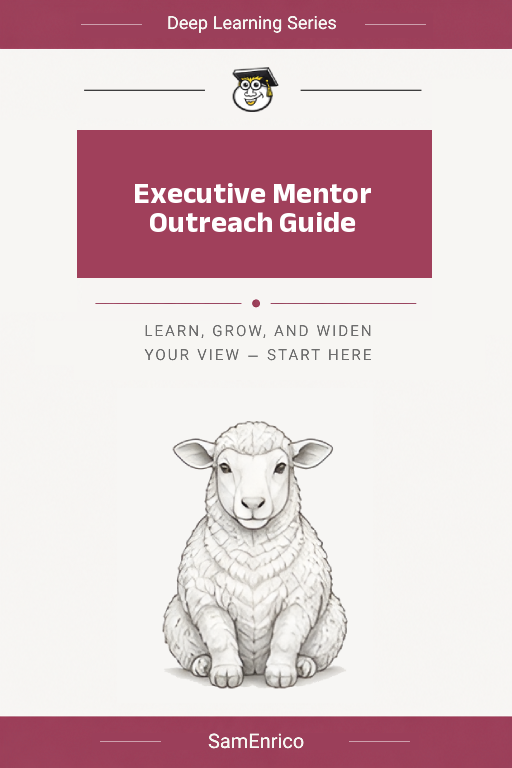
Non-FictionFirst 30 DaysExecutive Outreach
Executive Mentor Outreach Guide eBook
Approaches C-suite executives on LinkedIn for ment
Approaches C-suite executives on LinkedIn for mentorship using concise asks and respecting their limited time.
Formats
Free sample
Chapter 1: The Hidden Transaction--–- The first time I watched a rising director destroy her career in under three minutes, she was sitting across from me in a coffee shop, holding a printed copy of her résumé. She had done everything right, by conventional standards. She had researched the executive’s background. She had dressed professionally. She had arrived early.
And when the senior vice president sat down and asked, “So what brings you here today?” she took a deep breath and said the seven words that ended the conversation before it began: “I’m hoping you could be my mentor.”The SVP smiled politely, nodded, and spent the next forty-five minutes giving generic advice about “working hard” and “keeping your head down.” He never introduced her to anyone in his network. He never followed up after the meeting. He never replied to her thank-you email. From his perspective, he had done exactly what she asked: he had been a mentor, in the vaguest, most meaningless sense of the word. He had dispensed wisdom without risk, without investment, without opening a single door.
And she walked away believing she had failed to “connect” with him, when in reality, she had asked for the wrong thing entirely.This chapter opens with a provocative claim that will challenge everything you have been taught about career advancement: the standard approach to finding a mentor is not just ineffective—it is actively damaging to your career. Drawing from decades of research, including Rosalind Chow’s groundbreaking work in The Doors You Can Open and Kathy Kram’s foundational text Mentoring at Work, we will deconstruct the traditional mentor-mentee binary that has dominated career advice for generations. More importantly, we will replace it with a framework that actually works in the post-pandemic business world, where C-suite leaders face unprecedented burnout, schedule compression, and a flood of incoming requests from professionals just like you.The Vocabulary Trap The problem begins with a single word: mentor. It sounds noble, selfless, and professional. It is also, from an executive’s perspective, a landmine.
When you ask someone to be your mentor, you are not asking for a single piece of advice or a brief conversation. You are asking, implicitly, for a long-term, open-ended commitment that includes regular meetings, emotional support, career guidance, and sometimes even active advocacy. You are asking them to care about your career trajectory as if it were their own.Consider the unspoken contract embedded in the word “mentor.” A mentor is expected to remember your name, your goals, your challenges, and your progress over months or years. A mentor is expected to initiate check-ins, to ask thoughtful questions about your development, and to celebrate your wins as if they were partially responsible. A mentor is expected to be available when you hit a crisis, to offer wisdom when you face a difficult decision, and to absorb the emotional labor of your career anxiety.From the executive’s perspective, this request lands as a burden.
Most C-suite leaders already feel overwhelmed, under-resourced, and protective of their calendars. They manage dozens of direct and indirect reports. They sit on multiple boards. They travel constantly. They receive hundreds of emails and Linked In messages every day.
When they hear the word “mentor,” they do not hear an opportunity to help someone grow. They hear management. They hear another direct report they did not ask for.This is not because executives are selfish or unkind. It is because they are rational actors protecting their most scarce resource: attention. A 2023 study by the Harvard Business Review found that senior executives receive an average of 142 emails and 87 Slack messages per day, plus dozens of Linked In connection requests and DMs.
Of those, roughly 60 percent are requests for something: a meeting, an introduction, a favor, a job, or a mentorship. The executives who survive in these roles are the ones who have developed ruthless triage systems. They scan, categorize, and delete in seconds. And the word “mentor” is a reliable deletion trigger.The Sponsorship Distinction The solution is not to stop seeking help from senior leaders. The solution is to ask for a fundamentally different kind of relationship.
This chapter introduces a critical distinction derived from Rosalind Chow’s research: Sponsorship versus Mentorship.Mentorship, as traditionally defined, is passive, advisory, and often superficial. A mentor gives you wisdom. A mentor offers perspective. A mentor might suggest books to read or skills to develop. But a mentor rarely risks their own reputation on your behalf.
When a mentor introduces you to someone in their network, they are doing you a favor, but they are not staking their credibility on your performance. If you fail to impress, the mentor suffers no consequences.Sponsorship is fundamentally different. A sponsor uses their political capital to open doors, make introductions, and advocate for your advancement when you are not in the room. When a sponsor says, “You should meet my colleague Sarah—she is working on something you would find interesting,” they are implicitly vouching for you. If you waste Sarah’s time, the sponsor looks bad.
If you impress Sarah, the sponsor gains credibility for having identified talent. Sponsorship is active, advocacy-driven, and powerful. It is also, crucially, earned through demonstration, not requested through conversation.Here is the insight that changes everything: executives are far more willing to sponsor someone they have already vetted through a low-stakes interaction than to mentor a stranger. A sponsor needs evidence that you are worth the risk. That evidence comes from watching you handle a fifteen-minute conversation, act on advice, and deliver results.
A mentor, by contrast, is expected to commit before seeing any evidence at all.This explains why the director in the coffee shop failed. She asked for a mentor—a long-term, high-commitment, low-evidence relationship—from an executive who had never seen her work, never observed her judgment, never tested her follow-through. The SVP could not say yes to that request without exposing himself to unlimited future obligation. So he said a polite version of no, disguised as generic advice.The Micro-Engagement Model The alternative is what this book calls the micro-engagement model. Instead of asking for a mentor, you ask for fifteen minutes of judgment on a specific problem.
Instead of requesting a long-term relationship, you request a single, bounded interaction with a clear beginning and end. Instead of demanding emotional labor, you offer the executive a rare and valuable commodity: the chance to feel brilliant without obligation.A micro-engagement has five defining characteristics. First, it is time-bound. The executive knows exactly how long it will take—fifteen minutes, never more. Second, it is problem-specific.
You are not asking for general advice about your career. You are asking for judgment on a concrete, narrow question that falls within their expertise. Third, it is low-friction. The ask is easy to say yes to because it requires almost no preparation or follow-through. Fourth, it is flattering.
By asking a specific, intelligent question, you signal that you value their unique expertise. Fifth, it is a test. The executive is evaluating you during those fifteen minutes. If you impress them, they may choose to upgrade the relationship to sponsorship…
This is the end of the free sample. Get the eBook to keep going. Buy now
About this book
Details
- Author
- Steinberg Jeanmarie
- Publisher
- SamEnrico
- Language
- English
- Genre
- Non-Fiction, First 30 Days, Executive Outreach
- Released
- 2026-06-01
- Pages (approx.)
- 124
- Available as
- eBook, Audiobook

Read better in the ZLOADR app
Your eBooks on your phone or tablet. Sign in with your SamEnrico account and start reading.
More by Steinberg Jeanmarie
 Surrogate Pregnancy Loss HandbookSteinberg Jeanmarie$11.99
 Metta for PostpartumSteinberg Jeanmarie$11.99
 The Central Park Five CautionSteinberg Jeanmarie$11.99
 Education Services ESG GuideSteinberg Jeanmarie$11.99
 The Labyrinth Walking GuideSteinberg Jeanmarie$11.99
 The Ballad of Ben & Jerry: Scoops of Love and Ice Cream DreamsSteinberg Jeanmarie$11.99
 Brazil Payment Gateways GuideSteinberg Jeanmarie$12.99
 How to Start a National Trust (the) Business (Beginners Guide)Steinberg Jeanmarie$11.99
 Understanding Schizoaffective DisorderSteinberg Jeanmarie$17.99
 Porter EscortSteinberg Jeanmarie$11.99
You may also like
 Hong Kong Handover 1997Dunn Johnnie$11.99
 Zumba For Postnatal Recovery CourseNeal Christian$11.99
 Zumba for BeginnersLadner Nikia$11.99
 YouTube Comment Mining GuideHumes Pandora$12.99
 Worry Box MeditationCarlin Rudy$11.99
 Workplace Stress MeditationNguyen Lynn$11.99
 Workplace Stress and Sleep RepairHawley Ivory$11.99
 Workplace Perfectionism CureDelaney Jeffry$11.99
 Workplace Injustice Anger GuideWallen Isabelle$11.99
 Work Addiction and Burnout LinkGreenwood Ester$11.99
 Women in Yoga and WellnessBeattie Galina$11.99
 Women in Stand Up ComedyChun Evangeline$11.99