
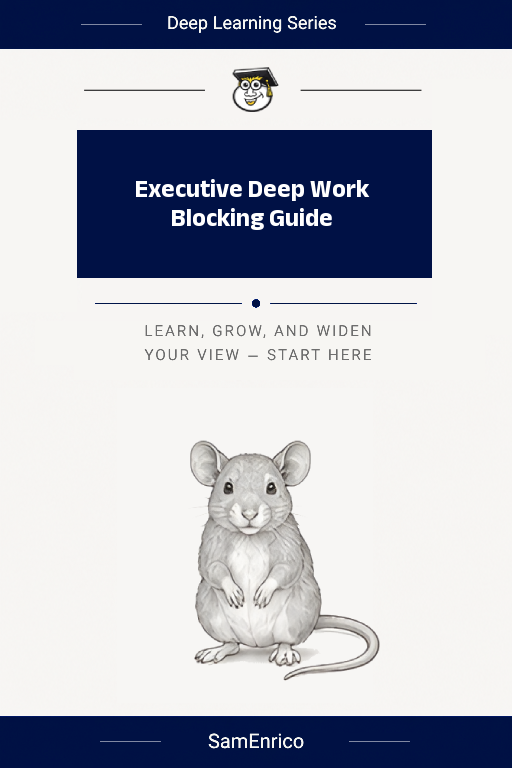
Non-FictionProfessional's Cheat SheetDeep Work
Executive Deep Work Blocking Guide eBook
Protects uninterrupted focus time using deep work
Protects uninterrupted focus time using deep work blocks, strategic scheduling, and communication blackout protocols.
Formats
Free sample
Chapter 1: The Slot Machine...--–- The first time a CEO told me “I don’t have time to think,” I almost laughed. Not because it was funny, but because he had just spent forty-five minutes answering every Slack ping, email, and calendar notification that crossed his screen. He was not busy. He was possessed. His phone buzzed, he twitched.
His computer chimed, he turned. He was not leading a company. He was pulling a lever, waiting for the next dopamine hit of closure, and calling it productivity.That CEO was not an outlier. He was the rule.Over the next three years, I watched more than two hundred executives do the same thing. They woke up early, stayed late, answered everything, and complained constantly about not having time for strategy.
They were proud of their responsiveness. They wore their full inboxes like medals. And every single one of them was confusing the feeling of busyness with the output of effectiveness.This chapter is going to show you why that confusion is not just a personal habit problem. It is a leadership failure with measurable costs. You will learn about the False Urgency Loop, the twenty-minute recovery tax, and the uncomfortable truth that your team interrupts you because you trained them to.
By the end of this chapter, you will never look at a notification the same way again.The Addiction You Did Not Know You Had Let us start with an experiment you can run on yourself. Take out your phone and look at your screen time report from the last seven days. Now add up every minute you spent on email, Slack, Teams, or any other work-related messaging tool. The average executive I work with spends fourteen hours per week just processing messages. That is nearly two full workdays.
And here is the painful question: what did you actually produce during those fourteen hours?Most executives cannot answer that question because the answer is very little. What they did was react. They moved things from an inbox to a folder. They acknowledged receipt. They said “looks good” or “let’s circle back.” They performed the rituals of responsiveness without creating any strategic value whatsoever.This is not an accident.
It is by design.The tools we use for communication are not neutral. They are engineered to exploit a psychological vulnerability called variable reward scheduling. Every time you check your email and find something that requires a response, you get a small hit of dopamine. Every time you clear that notification and watch it disappear, you get another hit. You are not being productive.
You are being trained. The same neural pathways that make slot machines addictive are the ones lighting up every time you answer a Slack message.I am not being dramatic. I am being literal.In 2018, researchers at the University of California, Irvine, studied the behavior of office workers and found that the average person checks their email seventy-seven times per day. Seventy-seven times. That is once every six minutes.
And here is the kicker: they were not doing this because they had to. They were doing it because the anticipation of a new message triggered a dopamine release that felt rewarding. They were addicted to the possibility of a notification, not the content of it.Executives are worse than average workers in this regard because they have convinced themselves that their responsiveness is a virtue. They tell themselves stories: “My team needs me.” “If I don’t answer, things will fall apart.” “I am being a good leader by being available.” These stories are not true. They are rationalizations for a behavioral addiction that is actively damaging your strategic capacity.The Twenty-Minute Tax Let me give you a number that will ruin your week: twenty-three minutes.That is how long it takes, on average, to fully return to a complex cognitive task after being interrupted.
The research comes from Gloria Mark at the University of California, Irvine, who has spent decades studying attention in the workplace. Her findings are devastating for any executive who believes they can “quickly” answer an email and get back to strategic thinking.Here is what actually happens. You are working on the quarterly budget. You are deep in the numbers, holding multiple variables in your head, making connections between revenue projections and hiring plans. Then a Slack message arrives.
Your team lead needs an approval. You glance at it. You type “approved.” It takes fifteen seconds.You have now lost twenty-three minutes.Why? Because the interruption did not just take fifteen seconds. It took you out of what psychologists call flow state.
Your brain had to disengage from the budget, process the interruption, answer it, and then figure out where you were before the interruption. That last part is the killer. You cannot just “pick up where you left off” because your brain does not store complex cognitive work like a bookmark in a book. You have to rebuild the context, reload the variables, and re-establish the connections you had made. That takes twenty-three minutes on average.Now do the math.
If you get interrupted ten times in a day—and most executives get interrupted far more than that—you have lost nearly four hours. Not to the interruptions themselves, but to the recovery time. That is four hours of strategic thinking that simply disappears from your day. You do not feel it because you are still “busy.” You answer emails. You attend meetings.
You approve things. But the work that actually moves the needle—the deep thinking, the synthesis, the strategic decision-making—that work is not happening. It cannot happen. You have fragmented your attention into uselessness.The False Urgency Loop Here is where the problem becomes self-perpetuating and where most executives unknowingly make it worse.When you respond quickly to interruptions, you send a signal to your team. The signal is not “I am responsive and helpful.” The signal is “interrupting me works.” Your team learns that if they send you a message, they will get an answer almost immediately.
That feels efficient to them. So they interrupt you more. They stop solving problems themselves because why would they? You are faster. You are always there.
You are the human equivalent of a Google search bar.This is the False Urgency Loop.It works like this: an interruption arrives. You respond quickly. The sender learns that quick responses are available. The sender interrupts more often. You respond even faster to keep up.
The sender escalates their expectations. Now everything is urgent because everything gets answered immediately. Your team stops triaging. They stop prioritizing. They just send you everything because you have trained them to believe that you want everything and that you will respond to everything.I have seen this loop destroy executive teams.
Not dramatically, not all at once, but slowly, like erosion. The executive becomes a bottleneck. Every decision, no matter how small, flows through them because the team has learned that the executive will answer immediately. The executive becomes exhausted and resentful. The team becomes dependent and infantilized.
And the strategic work—the work only the executive can do—simply stops happening.The False Urgency Loop has three stages:Stage One: Speed.…
This is the end of the free sample. Get the eBook to keep going. Buy now
About this book
Details
- Author
- Mccorkle Lupe
- Publisher
- SamEnrico
- Language
- English
- Genre
- Non-Fiction, Professional's Cheat Sheet, Deep Work
- Released
- 2026-05-29
- Pages (approx.)
- 155
- Available as
- eBook, Audiobook

Read better in the ZLOADR app
Your eBooks on your phone or tablet. Sign in with your SamEnrico account and start reading.
More by Mccorkle Lupe
 Senior Suicide Attempt Isolation StoryMccorkle Lupe$11.99
 Kiss Phobia Philemaphobia GuideMccorkle Lupe$11.99
 Norwegian Teacher ResistanceMccorkle Lupe$11.99
 AI Test Bank CreatorMccorkle Lupe$11.99
 Stress and Plantar Fasciitis GuideMccorkle Lupe$11.99
 The Battle of the Docks: Gangland Wars in 1920s LondonMccorkle Lupe$11.99
 Understanding MastoiditisMccorkle Lupe$17.99
 Overnight Veterinary TechnicianMccorkle Lupe$11.99
 Remote Review Recognition And RewardsMccorkle Lupe$12.99
 How to Become a Tube BalancerMccorkle Lupe$11.99
You may also like
 Hong Kong Handover 1997Dunn Johnnie$11.99
 Zumba For Postnatal Recovery CourseNeal Christian$11.99
 Zumba for BeginnersLadner Nikia$11.99
 YouTube Comment Mining GuideHumes Pandora$12.99
 Worry Box MeditationCarlin Rudy$11.99
 Workplace Stress MeditationNguyen Lynn$11.99
 Workplace Stress and Sleep RepairHawley Ivory$11.99
 Workplace Perfectionism CureDelaney Jeffry$11.99
 Workplace Injustice Anger GuideWallen Isabelle$11.99
 Work Addiction and Burnout LinkGreenwood Ester$11.99
 Women in Yoga and WellnessBeattie Galina$11.99
 Women in Stand Up ComedyChun Evangeline$11.99